
Lumens vs. Lux for Marine Spotlight Performance
Marine spotlights are widely used on boats, yachts, and ships. They serve as a practical light source for night work. Operators use them to see hazards, find navigation markers, light up docks, and improve overall night visibility. When selecting a marine spotlight, two important lighting measurements often come up: lumens and lux. Although these terms are closely related, they point to different aspects of lighting performance.
Getting the difference between lumens and lux right can help boat owners, marine equipment distributors, and vessel operators pick a spotlight that delivers the right balance of brightness, beam distance, and illumination efficiency.
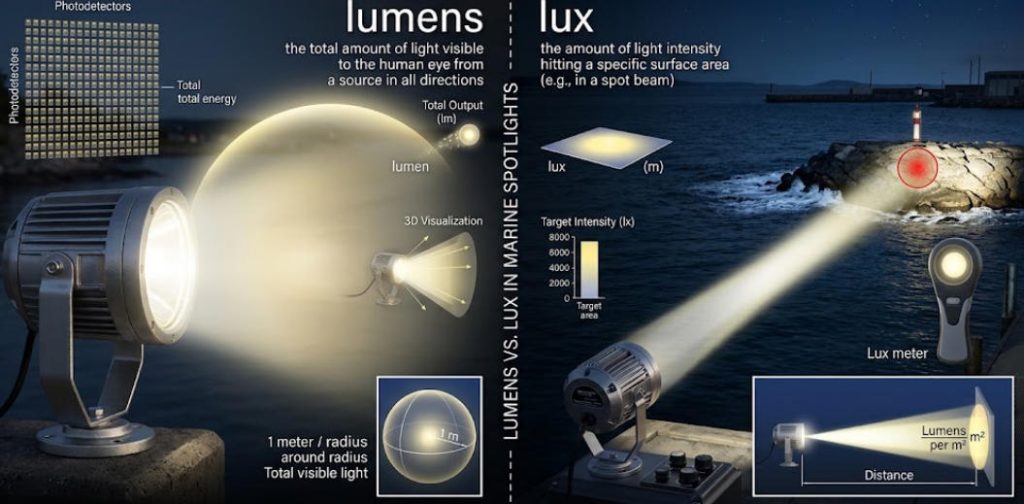
Table of Contents
What are Lumens in Marine Spotlights?
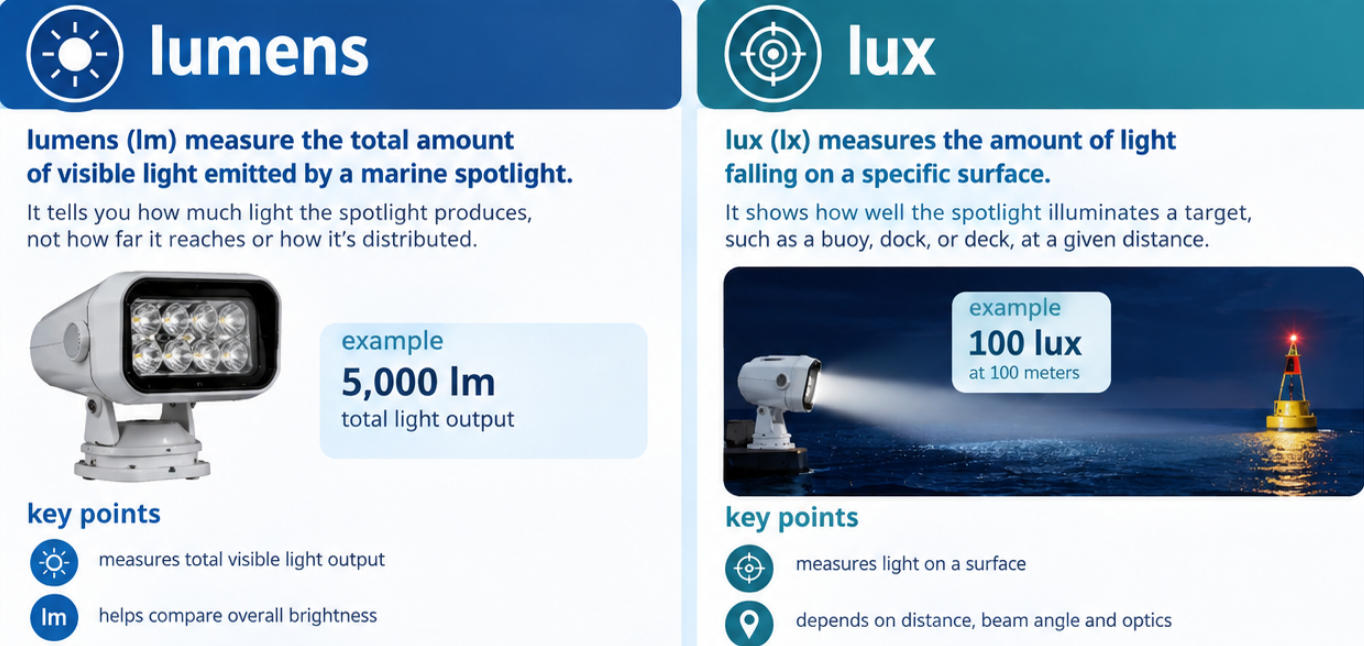
Lumens(lm), describe the total amount of visible light a fixture puts out. With marine spotlights, the lumen figure tells you how much light the lamp generates overall. It does not tell you how that light spreads on the ground or across a deck.
In general, more lumens means more total visible light. Still, a bigger lumen number does not always mean better long-range lighting. Beam shape matters.
For instance, two spotlights can list the same 5000 lumens. One may use a tight beam that sends light farther. The other may spread light over a larger area. The tight beam may help at longer distances. The wider beam may be better for lighting a deck, a dock edge, or nearby surfaces.
When you compare lumens, it helps to look at the following factors:
- Total light output: A higher lumen output can be useful when a vessel needs to illuminate a large area or provide substantial light for nighttime operations.
- Beam angle: A narrow beam concentrates light into a smaller area, while a wide beam distributes it over a broader field of view.
- Optical efficiency: Reflectors, lenses, and optical design affect how effectively the spotlight directs its available light toward the target.
- Light source performance: LED technology can deliver high light output with relatively low power consumption, making it a popular choice for modern marine lighting systems.
Lumens are therefore a useful starting point when comparing the overall light output of different marine spotlights, but they should not be the only selection criterion.
What Is Lux in Marine Spotlight Performance?
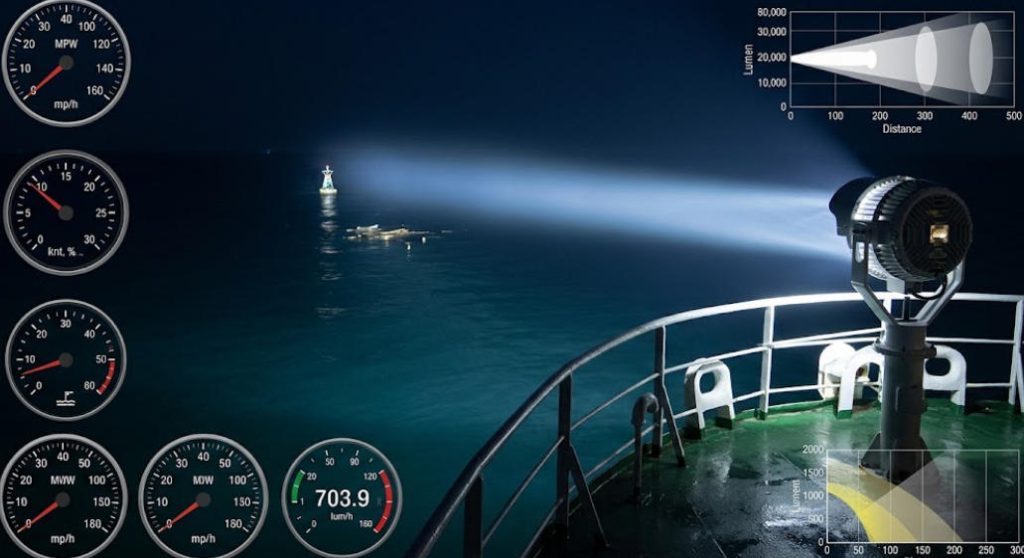
Lux(lx), measures illuminance. It describes how much light lands on a set surface area. One lux means one lumen spread across one square meter.
Unlike lumens, lux is about the light that actually reaches what you are trying to light. It focuses on the brightness on the surface, not the total light made by the lamp.
This matters for marine spotlights. Many of these lights are meant to help you see targets at a distance. Because of that goal, lux can be a more direct signal of how bright the scene will look.
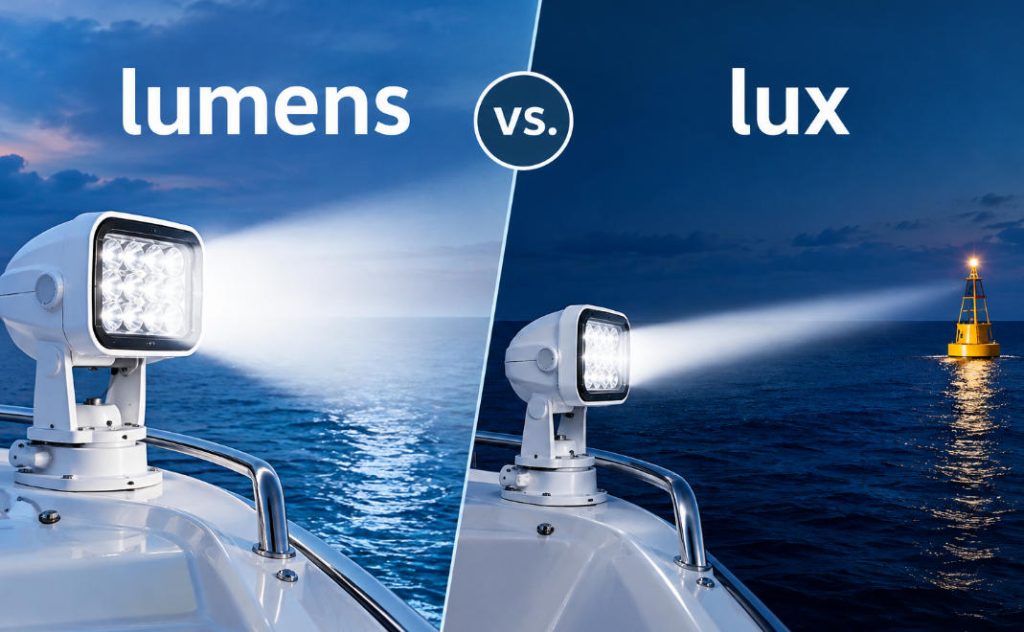
For instance, a spotlight can list a big lumen figure, yet still give weak lux on a buoy far away. This happens when the light is spread too much. If you use a beam that stays tighter, the same buoy can see stronger illumination. That can be true even when the lumen number is smaller.
Lux depends on more than one thing. It changes with how far the light is from the target. It also shifts with beam angle, the way the optics are built, and what the air is like.
In real marine work, lux gives operators a practical way to judge if there is enough light. It helps with object spotting, gear checks, and lighting work zones. You should also be careful with distance. Lux readings made at different ranges do not match well unless the testing setup is the same.
Key Differences Between Lumens and Lux for Marine Spotlight Performance
| Comparison Factor | Lumens (lm) | Lux (lx) |
| Definition | Measures the total visible light output of a marine spotlight | Measures the amount of light falling on a specific surface |
| Main Purpose | Evaluates the overall light output | Evaluates the illumination received by a target |
| Measurement Unit | Lumen (lm) | Lux (lx) |
| Distance Influence | Total rated output does not directly depend on target distance | Illuminance generally decreases as distance increases |
| Beam Angle | Does not indicate how concentrated the beam is | A concentrated beam can produce higher central illuminance |
| Long-Range Performance | Helps indicate the available light output | Helps evaluate illumination at a specified distance |
| Deck Lighting | Helps compare overall light output for broad-area lighting | Helps assess brightness and coverage across the deck |
| Searchlight Applications | Indicates the total light emitted | Helps determine whether distant objects receive sufficient illumination |
| Energy Efficiency | Can be combined with watts to calculate luminous efficacy (lm/W) | Helps assess illumination delivered at the target relative to power consumption |
| Main Limitation | Cannot independently determine effective illumination range | Depends on distance, beam distribution, and measurement position |
| Best Use in Selection | Comparing the overall output of different spotlights | Comparing practical illumination under consistent test conditions |
| Recommended Evaluation | Consider alongside wattage, optics, and beam angle | Consider alongside candela, distance, and beam coverage |
Lumens describe the amount of visible light a marine spotlight puts out. Lux describes how much of that light reaches the surface you care about. For long-range units, compare lux at the distance you need. Also look at candela and beam angle. Do not rely on lumens alone.
How Lumens and Lux Affect Marine Spotlight Performance
The relationship between lumens and lux determines how effectively a marine spotlight performs in real operating conditions.
1. Long-Range Visibility
Long-range visibility matters for navigation help, obstacle detection, and search efforts.
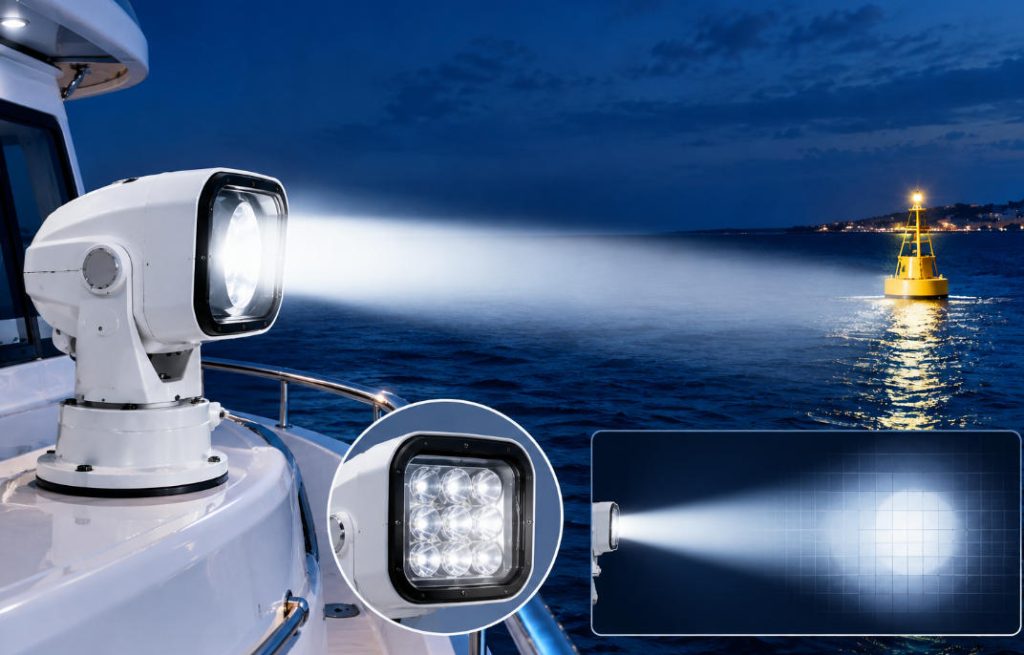
A model with higher lumen output can seem bright at first. Still, the real reach depends on how well the beam is aimed and shaped. A tight beam can push light onto a distant target. That often results in higher central illuminance than a broad beam with the same overall output.
Because of that, lux values at a set distance can help shoppers judge real lighting ability across different spotlights.
Even then, illuminance does not automatically mean easy visibility. Mist, rain, spray, glare, how reflective the target is, and the observer’s own sight conditions all play a role.
2. Beam Concentration and Coverage
Beam angle changes how the spotlight spreads its light.
A narrow-beam marine spotlight often fits best for far objects. Think navigation markers and hazards ahead of the vessel. Since the light is packed into a smaller area, central lux can rise.
A wider beam can be better for close tasks. This includes deck lighting, access points, docks, and areas used for service.
When selecting a marine spotlight, buyers should evaluate both total lumen output and the beam pattern. A high-lumen spotlight with an unsuitable beam angle may not provide the desired illumination in the intended application.

3. Energy Efficiency
Marine electrical systems often operate with limited power capacity, particularly on smaller boats and vessels relying on batteries.
LED marine spotlights are popular since they can give strong visible light and still draw less power. Even so, energy efficiency needs a two-part check. Look at the electrical input and also look at what the light output actually does.
Lumens per watt, or lm/W, tells how much visible light comes from each watt of power used. If you need light at a set distance, then also check the lux figure taken at that same distance.
A spotlight that reaches the needed target brightness while using less power can cut electrical demand. It does this without dropping the lighting level you are trying to maintain.
4. Safety and Operational Accuracy
Appropriate spotlight performance can support night work. It helps crews spot obstacles, check nearby structures, and find items when light levels are low.
If the light is too weak, key objects can blend into the dark. If the light is too intense, or if the beam is not controlled well, glare can happen. Glare can then reduce what people can see.
Picking a spotlight for the real task matters. You need the beam shape and the target illuminance, not just a generic rating. Spotlights should act as add-ons. They should not replace required navigation lights or other suitable navigation gear.
Which Measurement is More Important Between Lumens vs. Lux for Different Marine Applications?
The relative importance of lumens and lux depends on the intended use of the spotlight.
| Marine Application | More Important Measurement | Recommended Focus | Why It Important |
| Long-range marine search task | Lux | Lux at distance, candela, and beam angle | Helps determine whether distant objects receive sufficient illumination |
| Navigation support | Lux | Target illuminance, beam reach, and glare control | Supports identification of obstacles and navigation markers at night |
| Boat deck lighting | Both | Total lumens, average lux, and illumination uniformity | Ensures adequate and consistent lighting across the deck |
| Docking assistance | Lux | Illuminance at the docking area and beam coverage | Helps operators see docks, mooring points, and nearby obstacles |
| Marine inspection | Lux | Lux at the inspection surface and color rendering | Supports visual examination of equipment and vessel components |
| Emergency search operations | Both | Candela, lux at distance, and total light output | Combines strong light output with focused illumination for locating objects |
| Engine room lighting | Lux | Required working-surface illuminance and uniformity | Provides sufficient light for maintenance and equipment checks |
| Offshore operations | Both | Target illuminance, beam reach, power consumption, and durability | Supports demanding nighttime work in harsh marine environments |
| Small recreational boats | Both | Practical brightness, beam pattern, and electrical demand | Balances visibility with limited onboard power capacity |
| Wide-area harbor lighting | Lumens | Total output, area coverage, and average lux | Helps illuminate larger working areas and surrounding surfaces |
| Marine rescue operations | Lux | Lux at distance, candela, and adjustable beam control | Helps illuminate people, objects, and potential hazards during search activities |
Neither lumens nor lux is always the better choice. Lux is often more direct when you judge how bright a specific spot is at a given distance. Lumens are more useful when you compare overall light output and how well the light can cover a wider area. For marine spotlights, using lux data along with candela ratings and beam-angle details is a stronger way to choose the right spotlight.
Common Misconceptions about Lumens and Lux for Marine Spotlight Performance
Several misconceptions can lead to poor marine spotlight decisions.
Misconception 1: More lumens always mean longer range.
Higher lumen output does not automatically mean you will see farther. Light direction matters. Beam strength and the optical design help decide how much light lands on distant targets.
Misconception 2: A high lux rating always means better overall lighting.
A high lux value at the center might look great. But that number may reflect only one point. It does not guarantee the beam covers a broader area the way you need.
Misconception 3: Two spotlights with identical lumen ratings perform equally.
Even with equal lumens, results can differ a lot. Reflectors, lens choices, beam angles, and light spread can change target illuminance.
Misconception 4: Lux values can be compared without considering distance.
Lux only makes sense when you know where the reading was taken and under what setup. If you compare products, use the same distance, target placement, and measurement method.
Misconception 5: Brightness alone determines marine spotlight quality.
Reliability, corrosion resistance, power use, glare control, and environmental protection all play a role in how well the product works in real use.
The biggest mistake is judging marine spotlight performance by lumens alone. Lumens indicate total light output, while lux indicates the illumination reaching a target. If you want a fair comparison, look at lumens, candela, and lux at a set distance. Also check beam angle, power draw, and marine environmental protection.
Final Thoughts
Lumens and lux both matter for marine spotlights, but they serve different purposes. Lumens tell you the total visible light output of a spotlight. Lux measures the amount of light reaching a particular surface.
For long-distance marine applications, focus on candela ratings, beam angle, and the lux value at the distance you plan to use. For deck lighting, docking, or nearby inspection tasks, you may get better results by checking coverage, how even the light looks, and average illuminance.
When evaluating these measurements alongside energy efficiency, environmental protection, and glare control, vessel operators can choose spotlights that fit their actual tasks and help support safer night operations.
