
Lumens vs Candela: How to Evaluate Marine Spotlight Performance
In assessing the performance of a marine spotlight, the lumen measurement of light is usually among the first data mentioned in a product specification sheet. Nevertheless, luminous flux alone is not enough to give an idea of how a directional lighting system performs.
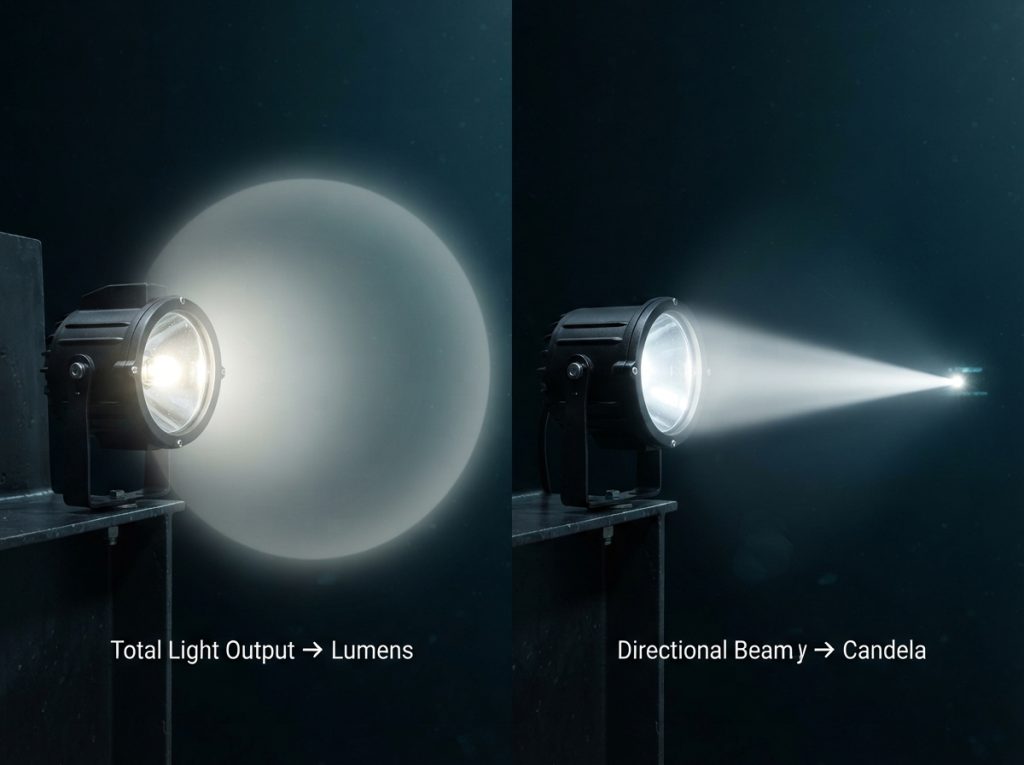
For marine spotlights, the distribution and concentration of light are equally important. This is where candela becomes relevant.
Lumens and candela give descriptions of two distinct properties of light; whereas lumens represent the amount of light, candela represents the intensity of light in a particular direction. Understanding this will help you better assess marine spotlight performance.
Table of Contents
Lumens and Candela Measure Different Aspects of Light
When reviewing the specifications of a Marine Spotlight, lumens and candela should be read together rather than treated as two ways of stating brightness. Lumen output reflects the total amount of light generated by the fixture, while candela shows the intensity achieved in a particular direction.
The difference becomes more apparent when comparing spotlights with different optical designs. Part of the available light may be spread across a wider beam, while another design may direct more of the output toward the beam’s central axis. The total lumen figures can be similar, yet the measured candela can be quite different.
For this reason, a lumen rating alone says little about how concentrated the beam will be. For Marine Spotlight Performance, the more useful question is how the available light is distributed and what directional intensity the optical system produces.
Why Higher Lumens Do Not Necessarily Mean Higher Spotlight Performance
One mistake frequently made when comparing lighting performance specifications is that the unit with the higher lumen output is guaranteed to deliver brighter light farther away.
Consider two Marine Spotlights with similar total lumen output. One may distribute its light across a relatively wide beam, while another may concentrate more of its output into a narrower beam.
The first fixture can provide broader coverage. The second can produce greater intensity along the central direction of the beam.
The distinction lies in the distribution of the light as opposed to the total light output.
This applies especially to Marine Spotlights in that they have optical components that deliver directional lighting. Reflectors, lenses, LED arrangement, and beam geometry all influence how the total light output is converted into directional intensity.
As a result, comparing lumen figures without considering candela can give an incomplete picture of optical performance.
Why Candela Matters in Marine Spotlight Performance
Candela becomes particularly useful when evaluating the intensity of a spotlight’s beam.
A larger value of candela suggests that the luminous intensity of the light source is higher in the particular direction. In the context of directional lighting, this is an important consideration in case the aim is to direct the light toward a specific target.
However, peak candela should not be interpreted independently.
A peak candela figure represents the highest measured intensity within the beam. It does not describe the complete distribution of light across the beam.
For example, two spotlights may have similar peak candela values but different beam profiles. One may maintain relatively strong intensity across a larger portion of its beam, while another may have a more pronounced central peak with faster reduction toward the edges.
Therefore, candela is an important performance indicator, but the value needs to be considered together with beam distribution.
The Relationship Between Lumens, Candela and Beam Angle
Beam angle helps explain why lumen output and candela can differ significantly between Marine Spotlights.
A wider beam distributes light across a larger angular area. A narrower beam concentrates the available light into a smaller angular area.
When the total light output remains similar, concentrating light into a smaller solid angle can increase luminous intensity in that direction.
This is why a lower-lumen spotlight with a highly concentrated optical system can potentially produce greater peak candela than a higher-lumen fixture with a much wider distribution.
The relationship can be summarized simply:
Lumens → total light output
Beam distribution → how the light is spread
Candela → directional intensity resulting from that distribution
This is a more useful framework for understanding Marine Spotlight Performance than treating lumen output as a standalone measure of brightness.
Yushuo’s existing Marine Spotlight range illustrates the importance of optical configuration across different product designs, with models developed around different output and beam characteristics.
How Candela Relates to Illumination at Distance
Candela is also relevant when considering how illumination changes with distance.
For an idealized point source, illuminance can be expressed as:
E = I / d²
Where:
- E = illuminance in lux
- I = luminous intensity in candela
- d = distance in metres
This equation reveals that, according to the assumptions of the model, the illumination falls off with increasing distance from the source.
For instance, the luminous intensity of 10,000 cd will give an illuminance level of about 100 lux at 10 metres and 25 lux at 20 metres in the respective direction.
This computation helps in explaining the relation between candela and illuminance; however, it does not predict the performance of the Marine Spotlight beam. Real fixtures have defined beam patterns and non-uniform intensity distributions.
Should Marine Spotlight Buyers Focus on Lumens or Candela?
Neither specification should replace the other.
Lumens are relevant to total light output, while candela is more directly related to directional intensity. For a Marine Spotlight, the relationship between these values is determined largely by the optical system and light distribution.
A higher candela lamp will be more appropriate where there is a need to project the light more effectively in a certain direction.
The bottom line is that while a higher lumens rating and a higher candela rating do not mean the same thing, a comparison must consider lumen output, candela, beam angles, and photometric information.
Conclusion
Lumens and candela are not to be considered as rival concepts for defining brightness. Lumens determine the amount of visible light produced by the Marine Spotlight, whereas candela determines the intensity of the light in a specific direction.
For directional marine lighting, this distinction is fundamental. A higher lumen rating does not automatically mean higher directional intensity, and a high peak candela value does not describe the complete beam pattern.
Evaluating lumens + candela + beam distribution provides a clearer picture of Marine Spotlight Performance and allows technical specifications from different lighting products to be interpreted more accurately.
For product comparison, the more relevant approach is to examine the manufacturer’s measured photometric data and understand the conditions under which the candela value was obtained.
FAQ
Q1: What is more important for a Marine Spotlight, lumens or candela?
They measure different characteristics. Lumens indicate total light output, while candela indicates directional light intensity. Both should be considered according to the required beam performance.
Q2: Does higher lumen output mean higher candela?
No. Candela depends on how light is distributed and concentrated. Two fixtures with similar lumen output can have significantly different candela values.
Q3: Why is candela important for Marine Spotlights?
Marine Spotlights are directional lighting systems. Candela helps describe the intensity of light directed along a particular angle, making it useful for evaluating beam performance.
Q4: Can a lower-lumen Marine Spotlight have higher candela?
Yes. If its optical system concentrates light more effectively into a smaller angular area, a lower total lumen output can still result in higher directional intensity.
Q5: What should be compared besides lumens and candela?
Beam angle and photometric data provide important context. These specifications help show how the total light output and directional intensity are distributed across the beam.
