
Fixed vs. Remote-controlled Marine Searchlights: 5 Key Differences
Marine searchlights are lighting equipment used on ships, boats, offshore platforms, and other marine applications. They help light up the area at night. They are used for navigation, cargo loading, vessel handling, search and rescue, and emergency support. When the surroundings are dark, or visibility is low, these searchlights make it easier for the crew to see hazards, monitor surrounding waters, and complete tasks with less risk.
Based on their installation structures and operating methods, marine searchlights are usually split into two types. There are fixed marine searchlights and remote-controlled marine searchlights. Both types are meant to aim light in a direction. However, they differ significantly in beam adjustment, control methods, installation requirements, operational flexibility, and maintenance.
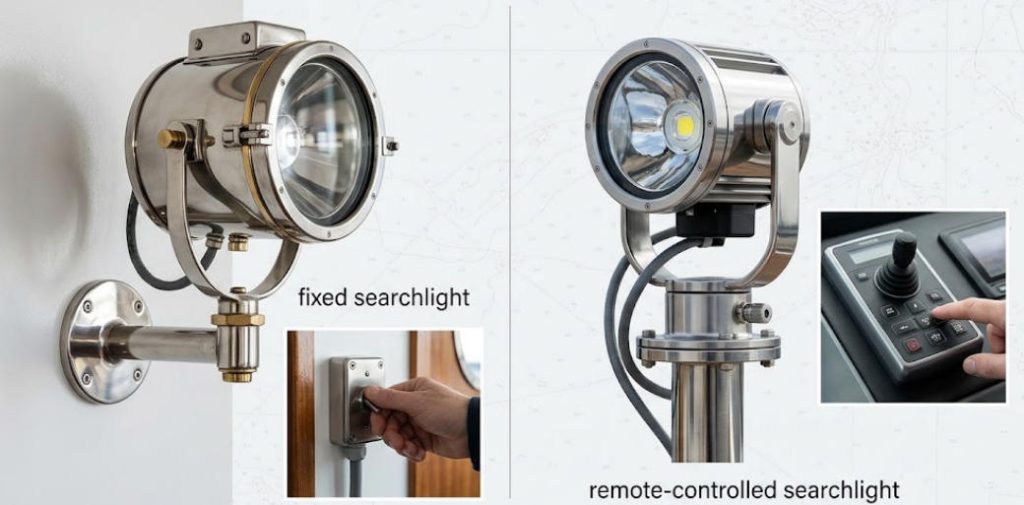
Table of Contents
An Overview of Fixed Marine Searchlights
Fixed marine searchlights are set in one place on a vessel or on an offshore structure. After they are installed, the light direction is based on the mounting angle. On some models, people can adjust the beam by hand. Most of the time, there is no built-in remote aiming system.
You will often find these lights on ship decks, bridge areas, masts, and other spots that need steady illumination.
These units are often chosen because the design is simple. The mounting is stable. The day to day operation is also easier. Since there are usually fewer parts that move and fewer control methods, they tend to need less attention. This can help in jobs where the beam does not need frequent changes.
They fit well for lighting the same work area over and over. Examples include cargo decks, gangways, equipment platforms, and inspection areas that stay in the same place.
An Overview of Remote-controlled Marine Searchlights
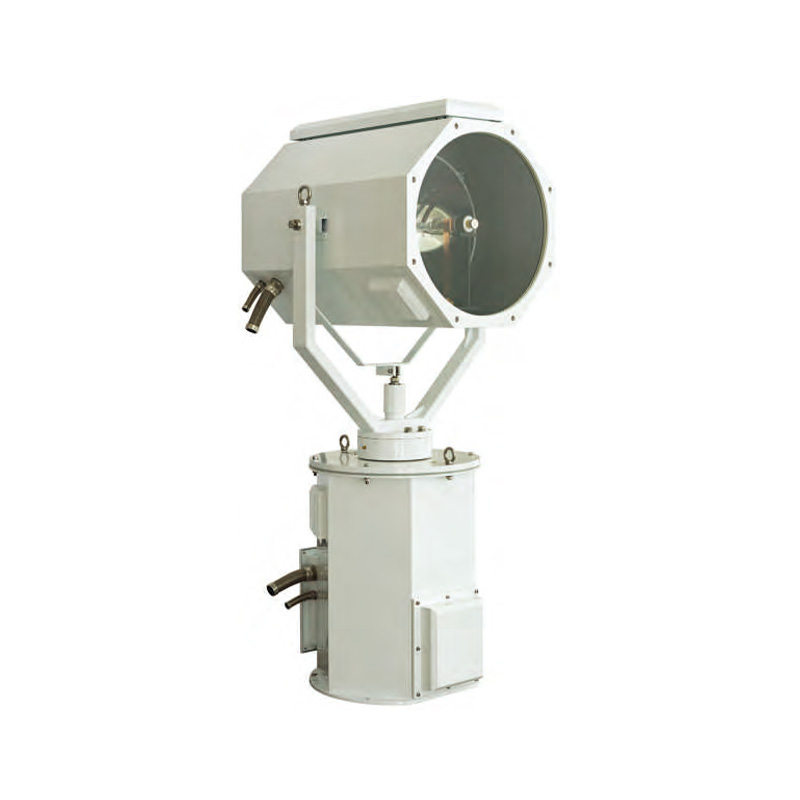
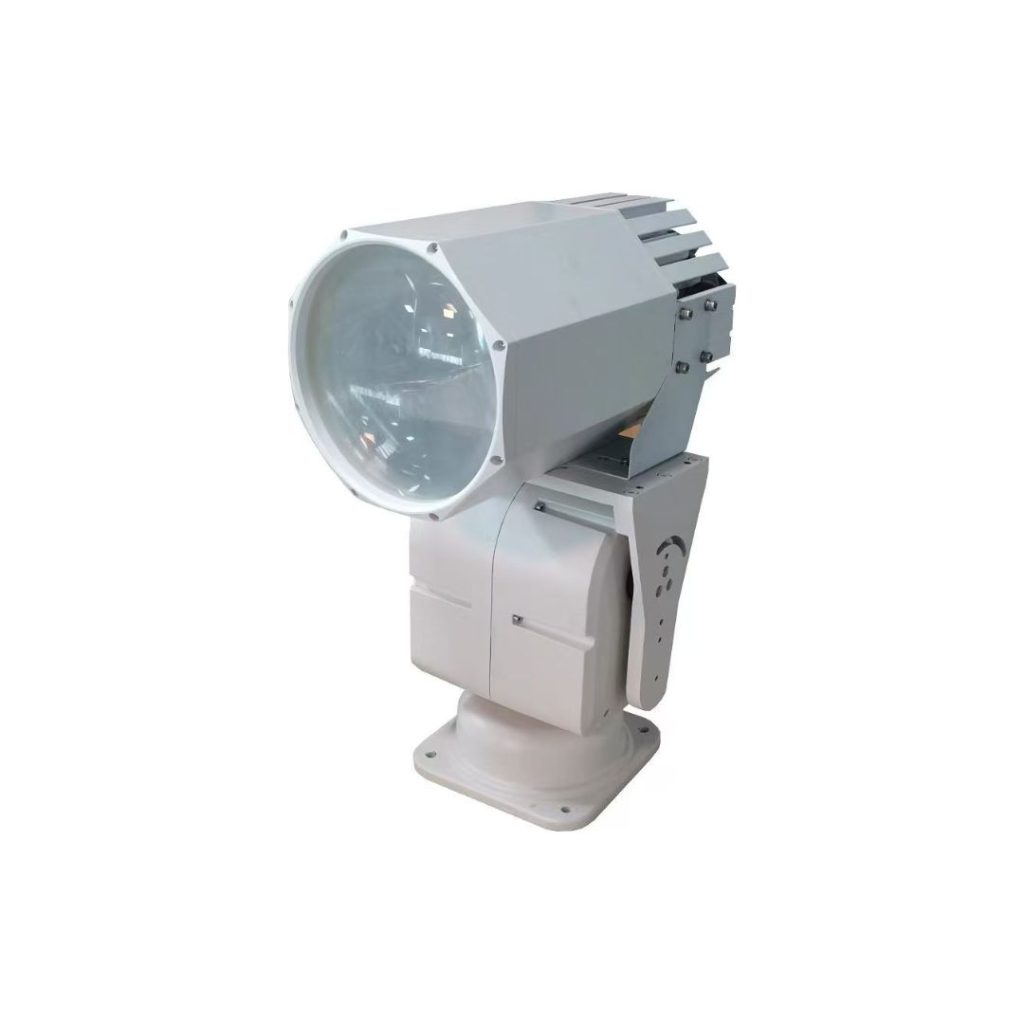
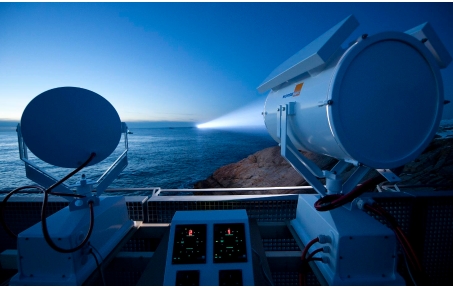
Remote-controlled searchlights let the operator aim the beam from a distance. Instead of moving the whole light body by hand, the crew can change its position using an electrical or electronic control system. This supports both horizontal turning and vertical movement.
These lights are usually controlled from the bridge or wheelhouse. Sometimes the controls are placed at another convenient station. With this setup, the crew can point the bright beam toward different areas without leaving their main work position.
Remote-controlled units are helpful for ships that need changing light coverage. They are used in night navigation. They also show value in search and rescue, docking, and emergency response.
Depending on the unit, remote-controlled systems may include 360-degree horizontal turning. They may also allow vertical angle changes. Some models support variable beam positioning and different lighting modes.
Their ability to move and adapt helps explain why these lights are chosen for cargo ships, patrol craft, offshore support work, and other boats that face tough conditions at sea.
Key Differences Between Fixed and Remote-controlled Marine Searchlights
1. Installation and Structural Design
A clear contrast between the two types shows up in how they are put in place.
Fixed marine searchlights usually use a basic mount. They are set at a planned spot, aimed where light is needed, and then left there. After the job is done, the beam direction stays the same in normal use.
Because of this, fitting them is usually simpler. They can suit boats that have little room for new equipment or that only need a steady light in one area.
Remote-controlled marine searchlights take more work to install. They need extra hardware for movement and control. Common parts include rotating mounts, tilt options, drive units, wiring for signals, and control stations placed for crew use.
That means installers must pay close attention to wiring, stable mounting, how cables are run, and how the system fits with the vessel controls.
If a ship often needs light in different directions, the extra setup effort can pay off through better daily use.
2. Operation and Beam Adjustment
Operating methods are another important distinction between fixed and remote-controlled marine searchlights.
Fixed searchlights are usually switched on and off with local controls. To change where the beam points, someone may need to move the unit by hand, based on the mount style.
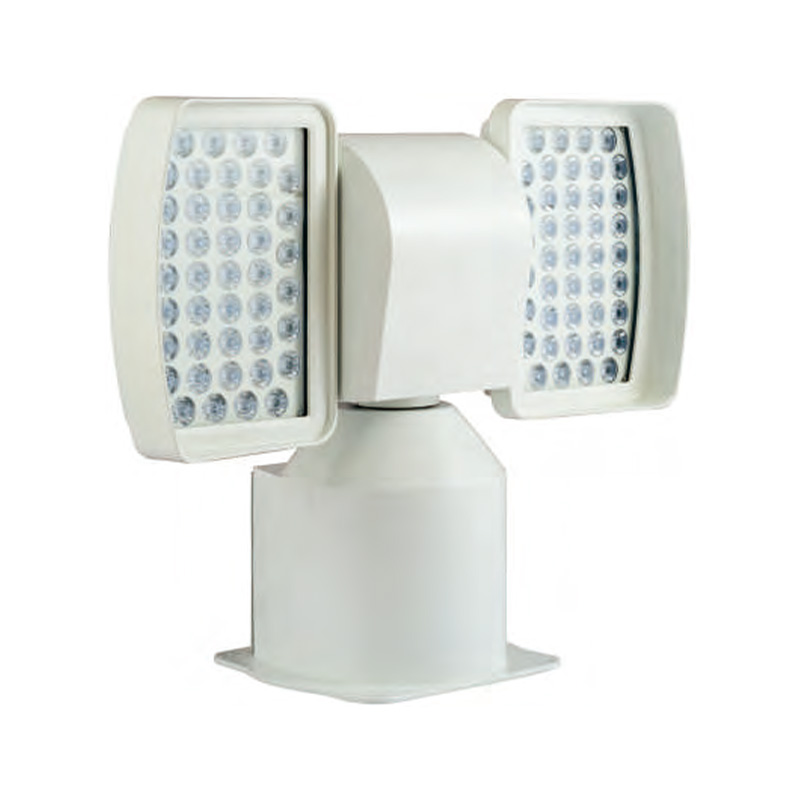
Remote-controlled LED searchlights are easier to operate. The crew can change the light’s horizontal and vertical position from a control point away from the unit.
This helps a lot during night work or when ships are operating in areas they do not know well. The beam can be shifted toward hazards, nearby boats, floating items, or defined work zones without delay.
As a result, remote-controlled systems provide greater flexibility when lighting requirements change frequently.
3. Lighting Coverage and Operational Flexibility
Lighting coverage directly affects how effectively a searchlight supports vessel operations.
Fixed marine searchlights are meant for one or a few set zones. The usable spread depends on where the light sits, the beam angle, and the light output. They fit best when the same zone must be lit for a long stretch of time.
Remote-controlled marine searchlights can cover more options. Since the beam can be aimed while the ship is operating, the crew can respond to changing conditions.
For instance, one operator can run a remote searchlight and point it toward the port side, the starboard side, the bow, or the water around the vessel. The light unit stays where it is physically mounted.
Because of that, remote models can fit better on boats that do several tasks and need different light angles at different moments.
However, a wider adjustment range does not automatically mean greater light output or longer illumination distance. Actual performance still depends on luminous flux, beam angle, optical design, and other product specifications.
4. Maintenance and Service Life
Maintenance requirements also vary between fixed and remote-controlled marine searchlights.
Fixed searchlights usually have fewer moving parts. Routine checks are often straightforward. In most cases, the owner focuses on the light source, wiring and terminals, the mounting frame, sealing parts, and the outer cover.
Remote-controlled searchlights need more attention. They add motor parts and control electronics. Regular checks should include the moving sections, the drive motors, the control box, cables, plug points, and the metal joints.
Both types have to be built for rough sea conditions. That means salt spray, damp weather, vibration, and temperature swings.
When picking either style, it helps to look for corrosion-resistant parts, good water sealing, and coatings meant for outdoor marine use.
With correct fitting and routine maintenance, the unit can last longer and keep working as expected.
5. Applications
Different vessel types have different operational requirements, so fixed and remote-controlled marine searchlights are suitable for different applications.
| Marine Application | Suitable Searchlight Type | Main Reason |
| Cargo Ships | Both types | Fixed models illuminate cargo areas, while remote models assist nighttime observation |
| Fishing Boats | Both types | Fixed lighting supports deck activities, while remote lighting helps locate objects on the water |
| Patrol Boats | Remote-controlled | Flexible beam positioning supports nighttime patrol and observation |
| Search and Rescue Vessels | Remote-controlled | Adjustable lighting helps search different areas of the water |
| Offshore Support Vessels | Both types | Different lighting configurations support deck work and surrounding-area inspection |
| Tugboats | Remote-controlled | Adjustable illumination assists nighttime maneuvering and towing |
| Passenger Ships | Fixed | Suitable for illuminating walkways, access areas, and designated decks |
| Workboats | Fixed | Provides stable illumination for specific working locations |
For vessels with more complex operating requirements, installing both types can be a practical solution. Fixed searchlights provide continuous illumination in important working areas, while remote-controlled models offer additional flexibility for external observation and navigation.
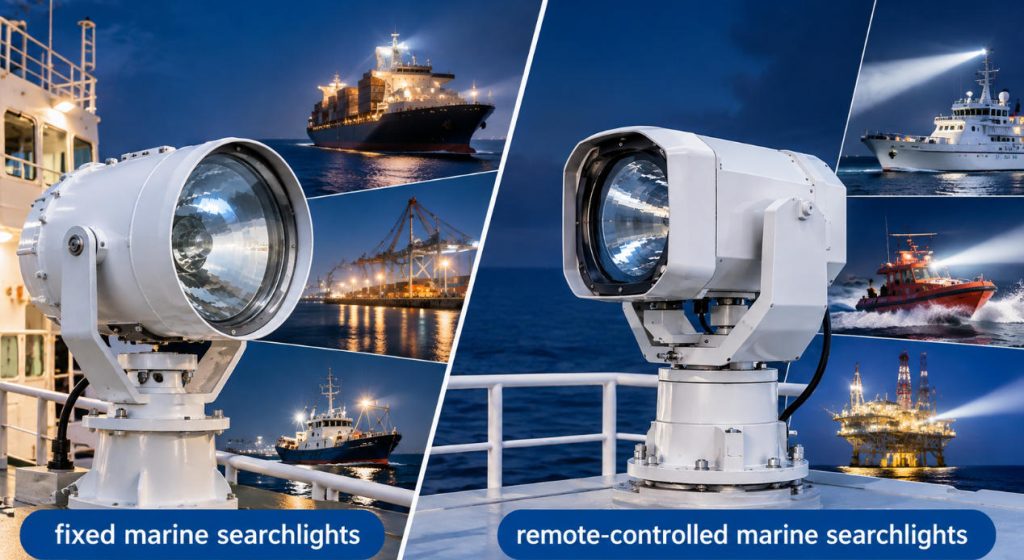
Summary Comparison Table of Fixed and Remote-controlled Marine Searchlights
| Comparison Factor | Fixed Marine Searchlights | Remote-controlled Marine Searchlights |
| Basic Design | Simple structure with a fixed mounting position | Equipped with motorized positioning mechanisms |
| Installation | Permanently installed in a selected direction | Installed with rotating and adjustable mounting components |
| Operating Method | Usually operated through local switches | Operated remotely from the bridge or control station |
| Beam Direction | Generally points in one predetermined direction | Can be adjusted to illuminate different directions |
| Horizontal Rotation | Usually fixed or manually adjustable | Supports motorized horizontal rotation |
| Vertical Adjustment | Usually fixed after installation | Allows motorized vertical adjustment |
| Lighting Coverage | Provides illumination for a designated area | Covers multiple areas through adjustable beam positioning |
| Control System | Simple electrical switching system | Remote controller and electrical positioning system |
| Operational Flexibility | Limited flexibility | High flexibility |
| Installation Complexity | Relatively simple | More complex due to additional motors and wiring |
| Maintenance | Easier maintenance with fewer moving components | Requires inspection of motors, control systems, and moving parts |
| Initial Cost | Generally lower | Generally higher |
| Energy Consumption | Depends mainly on the light source and power rating | Depends on the light source, positioning motors, and control system |
| Main Advantages | Simple operation, stable installation, and cost-effectiveness | Flexible positioning, convenient operation, and wider directional coverage |
| Main Limitations | Limited beam adjustment and coverage flexibility | Higher initial investment and more complex maintenance |
| Typical Applications | Cargo decks, walkways, fixed work areas, and equipment platforms | Patrol boats, search and rescue vessels, tugboats, and offshore support vessels |
| Best Choice For | Vessels requiring consistent illumination in specific areas | Vessels requiring frequent beam adjustment and flexible lighting coverage |
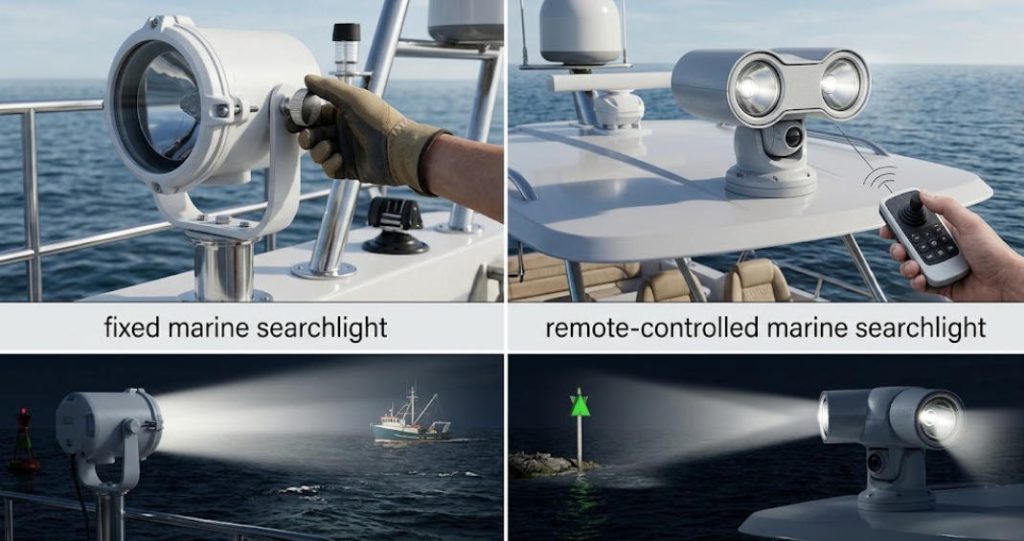
Key Factors to Consider for Choosing between Fixed and Remote-controlled Marine Searchlights
Choosing between fixed and remote-controlled marine searchlights requires more than comparing their prices. Buyers should evaluate several technical and operational factors before making a decision.
1. Vessel Type and Operating Environment
Vessel type matters a lot. Fishing boats, cargo ships, patrol craft, and offshore support vessels do not all need the same lighting.
If a boat mostly lights the same work area, a fixed searchlight might be enough. But if the boat often works in new areas, or does night searches, a remote-controlled setup can be the better fit.
2. Lighting Performance
Beam range, light output, beam angle, and how the light spreads all affect results.
Buyers should ask if the unit can cover the distance they need. LED marine searchlights are used more often now. They can deliver good brightness per watt, use less power, and last for a long time.
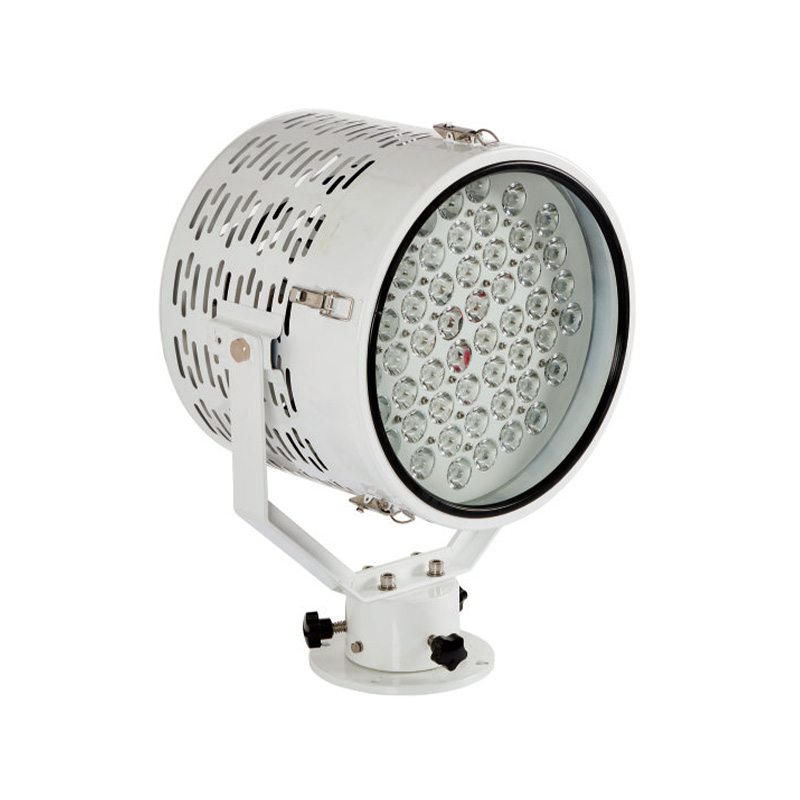
3. Rotation and Adjustment Range
For remote-controlled units, two specs matter a lot: the horizontal turn range and the vertical up-and-down travel. If the travel is wider, the operator can cover more spaces. They do not need to move the light or redo the mounting position.
Next, check how well the unit holds its target. Also look at how quickly it reacts when commands are sent. These points help it match real work needs during operation.
4. Environmental Protection
Marine equipment has to handle harsh weather and harsh surroundings. Think about salt mist, wet air, strong vibration, rain, and heat and cold swings.
A good marine searchlight should use rust-resistant parts. It should also seal well against water and dust. Make sure the ingress protection rating fits the planned use. These steps protect the internal electrical parts and the mechanical parts.
5. Installation and Maintenance
Fixed searchlights usually require fewer steps. Remote-controlled models often need extra items for control. You may need control wiring, power wiring, brackets, and extra operating hardware.
Before you buy, measure the space where it will mount. Confirm power availability. Also check how easy it is to reach the unit for upkeep. Verify the unit works with the current vessel system.
6. Budget and Long-Term Operating Costs
Fixed searchlights often cost less at first. Still, the buy choice should not stop at the purchase price. Plan for power use, upkeep needs, part swaps, and the expected lifespan.
If a vessel must change the beam position often, a remote-controlled searchlight can be a better long-term option. It may add more practical value as time passes.
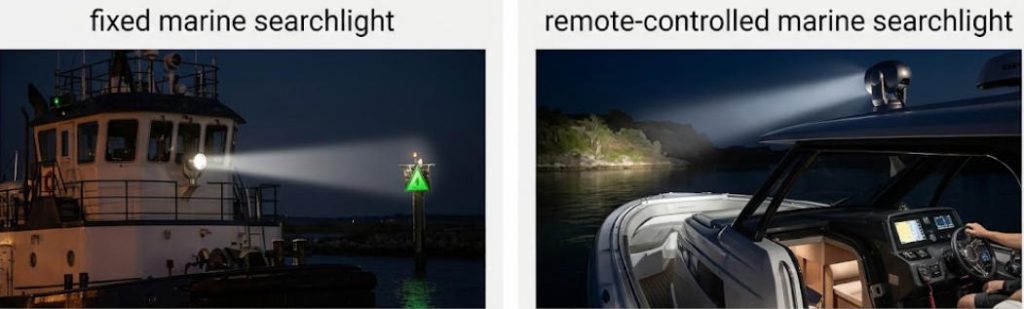
Summary
- Fixed marine searchlights are ideal for designated working areas that require stable and consistent illumination. Their simple construction, straightforward operation, and relatively low initial investment make them suitable for dedicated lighting applications.
- Remote-controlled searchlights are better suited to applications requiring flexible beam positioning and wider directional coverage. Their ability to adjust lighting remotely makes them valuable for nighttime navigation, patrol, docking, and search and rescue operations.
Final Thoughts
Both fixed and remote-controlled marine searchlights help improve night visibility and support safer marine work. The key differences show up in installation structure, operating methods, beam adjustment, lighting coverage, maintenance requirements, and application scenarios.
When you choose a marine searchlight, think about vessel type, lighting requirements, environmental conditions, installation arrangements, and budget. Choosing the right configuration can raise work efficiency, enhance nighttime visibility, and help the marine equipment last longer in real service.
