
Marine Searchlights vs. Navigation Lights: Complementary Roles
Marine lighting systems are essential safety tools that help a vessel keep moving safely in darkness and in poor visibility, also when waterways get busy. Onboard, you will often rely on two major kinds of lighting: marine searchlights and navigation lights. Even if both are about helping people see, they are made for very different purposes. If you understand how they work together, vessel operations stay safer and more efficient.
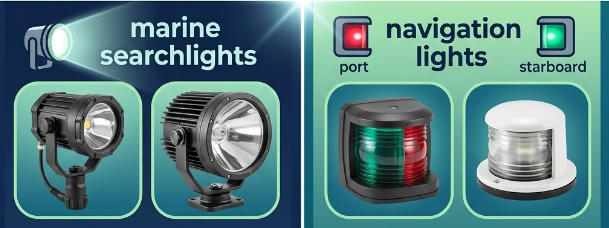
Table of Contents
Understanding Marine Searchlights
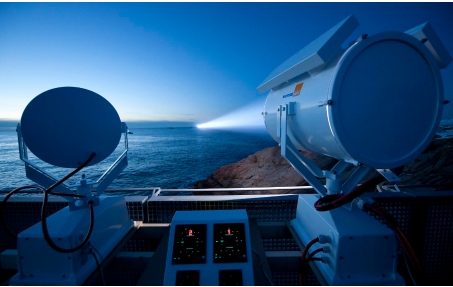
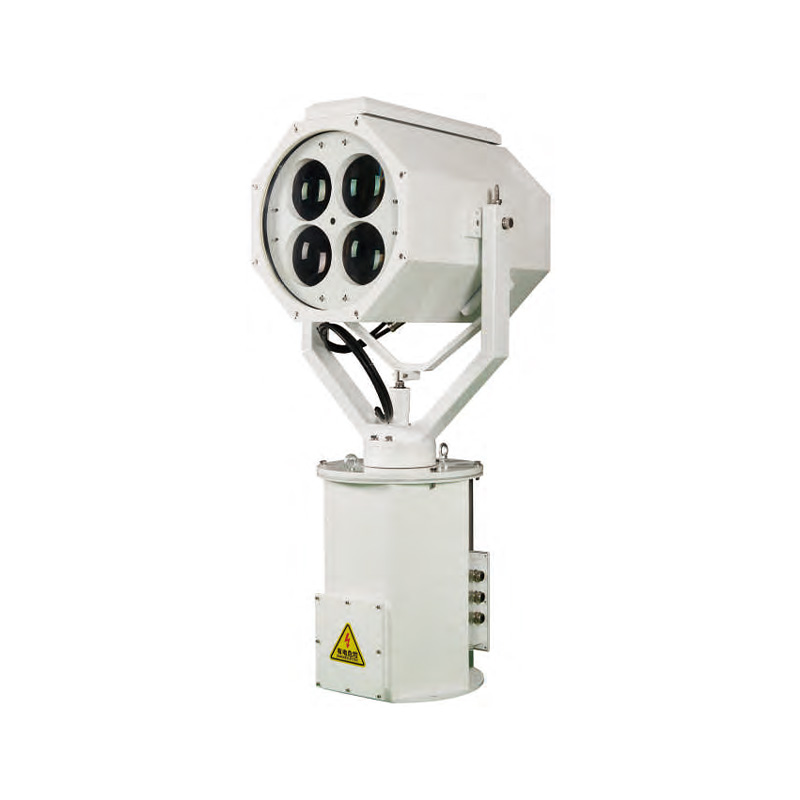
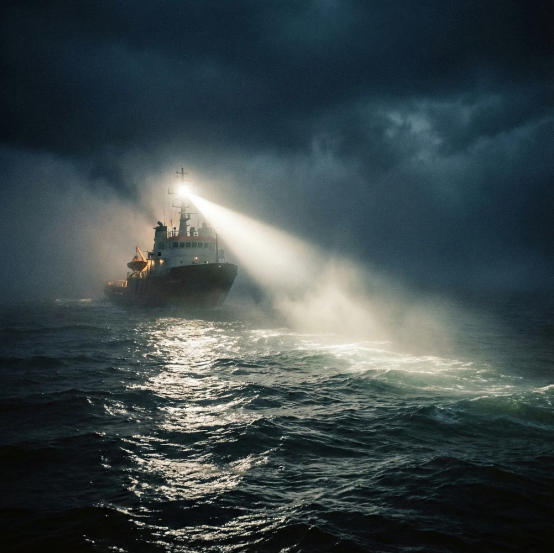
Marine searchlights are high-intensity lighting devices, placed on ships so they can throw focused light over medium to long distances. Most of the time they are operated by hand, or, when needed, remotely controlled from the bridge. The remote control searchlight lets the operator swing the direction and set the angle, and in some cases tune the beam intensity too. You see them used during nighttime navigation, docking and those tricky harbor movements, offshore platform activities, and search and rescue efforts where seeing and recognizing people or objects makes a real difference. In other words their main job is not general room like illumination, but targeted visibility enhancement.
Advantages
- Enhanced Long-Distance Visibility: One of the biggest benefits of marine searchlights is their capability to illuminate distant targets. That is especially helpful when nearing a coastline, spotting navigational risks, or noticing unlit structures at sea.
- Improved Operational Safety: Searchlights let crews see what radar or other electronic systems maybe do not fully show, for example floating debris, small vessels, or those more complex docking structures. In practice it helps the people in charge to make better calls and it also lowers the chances of collision or grounding .
- Critical Support for Search and Rescue: In emergencies, searchlights are truly indispensable. They make it possible to find people in the water, lifeboats, or wreckage during night operations or when visibility is poor. This tends to raise survival odds a lot.
- Precision Targeting Capability: A searchlight can be aimed very precisely toward a chosen object or a particular zone. Because of that flexibility, operators can keep the illumination on target exactly where it is needed , rather than wasting light energy.
- Versatility in Maritime Operations: Searchlights get used in a lot of different maritime work, like offshore construction activities, port operations, naval missions, and everyday vessel navigation. Because they can be adjusted so easily, they end up as a very handy onboard instrument, though the results still depend on how they are handled.
Limitations
- Limited Coverage Area: Even when a searchlight is powerful, it only shines within a tight beam. Because of that, you will not get wide, full-area illumination, and the light has to be moved, repositioned often, to reach separate sections.
- Operator Dependency: How well it works relies a lot on the operator. If the aiming is clumsy or the adjustments happen too late, the usable visibility drops. Sometimes that leads to operational blind spots that are easy to miss in the moment.
- Glare and Night Vision Interference: If a searchlight is aimed poorly or used at the wrong time, it can produce glare. That glare can briefly reduce night vision for crew nearby, or even for other vessels in the vicinity. If this is not managed carefully, it raises safety risks.
- Energy Consumption and Heat Generation: High-intensity searchlights draw a lot of electrical energy and they can also start to produce heat if they run for too long. That extra warmth tends to add more strain on a vessel’s power system, and then thermal management becomes necessary in practice.
- Reduced Effectiveness in Severe Weather: When there is fog, heavy rain, or snow, the light beams get scattered, and visibility range drops quickly. Under those circumstances, the searchlights may offer only modest gains compared with regular ambient visibility.
Understanding Navigation Lights
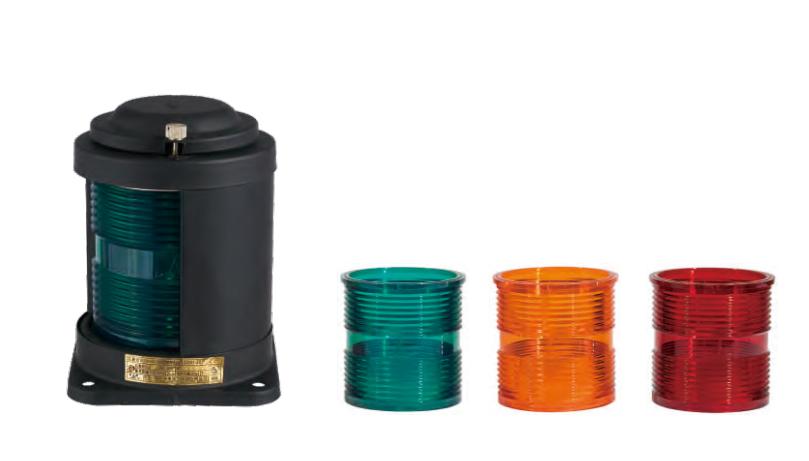
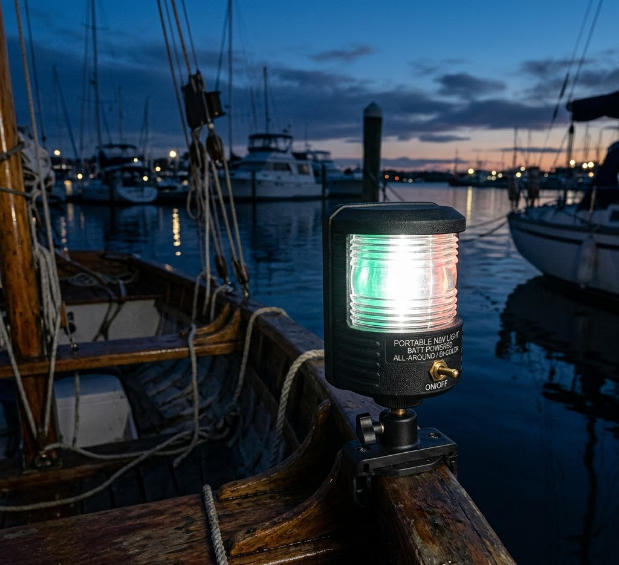
Navigation lights are fixed lighting systems on vessels, fitted under international maritime rules, like the International Regulations for Preventing Collisions at Sea, (COLREGs). Marine navigation lights are built to be noticeable within certain angles and at set distances, so other vessels can infer how the ship is placed and also how it is moving.
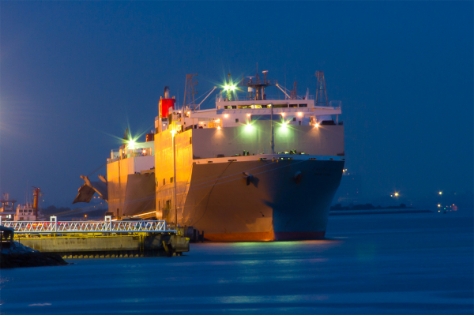
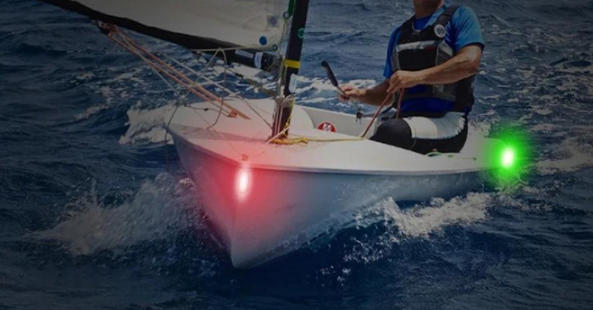
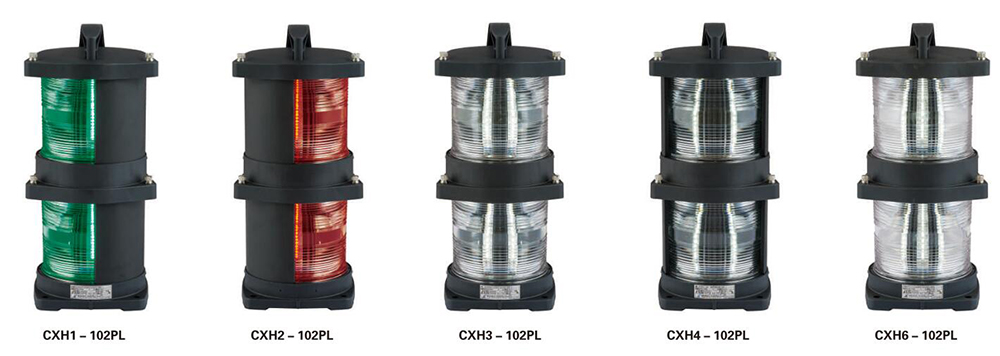
In typical setups you will see red and green sidelights ( port and starboard), plus a white stern light, and masthead lights that show propulsion and the general heading. There can also be extra lamps depending on the vessel type, its size, and what is happening during operations. The main goal is not to light the way, but more for identification, recognition, and communication, even if it feels a bit redundant at first.
Advantages
- Standardized Global Communication: One of the biggest strengths behind navigation lights is that they follow a universal standard. No matter where the vessel comes from, or what waters it is in, the meaning of each particular light pattern is internationally recognized. Because of that, the chance of confusion drops a lot, and misinterpretation at sea becomes much less likely.
- Collision Prevention: Navigation lights give nearby ships reliable cues about direction and movement. So other vessels can judge whether they are in a crossing layout, overtaking path , or facing head-on, then choose the proper maneuver for navigation lights to avoid a collision.
- Continuous Passive Operation: Once activated, navigation lights operate continuously without requiring manual adjustment. This ensures constant visibility and communication even when the crew is occupied with other tasks or during reduced staffing conditions.
- Regulatory Compliance: Proper use of navigation lights is a legal requirement under maritime law. Compliance ensures vessels meet international safety standards and avoid penalties or operational restrictions.
- Low Operational Complexity: Navigation lights are relatively simple systems with fixed placement and function. This reduces the need for operator intervention and minimizes the risk of misuse compared to more complex lighting equipment.
Limitation
- No Environmental Illumination: Navigation lights are not designed to illuminate surroundings. They do not help crews see obstacles, shorelines, or hazards, meaning they cannot support close-range visual navigation tasks.
- Limited Information Scope: Even though navigation lights help with position and movement, they do not really say much about how fast, how far, or what the environment is doing around them. In practice mariners end up depending on radar, AIS, or straightforward visual observation to get deeper situational awareness.
- Dependence on Visibility Conditions: Nighttime works well for navigation lights but in heavy fog, rain, or bumpy seas they can be hard to spot. In those cases their usefulness as a messaging cue drops.
- Risk of Misinterpretation in Poor Maintenance Conditions: When the lights look weak , the colors are wrong , or they are set in the incorrect spot because of maintenance problems, other vessels may read the signals as something else. That can make how a ship is moving or facing seem unclear, and the collision risk climbs.
- Limited Adaptability: Navigation lights are fixed systems with standard patterns. They cannot be tuned for special working circumstances or sudden changes, so they end up having less flexibility than other navigational aids.
Key Differences Between Marine Searchlights and Navigation Lights
| Feature | Marine Searchlights | Navigation Lights |
| Primary Function | Actively illuminate distant objects, targets, or areas at sea | Indicate vessel position, direction, and status |
| Light Type | High-intensity, directional beam | Low-intensity, fixed-color signaling lights |
| Visibility Range | Long-range illumination (can reach hundreds or thousands of meters) | Short to medium range visibility for collision prevention |
| Operation | Manually or remotely controlled, often adjustable in direction | Automatically operated when vessel is active (per regulations) |
| Purpose in Navigation | Assists in search, rescue, docking, and obstacle detection | Ensures safe navigation and prevents collisions |
| Beam Focus | Narrow, concentrated beam | Wide, omnidirectional or sector-specific visibility |
| Regulatory Role | Not strictly mandatory for all vessels | Mandatory under international maritime regulations |
| Power Consumption | High due to strong illumination output | Low to moderate power usage |
| Typical Mounting Location | Mast, bridge wings, or elevated rotating mounts | Fixed positions (bow, stern, port, starboard, masthead) |
| Usage Conditions | Night operations, poor visibility, search and rescue | Always required when vessel is underway or anchored at night |
| Control System | Adjustable rotation, tilt, and brightness control | Fixed operation with predefined color/position rules |
How Marine Searchlights and Navigation Lights Complement Each Other at Sea
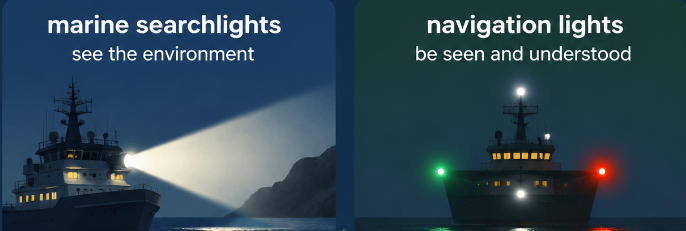
Navigation lights ensure that a vessel is visible and readable for surrounding traffic, in practice, answering that lingering question of “who is there and how are they moving”. At the same time, marine searchlights meet a separate need, helping the on board crew figure out “what is around us and what lies ahead”. This dual approach makes a certain balance, between outward signaling and inward situational understanding, even if the roles overlap a bit. Navigation lights make the vessel’s presence known in the maritime space, while searchlights give the crew crisp visual confirmation of what is close by, and what may be coming next.
Coordinated Use in Real Maritime Scenarios
When a vessel comes into a harbor at night, the navigation lights make it possible for nearby ships and port infrastructure to see it clearly, and to also recognize its direction. This helps avoid misunderstandings, and lowers the chance of collisions in crowded waters. At the same time, marine searchlights help the crew visually verify where docking points are, check mooring structures , and locate channel markers that can be hard to notice in low light.
In offshore activities, like platform approaches, or supply runs, navigation lights keep the vessel visible to other traffic operating nearby. Searchlights in turn assist with careful maneuvering, by brightening cranes, transfer points, and deck sections where accuracy matters a lot.
During search and rescue work, this combination becomes even more important. Navigation lights help coordinate multiple boats operating in the same area, making sure they stay in sight of each other. Searchlights actively sweep across the sea surface to find people, lifeboats, or even floating wreckage bits, improving the odds of a successful rescue.
Improving situational awareness with layered lighting
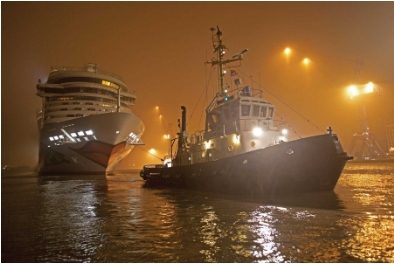
When marine searchlights and navigation lights work together, you get a kind of layered safety setup that strengthens awareness from two different directions. Navigation lights give ongoing, passive visibility to other vessels, acting as the regulatory backbone of maritime safety. Searchlights bring an active layer of perception, so the crew can respond fast to changing visibility, sudden weather, or unexpected obstructions.
This layered approach is especially valuable in complex maritime environments, like hectic shipping lanes, offshore construction areas and coastal waters where you have both heavy movement, and a lot of environmental ambiguity at the same time. It helps because conditions are never really fully predictable, and the risks stack up in a way that a single measure just can’t cover.
Operational balance and safe practices
Even though these systems work well together, they still need a careful sort of tuning in daily use. Navigation lights have to stay properly configured and fully functioning whenever maritime rules say they should be active. They basically become the anchor for vessel identification. If even one unit is wrong, or doesn’t behave as expected, the safety margin drops quickly and other ships may read the situation incorrectly.
Searchlights, though, need more discretion than people assume. Too much brightness, or beams pointing in awkward angles, can throw off glare and briefly mess with night adaptation for nearby crews. It can also cause visual clutter, so commanders often treat them like a focused instrument rather than a constant, always on illumination source.
Operational Considerations for Marine Searchlights and Navigation Lights
Effective use of both searchlights and navigation lights requires proper considerations.
| Operational Factor | Marine Searchlights | Navigation Lights | Key Operational Insight |
| Maintenance Requirements | Require regular checks for beam intensity, alignment, rotation mechanism, and electrical components | Require inspection of bulbs/LEDs, wiring integrity, and correct color output | Searchlights need more mechanical and electrical upkeep due to moving parts |
| Power Consumption | High energy demand, especially during prolonged use | Low to moderate power consumption with continuous operation | Searchlights place greater load on vessel power systems |
| Regulatory Compliance | Not strictly regulated for signaling purposes, but must follow safe use practices | Strictly governed by COLREGs | Navigation lights are legally mandatory for vessel identification |
| Operational Role | Active illumination for observation and hazard detection | Passive signaling for vessel visibility and communication | Searchlights support internal awareness; navigation lights support external communication |
| Usage Frequency | Intermittent, used during specific operations (docking, SAR, inspection) | Continuous during nighttime or restricted visibility | Navigation lights operate as a baseline safety requirement |
| Weather Performance | Reduced effectiveness in fog, rain, or heavy snow due to light scattering | Remains visible but range may be reduced in poor weather | Navigation lights are more consistent in adverse conditions |
| Risk of Glare | High if misused, may affect nearby vessels or crew night vision | Very low due to fixed intensity and positioning | Searchlight operation requires careful direction control |
| Training Requirement | Higher, requires operator skill for aiming and situational judgment | Lower, mainly understanding correct configuration and meaning | Searchlights depend heavily on operator competence |
| Operational Flexibility | Highly flexible, directional, and adjustable | Fixed configuration with limited adaptability | Searchlights provide tactical flexibility; navigation lights provide standardization |
Final Thoughts
Marine searchlights and navigation lights aren’t rival setups, they work together, like two parts of the same safety routine. Navigation lights make a vessel easy to spot, and they help others understand direction and movement, so communication stays clear. At the same time, searchlights deliver focused illumination, which supports situational awareness, and helps with on scene decisions during work or transit.
Used well, this pairing strengthens safety outcomes, cuts down on navigation risk, and boosts operational effectiveness in rougher, demanding marine settings.
