
What Determines the Required Navigation Light Visibility Range
Navigation lights are really key safety equipment for marine vessels; they sort of communicate with others where the ship is, which way it’s moving and what it’s doing operationally, mainly when it’s dark out or visibility is limited. One of the most important requirements for navigation lights is their visibility range, which determines how far away other vessels can identify and interpret a ship’s movements.
The required visibility range of navigation lights depends on several factors: vessel size, the kind of light used, where it’s mounted on the hull, and international maritime regulations. When the visibility is right, navigation tends to be safer, collisions are less likely, and vessels can keep to the standardized communication habits at sea, which matters more than people think.
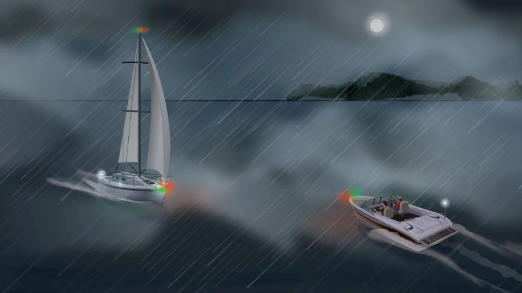
Table of Contents
Understanding Navigation Light Visibility Range
Navigation light visibility range means the furthest distance a navigation light can be seen clearly, in usual atmospheric conditions. People often state this distance in nautical miles, or NM, and one nautical mile is about 1.852 kilometers, give or take.
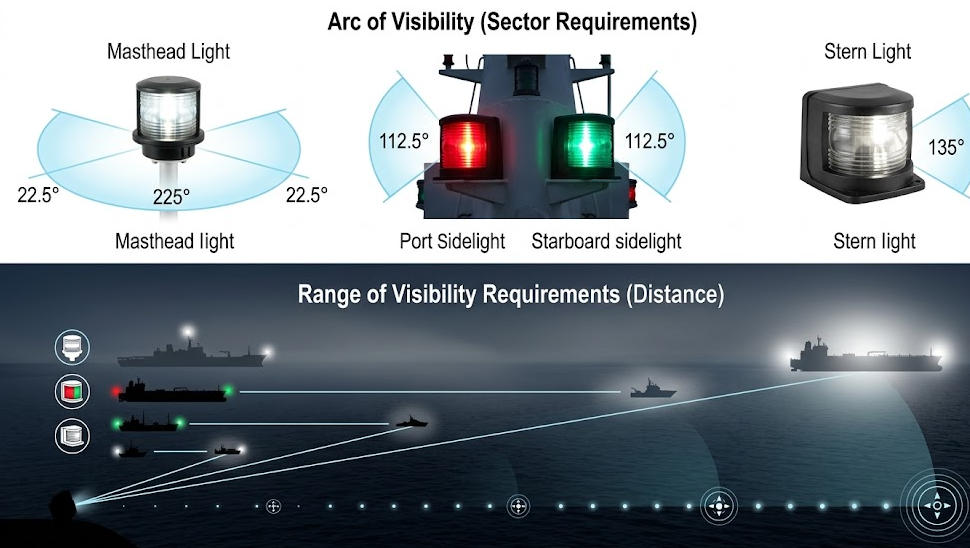
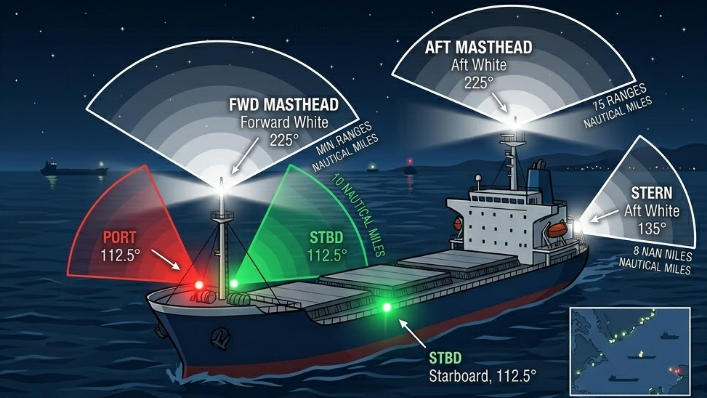
That required range is not identical for every navigation light. Each light does its own job, and it needs to be seen well enough so other vessels can piece together what’s going on with the navigation situation. For instance, masthead lights are used to help show the heading of a power-driven vessel. Sidelights, on the other hand, are meant to tell whether another vessel is drawing nearer from the port side or the starboard side.
So these visibility range standards exist so a ship has enough seconds, or at least adequate time, to spot the other craft, judge its course and movement, and then carry out safe navigation decisions.
Key Factors Affecting the Required Navigation Light Visibility Range
1. Vessel Size and Classification
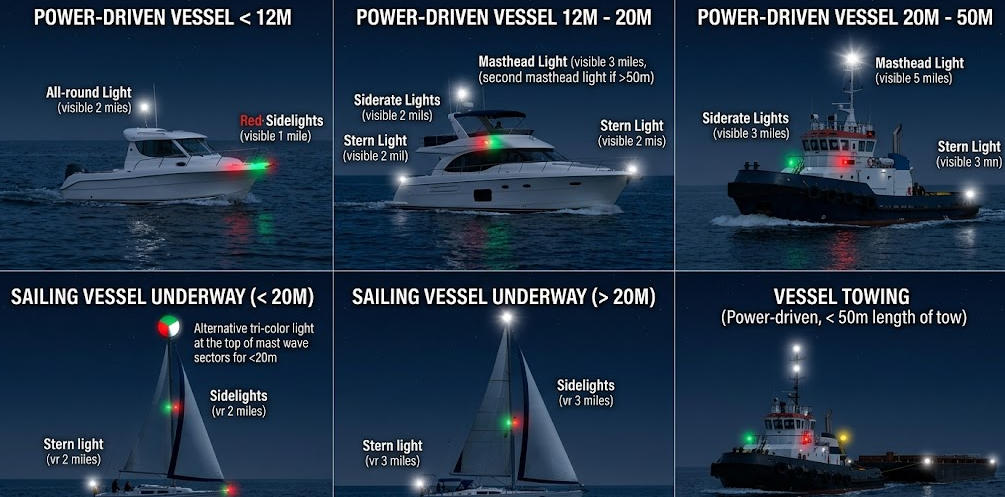
One of the most important factors affecting required navigation light visibility range is vessel size.
The following chart provides specific navigation light visibility requirements of different vessels.
| Vessel Type | Vessel Size / Condition | Specific Visibility Requirements |
| Small Power-Driven Vessels | Less than 12 meters in length | Masthead light: about 2 nautical miles; sidelights and stern light: about 1–2 nautical miles depending on light type |
| Small Sailing Vessels | Less than 12 meters in length | Generally visible for about 2 nautical miles for all-round or combined lights |
| Power-Driven Vessels | 12 meters to less than 50 meters | Masthead light: about 5 nautical miles; sidelights and stern light: about 2 nautical miles |
| Large Commercial Ships | 50 meters or more in length | Masthead lights: about 6 nautical miles; sidelights and stern light: about 3 nautical miles |
| Towing Vessels | Less than 50 meters | Visibility generally follows vessel size requirements; towing lights must be clearly visible for safe identification |
| Large Towing Vessels | 50 meters or more | Masthead lights may require visibility up to 6 nautical miles; towing lights typically follow commercial vessel standards |
| Fishing Vessels | Various sizes | Usually 2–3 nautical miles depending on vessel length and fishing operation |
| High-Speed Craft | Special high-speed vessels | Visibility requirements generally follow vessel length, with enhanced reliability due to operating speed |
| Offshore Supply Vessels | Workboats supporting offshore operations | Typically 3–6 nautical miles depending on vessel size and operating conditions |
| Passenger Ships and Ferries | Medium and large vessels | Usually follows commercial vessel standards: up to 6 nautical miles for major lights |
| Military and Government Vessels | Various sizes | Visibility follows international navigation rules while allowing additional operational signals |
2. Navigation Light Type and Purpose
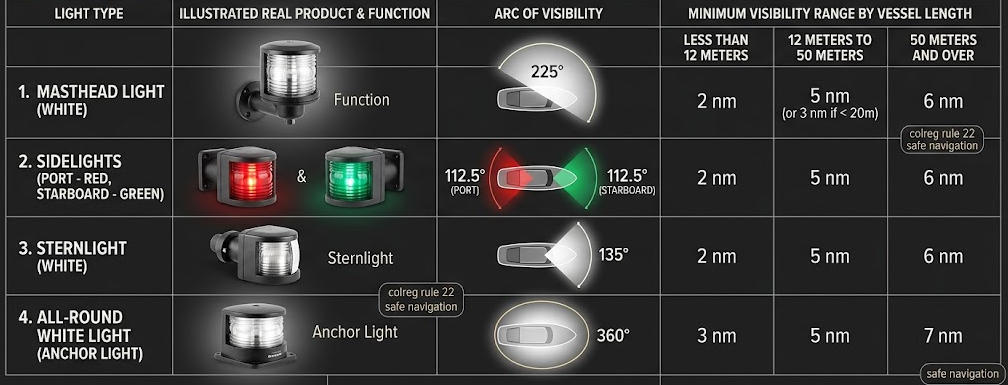
Different type of navigation lights have different visibility requirements because each light communicates specific information to other vessels.
| Navigation Light Type | Light Color | Main Purpose | Typical Visibility Requirement |
| Masthead Light | White | Indicates a power-driven vessel’s forward direction and position | Up to 6 nautical miles for vessels 50 meters or longer; about 5 nautical miles for vessels 12–50 meters; about 2 nautical miles for smaller vessels |
| Sidelights | Red (port side) and Green (starboard side) | Shows the vessel’s heading direction and helps determine crossing situations | About 3 nautical miles for vessels 50 meters or longer; about 2 nautical miles for smaller vessels |
| Stern Light | White | Indicates the rear position of a vessel when viewed from behind | About 3 nautical miles for vessels 50 meters or longer; about 2 nautical miles for smaller vessels |
| Towing Light | Yellow | Identifies a vessel engaged in towing operations | Generally similar to stern light requirements: about 3 nautical miles for larger vessels |
| All-Round Light | White, Red, Green, or Yellow | Provides 360° visibility for special operating conditions | Usually 2 nautical miles; up to 3 nautical miles for larger vessels |
| Anchor Light | White | Shows that a vessel is at anchor | About 2 nautical miles for vessels under 50 meters; about 3 nautical miles for vessels 50 meters or longer |
| Special Flashing Lights | Yellow or Blue (depending on regulations) | Provides additional warnings for specific operations | Depends on application and local regulations |
3. Light Intensity and Optical Performance
The luminous intensity of a navigation light directly impacts how far it can be seen, and this is pretty important. If the brightness is too low, it may not get detected at the needed distance, which then creates navigation risks that can be pretty serious.
Modern LED marine navigation lights improve the ability to see by delivering steady illumination, high energy efficiency, and stable output across their service life. Compared with older bulb types, LED units are less bothered by vibration and still keep dependable performance when exposed to rough sea conditions.
Optical elements like lenses, reflectors, and the light distribution approach also play a role in visibility. A well-judged optical layout makes sure the beam is sent out at the proper angle and with the intensity required by maritime rules.
4. Installation Height Above Water
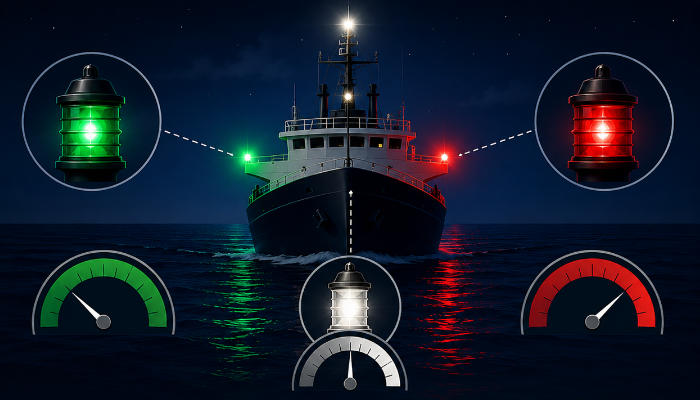
The height where navigation lights are put on the vessel influences how far they can be noticed. Lights mounted higher above the waterline usually give a longer line of sight, because they are less likely to get masked by rolling waves, vessel components, or nearby gear.
Big ships commonly place masthead lights on elevated points of the hull, to improve visibility as much as possible. Smaller boats often install them lower, and that tends to naturally shorten the viewing distance.
Even so, navigation lights need to be installed based on regulatory requirements, so the positioning stays correct and the light does not conflict with other structures.
5. Weather And Environmental Conditions
Weather and environmental conditions can reduce the effective visibility range of navigation lights in a meaningful way.
Fog, heavy rain, snow, sea spray, and haze can scatter light and also absorb it, so navigation lights often seem weaker when you are further away. In extreme weather situations, even well-designed navigation lights may not manage to reach their claimed maximum range.
Marine operators need to take weather conditions into account while sailing, and they should add more safety steps too, like radar, automatic identification systems (AIS), and sound signals when visibility gets reduced.
6. Light Color and Recognition Capability
The color of navigation lights changes how quickly other vessels recognize them. International standards for the sea set out different colors for different intentions, this includes red, green, white, and yellow.
White lights usually give strong visibility across long distances, while the colored lights are meant to signal specific navigation information. The wavelength and intensity of each color affect how the signals are perceived under different environmental conditions.
Correct color output for navigation lights is essential because the wrong hues may lead to confusion and ultimately bad navigation decisions, especially at night, when visibility is limited.
7. Power Supply Stability
A stable power supply is necessary for keeping navigation light performance steady. Voltage swings, battery problems, or electrical system failures can lower the light intensity or even cause a full outage.
Many modern vessels include backup power systems and monitoring equipment so navigation lights stay active during emergencies or when there is an electrical fault.
Automatic alarm systems can also warn the crew when a navigation light is damaged, or when it is working under the required performance level.
8. Lens Cleanliness and Maintenance Condition
Routine maintenance of navigation lights supports clear navigation light visibility. Debris, salt buildup, corrosion, and physical harm to the lens can reduce light transmission and shrink the usable viewing distance.
Marine settings can be difficult in a very real way because saltwater exposure can mess with electrical components and also optical surfaces. Usual inspections should cover things like checking light covers, verifying wire connections, looking at mounting systems, and confirming brightness levels.
When navigation lights are well maintained, they tend to perform in a more stable manner and this reduces the risk of navigation-related failures.
9. Regulatory Requirements and Compliance Standards
The visibility range for navigation lights has to match international and local maritime standards. The International Regulations for Preventing Collisions at Sea (COLREGs) describe the needed light characteristics, the expected visibility ranges, colors, and the correct installation positions.
Ship operators, designers, and manufacturers have to make sure navigation lights meet the approved requirements before installation and during operation. Compliance checks help verify that the vessel keeps proper navigation safety levels.
How to Improve Navigation Light Visibility
Vessel operators can kinda improve navigation light visibility by doing regular maintenance and picking the right kind of equipment for the job.
Regular inspections should cover lens cleanliness, confirming electrical connections are tight, checking mounting stability and verifying the light output. If lenses are damaged or the brightness starts dropping that can really cut visibility and create a bad situation faster than people expect.
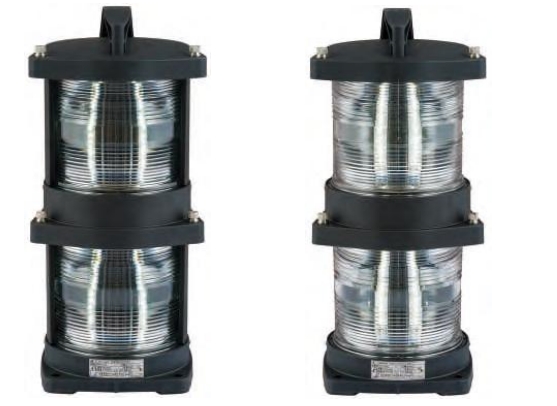
It’s also key to use certified navigation lights that are designed for marine conditions. These marine navigation lights have to handle vibration, saltwater exposure, temperature swings, and also continuous use without acting up.
LED navigation lights are getting more popular these days, mainly because they deliver steady illumination while cutting down on maintenance needs. Add to that their energy efficiency and they fit well with modern vessels that want dependable, long-term operation.
Final Thoughts
The required visibility range of navigation lights depends mostly on vessel size, light type, and operational conditions. Small boats often need shorter visibility distances, while big commercial vessels may need lights that can be seen for several nautical miles, and each requirement matters for maritime safety.
When navigation lights are chosen well, installed correctly, and kept in good condition, vessels can communicate on the water in a clearer way, which helps reduce the odds of accidents and supports safer navigation across different operating environments.
