
How to Wire Boat Navigation Lights
Proper wiring of your boat navigation lights is important to guarantee safety operation during night time and when visibility conditions are low, along with adhering to international navigation laws. No matter whether you are fitting LED navigation lights to a fishing boat, pontoon boat, yacht, or any other type of boat, proper wiring will increase performance and prevent electrical problems due to moisture and vibrations.
The Yushuo has years of experience in the field of marine lighting and has considerable industry knowledge and expertise. The following article tries to assist you in properly connecting boat navigation lights.
Table of Contents
Boat Navigation Light Wiring Diagram
Before beginning installation, it’s helpful to understand how a typical navigation light circuit is connected.
Basic Wiring Layout
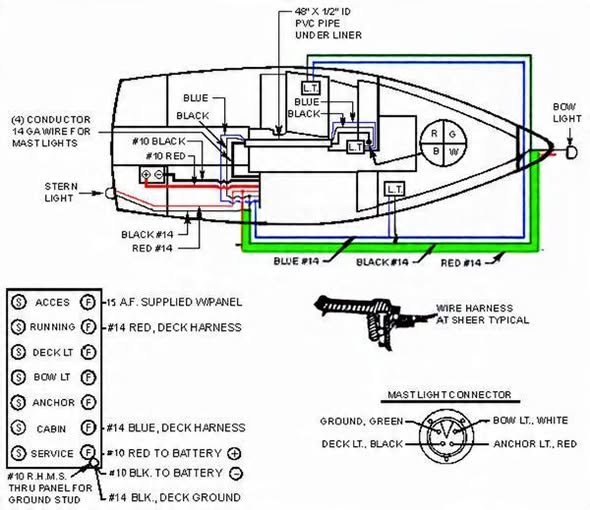
Wiring Components
| Component | Function |
| Battery | Supplies electrical power |
| Marine Fuse | Protects the circuit from overload |
| Navigation Switch | Controls the lights |
| Positive Wire | Delivers power to each light |
| Ground Wire | Completes the electrical circuit |
| Waterproof Connectors | Prevent moisture from entering the wiring |
Tools and Materials
Prepare all necessary tools before installation.
Required Tools
- Wire stripper
- Marine crimping tool
- Screwdriver
- Multimeter
- Heat gun
- Electrical tape
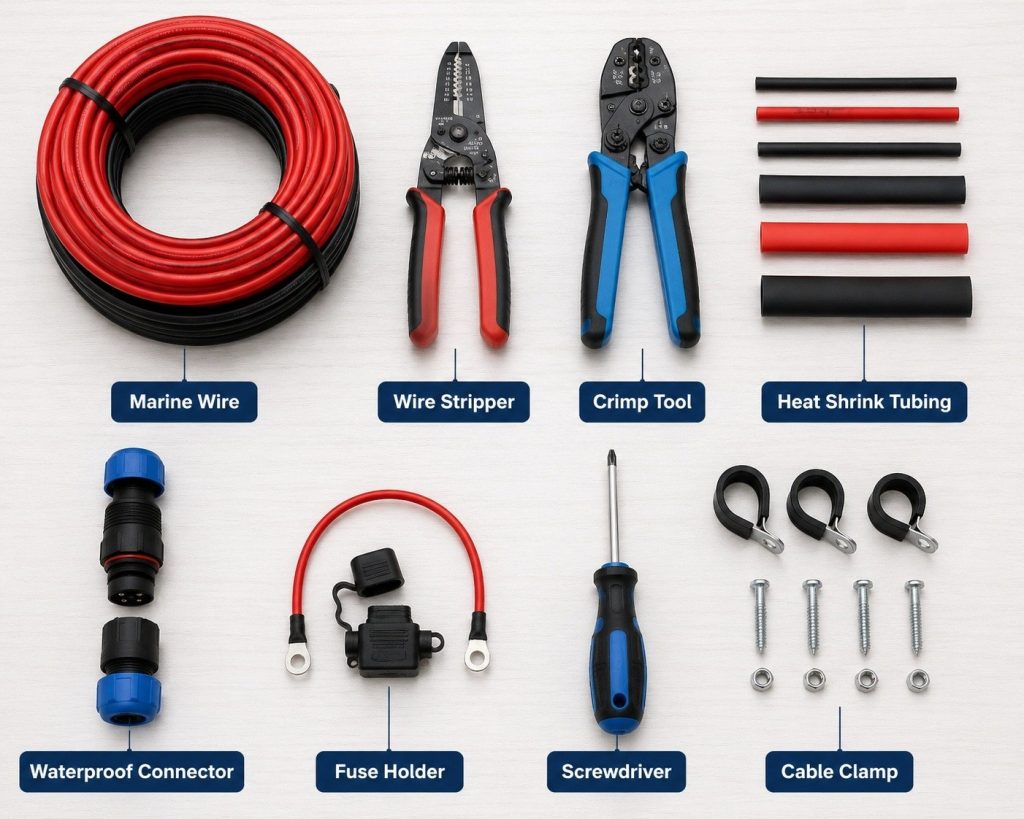
Recommended Materials
- Marine-grade copper wire
- Waterproof heat shrink connectors
- Inline marine fuse
- Waterproof switch panel
- Cable clamps
- IP67 waterproof navigation lights
Using marine-rated components significantly improves durability in saltwater environments.
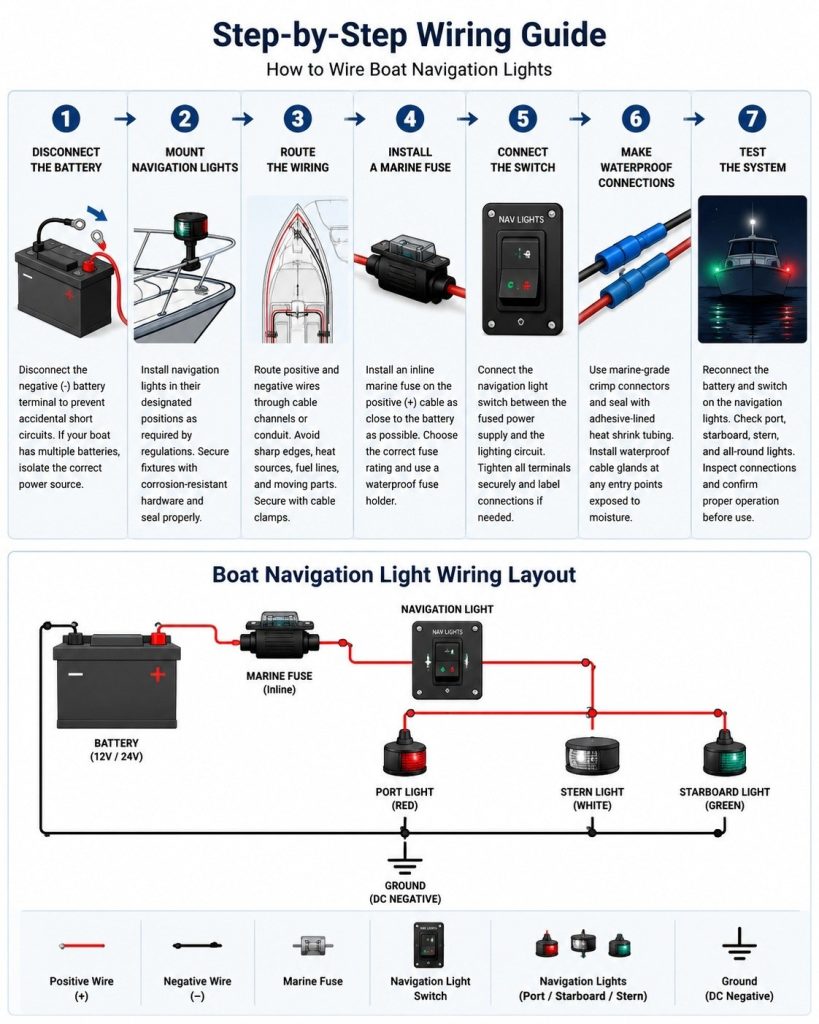
Step-by-Step Wiring Guide
Step 1. Disconnect the Battery
In order to carry out electrical work safely, it is recommended to disconnect the negative battery terminal to avoid possible accidents. In case there are several batteries aboard, identify the required power source.
Step 2. Mount the Navigation Lights
Mount the navigation lights into the proper places according to the type of your boat and the rules of navigation. Fix the fixtures securely by means of stainless steel mounting hardware. Ensure that the mounting surface is dry and properly sealed.
Step 3. Route the Wiring
When installing the wires, put them into available cable channels or conduit. It is advisable to keep wiring away from sharp edges, hot spots, fuel lines, and moving parts. Secure the cables with special marine cable clamps.
Step 4. Install a Marine Fuse
Install an inline marine fuse onto the positive power wire as close as possible to the battery. Choose the appropriate fuse according to the current draw of the navigational lights.
Step 5. Connect the Switch
Install the navigation light switch between the fused power source and the lighting circuits. Ensure that all wiring connections are properly tightened and marked, especially if multiple lighting circuits will be controlled by the same panel.
Step 6. Make Waterproof Connections
Crimp the marine grade wire connections together and protect the connections from any moisture with heat shrink tubing that has an adhesive interior. If there are any areas where cables will be exposed to the elements, such as when cables enter the panel and rain or salt spray can come in, use cable glands to ensure that no water enters the electrical system.
Step 7. Test the System
Restore power to the boat’s battery and test the operation of the navigation lights. Check each light separately as well as making sure that no loose connections or voltage drops exist in the wiring.
Common Wiring Mistakes
Improper installation can reduce the lifespan of marine lighting systems and create safety risks.
Skipping the Fuse
Without circuit protection, electrical faults can damage the wiring or lights.
Using Household Wire
Marine environments require tinned copper marine cable that resists corrosion.
Poor Waterproofing
Unsealed connectors allow water intrusion, causing corrosion and intermittent failures.
Incorrect Wire Size
Undersized wires create voltage drop, reducing light brightness over long cable runs.
Reversed Polarity
Connecting positive and negative wires incorrectly may prevent LED navigation lights from operating properly.
How Wiring Differs by Boat Type
The requirements for navigation light wiring differ according to the type and nature of boats in question. Though the principle behind wiring remains constant, the routing of cables, installation of lights, and selection of components should vary for every boat type.
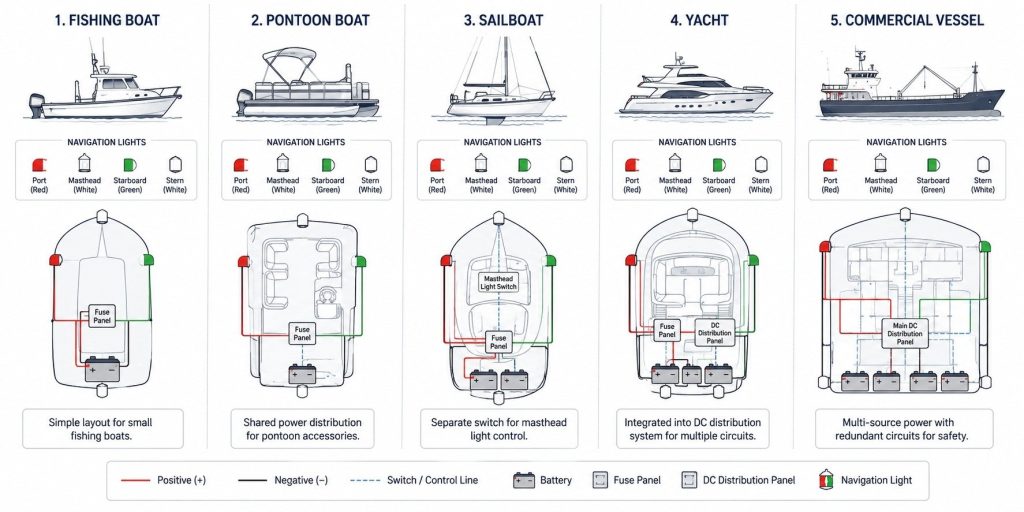
Fishing Boats
Fishing vessels normally have basic navigation light systems made up of port light, starboard light, and stern light. The cable lengths being small, it is easy to install, but marine-quality wiring should be used because of the regular exposure to water and vibrations.
Pontoon Boats
Longer cables are required for pontoon boats as a result of the wide spacing on the decks of these boats. The use of the right wire gauge will help to reduce voltage loss. It will also enable the provision of even light distribution.
Sailboats
The typical sailboat will have both masthead and anchor lights along with the regular navigation lights, making the electrical installation more intricate. The cables should be routed through the mast in a proper manner and also protected from water using waterproof cable glands.
Yachts
Navigation lights on modern yachts are often incorporated into an electrical control system. Clearly marked wiring, appropriate circuit protection, and corrosion-resistant LED navigation lights enhance system reliability and make future maintenance easier.
Commercial Vessels
The commercial ships usually sail through more challenging conditions, requiring more than one navigation light in compliance with the rules set by COLREGS or SOLAS. The use of marine cables, waterproof junction box, and corrosion-free components is highly recommended for reliable performance.
Professional Tip: When designing the wiring for navigation lights, take into account the voltage of the power source on your boat, length of the cables, and weather conditions. Adequate wire gauges and waterproof components used will help minimize the voltage drop.
FAQs
Q1: Can I wire boat navigation lights directly to the battery?
No. It is imperative that you have a fuse installed along with the navigation light switch.
Q2: What size wire should I use for boat navigation lights?
The type of wire that should be used will depend on both the length of the cable and the amount of current flowing through it. Copper wire is ideal for all boat navigation light installations.
Q3: Can LED navigation lights use existing wiring?
Yes, usually. Provided that the wire is of good quality and the voltage matches the system.
Q4: How do I waterproof navigation light wiring?
Use waterproof crimp connectors, heat shrink with adhesive liner, and cable glands.
Q5: Why are my navigation lights dim?
This could be caused by voltage drop, wires that are too small, corroded connections, weak batteries, or poor grounding.
Q6: How often should boat navigation light wiring be inspected?
The boat navigation lights wiring needs to be checked at least once a year.
