
IEC 60945 for Marine Navigation Lights: How to Ensure Compliance
Navigation lights are safety devices enabling ships recognize each other’s location, heading, and basic status while underway. On the water, the lights face constant strain. It has to deal with shaking, salt spray, big temperature swings, radio and electrical noise, and other tough conditions.
The IEC 60945 standard, titled Maritime Navigation and Radio communication Equipment and Systems-General Requirements-Methods of Testing and Required Test Results, defines general performance, environmental, and electromagnetic compatibility requirements for shipborne navigation equipment. The standard is widely used as a reference for testing marine electronic equipment and navigation systems.
For manufacturers of marine navigation lights, compliance with IEC 60945 helps ensure dependable use on real ships. It is not just about passing a test once. The goal is steady operation in daily conditions.
Table of Contents
Understanding IEC 60945 for Marine Equipment
IEC 60945 lays out minimum performance levels. It also gives set test steps for shipborne navigation gear and related marine systems.
The focus is on traits that impact real reliability. That includes resistance to harsh surroundings, electrical behavior, safety requirements, and electromagnetic compatibility. The intent is simple. Equipment meant for safe navigation should still work in rough ship environments.
IEC 60945 tests the performance of marine navigation lights after exposure to seawater, vibration, very high or very low temperatures, and electrical disturbances.
Why IEC 60945 Compliance is Important for Navigation Lights
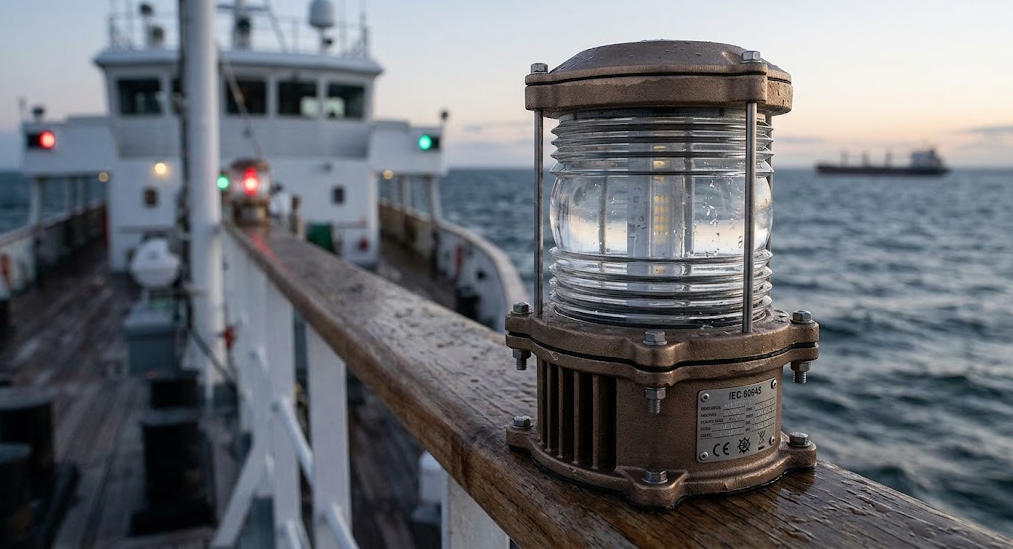
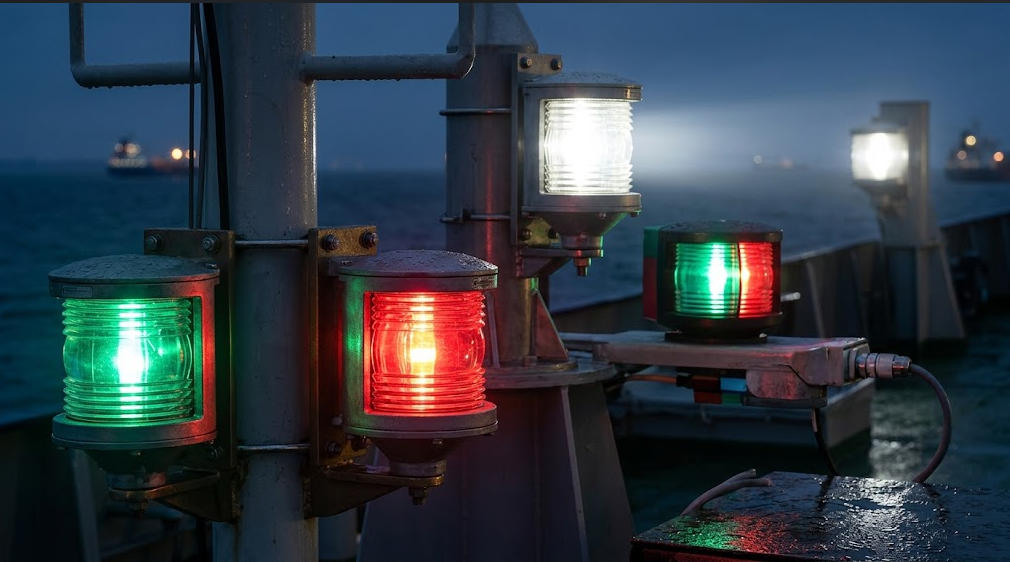
Navigation lights are often mounted in open places. You might see them on masts, bridge areas, and deck structures. Because of that, wind, waves, wet air, and heat and cold changes keep hitting the units.
If a light stops working, it can lead to clear safety issues. Other vessels may not get the correct view of a ship’s position or operating status. Following IEC 60945 helps manufacturers build lights with better dependability. It also supports longer service life and improved endurance in marine weather.
Lights made to marine standards usually use strong housings. They often use corrosion-resistant parts. Optical sections are sealed. LED systems are built to keep output stable over long operation.
Key IEC 60945 Requirements Related to Navigation Lights
IEC 60945 requirements help ensure that marine navigation lights can withstand temperature variations, humidity, vibration, corrosion, and electromagnetic interference.
| Requirement Area | Description | Importance for Marine Navigation Lights |
| Environmental Testing | IEC 60945 requires marine equipment to be tested under harsh environmental conditions, including temperature changes, humidity, vibration, and corrosion exposure. | Ensures navigation lights can operate reliably in offshore, coastal, and extreme marine environments. |
| Dry Heat Testing | Equipment is evaluated under high-temperature conditions to verify stable performance during hot weather or engine-room-adjacent installations. | Prevents LED modules, electronic drivers, and housing materials from overheating or losing performance. |
| Low Temperature Testing | Navigation equipment must maintain operation under cold environmental conditions. | Ensures navigation lights remain functional in cold regions and offshore applications. |
| Damp Heat Resistance | Tests evaluate resistance to high humidity and condensation that may occur in marine environments. | Helps prevent corrosion, insulation failure, and electrical faults caused by moisture. |
| Salt Mist Corrosion Testing | Equipment is exposed to a saltwater atmosphere to assess corrosion resistance. | Confirms that navigation lights can withstand continuous exposure to seawater and salt spray. |
| Vibration Resistance | Equipment undergoes vibration tests that simulate mechanical stress from engines, waves, and vessel movement. | Reduces the risk of internal component damage and lighting failure during operation. |
| Mechanical Strength | Navigation equipment is tested for physical durability and resistance to mechanical impacts. | Improves reliability when lights are installed on exposed areas such as masts and decks. |
| Electromagnetic Compatibility (EMC) | IEC 60945 evaluates electromagnetic emissions and immunity to interference from other electronic systems. | Prevents navigation lights from affecting radar, GPS, communication systems, and other onboard electronics. |
| Power Supply Requirements | Equipment performance is tested under different power supply conditions, including voltage variations and interruptions. | Ensures stable illumination even when vessel power systems experience fluctuations. |
| Electrical Safety | Tests verify insulation, protection measures, and safe electrical operation. | Reduces risks of electrical failures and improves onboard safety. |
| Water and Moisture Protection | Equipment design must provide suitable protection against water exposure and marine humidity. | Helps maintain long-term operation and prevents internal damage. |
| Reliability Testing | Products are evaluated to confirm consistent performance during extended marine service. | Supports longer service life and reduces maintenance requirements for ship operators. |
Environmental Testing Requirements Under IEC 60945
1. Resistance to Temperature Changes
Ships move through many climate zones. Some areas are hot and tropical. Others are cold and offshore. Navigation lights must keep proper brightness and electrical stability even when temperatures shift fast.
IEC 60945 has environmental tests for checking how marine gear behaves in hot and cold settings. The goal is to see if the equipment still works as expected. This includes LED modules, electronic drivers, and protective parts. The tests are meant to catch failures before real use.
To reduce trouble from heat, many makers select materials that handle temperature changes well. They also plan thermal paths and cooling steps so heat does not build up. This helps limit problems like dimming, internal electronic stress, and warped housings.
2. Humidity and Water Resistance
Navigation lights deal with water all the time. Rain, salt spray, trapped condensation, and high humidity can all be present. Navigation lights must keep working even when conditions are wet.
IEC 60945 sets checks for equipment used in damp sea areas. It looks at whether the unit can keep stable operation during moisture exposure.
Manufacturers often add moisture control methods, such as:
- Sealed housing designs
- Metal parts that resist rust
- Coating layers on key surfaces
- Cable connections made to last
These steps aim to stop inner corrosion, prevent short circuits, and protect light output.
3. Vibration and Mechanical Durability
On a ship, vibration is normal. Engines, propulsion parts, waves, and general vessel motion add stress. Lights on exposed spots must stay functional even when the structure shakes.
IEC 60945 includes vibration tests for marine equipment. These checks confirm that the unit can hold performance under mechanical shocks and steady shaking.
In many cases, rugged navigation lights use stronger mounting parts. They also use shock-resistant pieces and fixed internal wiring. The idea is to lower the chance of failure linked to vibration.
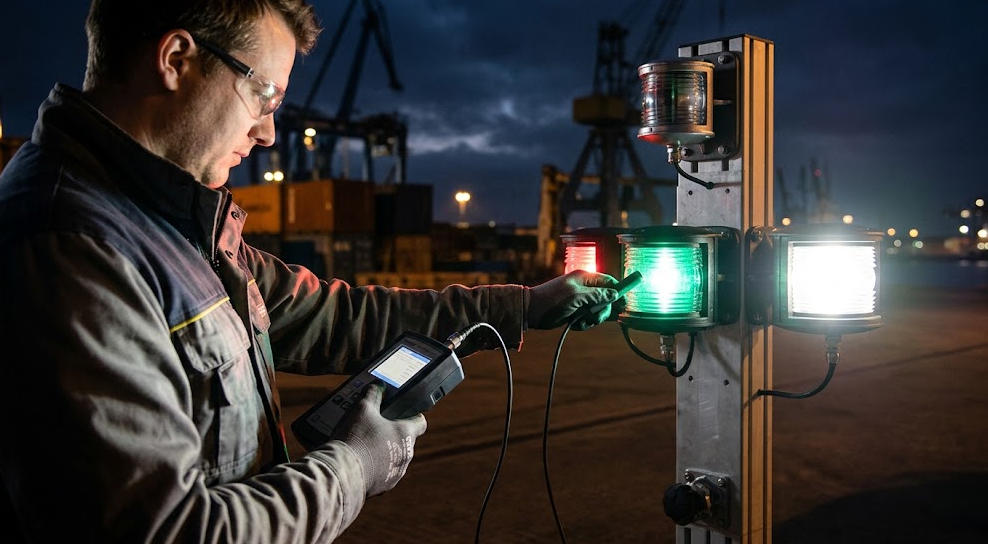
Electromagnetic Compatibility (EMC) Requirements Under IEC 60945
Today’s ships use many electronic systems at the same time. You may find radar, GPS units, radio gear, and automatic identification systems. When one unit emits interference, it can disrupt another unit’s work.
IEC 60945 lists EMC emission and immunity needs for marine equipment. It is designed to help prevent harmful interference. It also supports correct operation while the ship is full of electromagnetic noise.
For LED navigation lights, EMC work usually includes steady power circuit design, parts that reduce electrical noise, and electronics drivers built with care. Good EMC results matter a lot on commercial ships, since many navigation and communication systems are active at the same time.
Relationship Between IEC 60945 and Other Marine Regulations
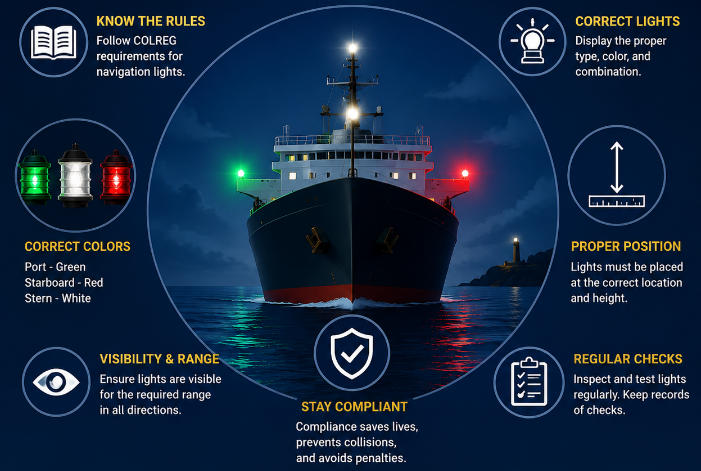
IEC 60945 provides general testing requirements, but marine navigation lights must also meet specific navigation light regulations, such as those related to vessel signaling and visibility requirements.
Common related regulations include:
Relationship Between IEC 60945 and Other Marine Regulations
| Standard / Regulation | Main Purpose | Relationship with IEC 60945 |
| IEC 60945 | Defines general requirements, testing methods, and performance criteria for maritime navigation and communication equipment, including environmental and electromagnetic compatibility tests. | Provides the foundation for evaluating equipment reliability under marine conditions. |
| COLREGs (International Regulations for Preventing Collisions at Sea) | Establishes international rules for vessel navigation lights, sound signals, and collision avoidance procedures. | Works together with IEC 60945 by defining what navigation lights must achieve, while IEC 60945 evaluates equipment durability and reliability. |
| SOLAS (Safety of Life at Sea Convention) | Sets international safety requirements for ship construction, equipment, and operation. | Supports the use of reliable marine equipment by requiring approved safety-related systems. |
| IMO Requirements | Provides global maritime safety guidelines and regulations through the International Maritime Organization. | IEC standards are often used as technical references to support IMO-related equipment requirements. |
| Classification Society Rules | Defines technical requirements for vessel approval by organizations such as CCS, DNV, ABS, and others. | IEC 60945 test results may support classification approval processes. |
| IEC 60533 (Electromagnetic Compatibility Standard for Ships) | Provides additional EMC requirements for electrical and electronic installations on ships. | Complements IEC 60945 by addressing broader shipboard electromagnetic environments. |
| IP Protection Ratings (IEC 60529) | Defines enclosure protection levels against dust and water ingress. | Often considered alongside IEC 60945 environmental requirements. |
| MED (Marine Equipment Directive) | Establishes certification requirements for marine equipment used on vessels under certain flag states, especially in Europe. | IEC 60945 testing can support compliance evaluation for applicable marine equipment. |
IEC 60945 supports compliance by ensuring that equipment can operate reliably in the marine environment.
How Navigation Light Manufacturers Ensure IEC 60945 Compliance
Ensuring IEC 60945 compliance for navigation lights, requires a combination of careful product design, material selection, laboratory testing, quality control, and continuous improvement throughout the manufacturing process.
1. Marine-Focused Product Design and Material Selection
The work starts when the product is still on the drawing board. Navigation lights have to be made for ship use. Regular lighting gear is not meant for constant saltwater contact, wet air, and knocks from the marine environment.
Manufacturers pick corrosion-resistant parts to keep the unit strong over time. Marine-grade aluminum alloys are common. Stainless steel parts are also used. Some designs use tough engineering plastics as well. Coatings and surface treatments are added to limit salt spray wear and moisture-related corrosion.
Lens and cover parts are chosen with UV resistance in mind. This is to slow aging and help keep light passing through at a steady level during long outdoor use.
The case design matters too, not just the electronics. Good sealing is needed to stop water from getting inside. That helps the light keep working in wet and rough sea conditions.
2. Developing Reliable LED Lighting Systems
Modern LED marine navigation lights use less power. They also tend to last longer. They usually handle vibration better than older light types.
To match IEC 60945, the LED section is planned with care. Manufacturers select dependable LED chips. They also shape the heat path and use electronic drivers that work in the real conditions.
Heat control is a key point. Too much heat can cut LED life and shift brightness. Because of that, heat sinks, vent or airflow features, and parts that tolerate high temperatures are used.
Control electronics are also set up to stay stable when ship power changes. The goal is that the navigation light keeps running correctly, even if the vessel supply varies.
3. Conducting Environmental Durability Tests
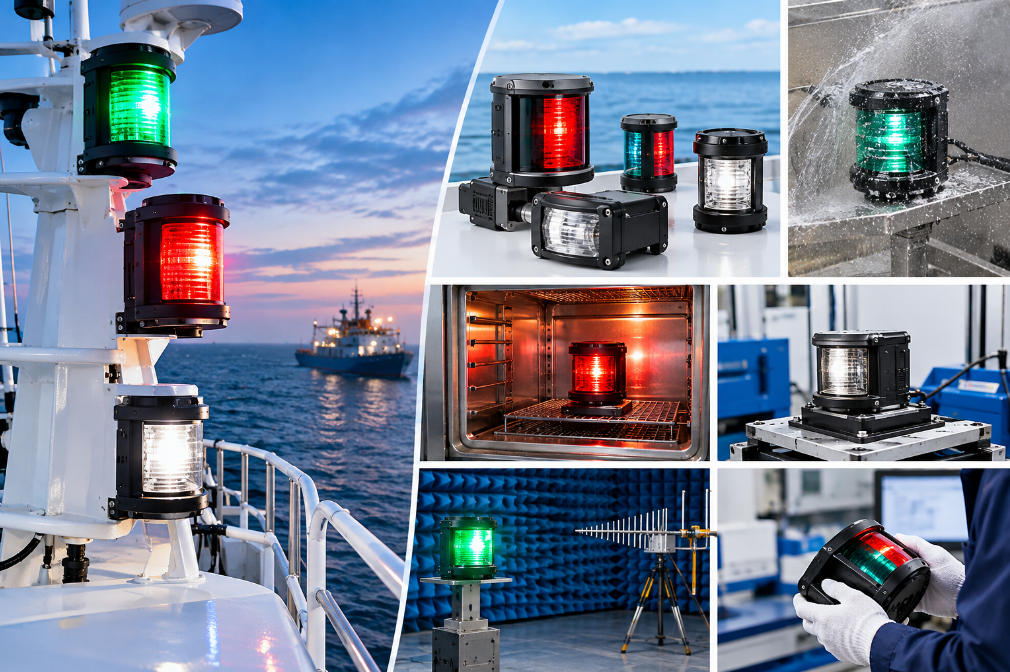
Environmental durability testing is a major part of IEC 60945 compliance. Manufacturers run multiple checks to see if the navigation lights can handle marine conditions.
Temperature tests look at operation in both hot and cold settings. These tests help point out weak spots tied to electronics, sealing materials, and how the optics perform.
Humidity and damp heat tests check resistance to moisture and condensation. Ships often run in damp areas. Because of that, the light housing needs to limit water entry and help stop internal corrosion.
Salt mist testing is used to mimic salty sea air. The air includes tiny salt particles. The goal is to see how well a light handles corrosive exposure. This supports better choices in materials and protective coatings.
These checks also help teams spot weak spots early. Manufacturers can reduce the chance of failures after installation on ships. Navigation lights can be assessed before they are mounted on vessels.
4. Ensuring Mechanical Strength and Vibration Resistance
On ships, movement never stops. Engines, propellers, wind, and waves all create shaking. Navigation lights placed on masts and exposed parts must work through constant vibration. The light should not lose function even when the ship is moving hard.
Vibration tests are done to check the housing and mounting parts. Internal wiring and electrical connections are also tested. The aim is to see if everything stays firm under stress.
A solid mechanical build lowers risks. It can prevent loose joints, broken parts, and sudden lighting problems. Many designs use reinforced housings and tight mounting brackets. Durable internal sections also help.
5. Meeting Electromagnetic Compatibility Requirements
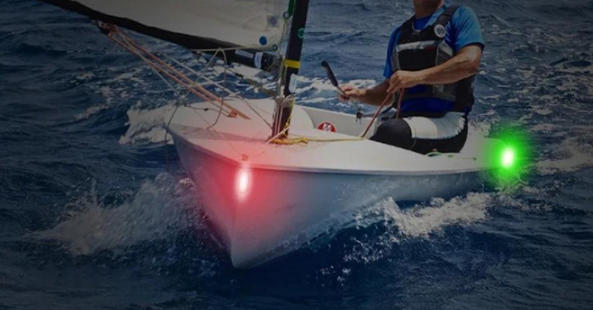
Vessels carry many electronics at the same time. Systems include radar, GPS, radios, and control units for navigation. Lighting equipment can create electromagnetic interference. That interference may disrupt other devices onboard.
IEC 60945 sets electromagnetic compatibility rules. These rules aim to limit harmful interference. They also require marine gear to keep working in an electromagnetic setting.
Manufacturers reach EMC compliance with more than one step. Circuit layout is improved to reduce trouble. Electrical noise is lowered. Filtering parts are added where needed. Power management is also kept steady.
When EMC needs are met, navigation lights can run near other marine electronics. Operation remains safer in the shared environment.
6. Improving Waterproof Protection and Sealing Performance
Water resistance strongly affects navigation light life. Even small moisture leaks can harm electronics. It can also reduce product lifespan over time.
To improve waterproof performance, manufacturers use careful sealing methods. They use good gaskets and proper cable seals. Enclosure structures are built to hold up in wet conditions.
During production, waterproof checks are carried out. Sealing tests confirm the light can handle rain and sea spray. Marine moisture exposure is part of the evaluation.
With solid sealing, navigation lights can keep working during long trips. This also helps in offshore use.
7. Implementing Strict Manufacturing Quality Control
IEC 60945 compliance relies on design and making methods. Even a good design can fail if production varies too much. Navigation light makers use quality control systems to keep output consistent. Each unit must reach the stated performance requirements.
During manufacturing, workers check incoming raw materials, electronic parts, optical pieces, and finished units. They also run electrical tests, look at brightness, and do structure checks. The goal is simple. Find problems before delivery.
Marine lighting manufacturers add aging trials. They run the navigation lights for long stretches. This helps show how they hold up over time. It can also reveal weak units early.
Quality systems are kept tight. That way, each navigation light should act the same, even when made in different batches.
8. Final Testing and Certification Evaluation
Before navigation lights are delivered to customers, manufacturers perform comprehensive testing to verify product reliability.
Final testing may include:
| Testing Category | Purpose |
| Optical Testing | Confirms brightness, light distribution, and visibility performance |
| Electrical Testing | Checks voltage stability, power consumption, and safety |
| Environmental Testing | Evaluates resistance to temperature, humidity, and corrosion |
| Vibration Testing | Confirms mechanical durability during vessel operation |
| EMC Testing | Ensures compatibility with onboard electronic systems |
| Waterproof Testing | Verifies protection against water and moisture |
These tests help ensure that navigation lights meet marine industry expectations before installation on vessels.
9. Continuous Improvement of Marine Navigation Light Technology
Marine environments keeps getting tougher. Because of that, companies making navigation lights have to keep improving. Better LED output, smarter monitoring, and newer materials all support more stable performance.
Future navigation lights may add fault detection that works on its own. They may also support remote checks and lower power use through better design. With these steps, ships can run more safely and more efficiently. The lights can still meet global marine rules.
Final Thoughts
IEC 60945 matters for marine navigation equipment. It supports reliability and long life. For navigation light manufacturers and ship operators, compliance with IEC 60945 shows the products were tested under harsh conditions. Those include temperature changes, vibration, corrosion, and electromagnetic interference.
When manufacturers follow IEC 60945 along with the required navigation light regulations, the result is better marine lighting products which are safer, more durable, and more reliable on commercial ships, offshore platforms, and other marine applications.
