
How Tugboats Use Marine Searchlights during Harbor Operations
Tugboats are a key part of port work. They help larger vessels with maneuvering, docking, undocking, and navigating through restricted waterways. Ports can be packed and busy, and visibility may be poor. For that reason, tugboat staff need reliable marine lighting equipment to perform their duties safely and efficiently. In the list of lights used on tugboats, marine searchlights are particularly important.
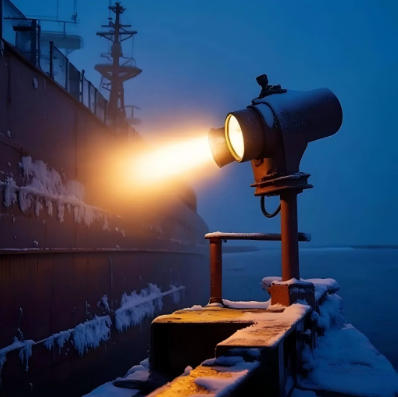
Marine searchlights provide powerful, focused illumination that helps crews identify obstacles, observe nearby vessels, monitor harbor infrastructure, and coordinate towing operations. This matters most at night or when weather makes conditions worse. They also help to illuminate objects farther away and to highlight specific work areas. That is why this type of searchlight is used for tugboats operating in challenging maritime environments.
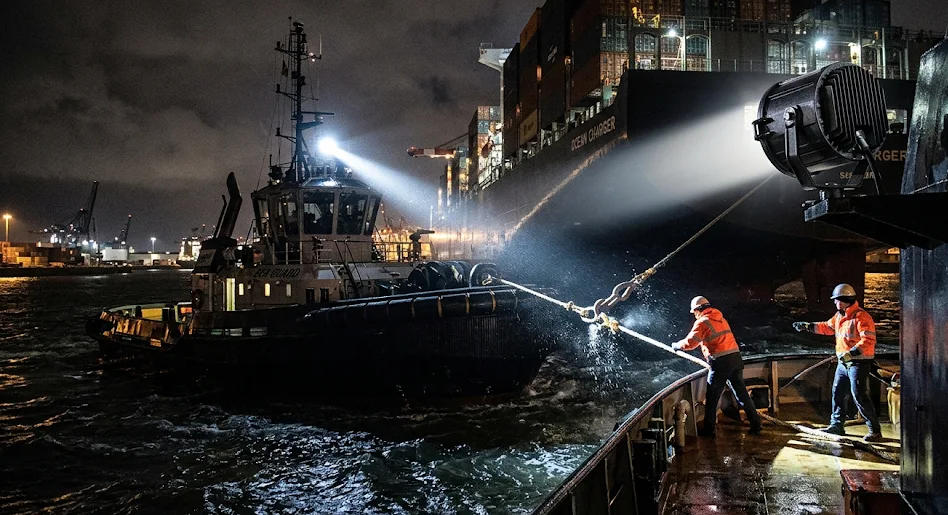
Table of Contents
Why Marine Searchlights are Important for Tugboat Operations
Tugboats often run in crowded harbors. They may also work in narrow passages. Large commercial ships cannot move easily in some areas. That means tug crews must steer with care. They also must keep steady contact with pilots and other vessels.
At night, regular deck lights may not be enough. They can fail to show distant obstacles. They may also make it hard to see what is around the tug. A marine searchlight helps with this. It can cast a beam to selected spots near the ship.
This tool supports crews when they approach large vessels. It also helps when working by docks. It gives more usable light when moving through busy waterways. Crew members can also use it while checking towing lines, fenders, and other gear during close work.
Marine searchlights are also useful in unfamiliar harbor areas. They help during sudden problems. They are most helpful when lighting is low and the team must act fast.
Key Applications of Marine Searchlights During Tugboats Operating in Harbors
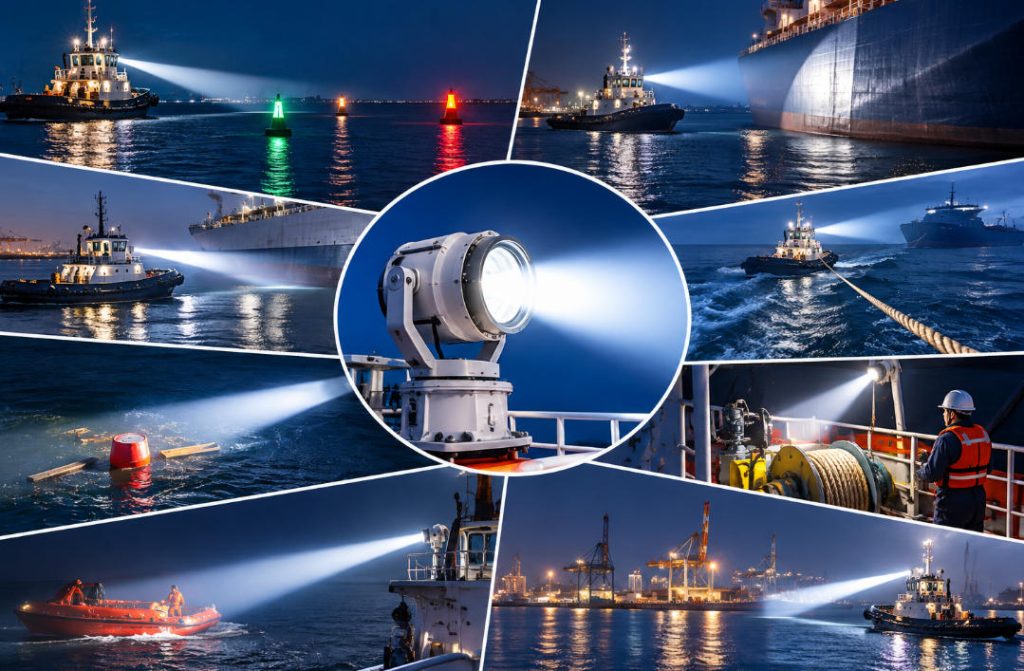
Marine searchlights serve several important functions throughout tugboat operations. Their applications extend from navigation assistance to towing support and emergency response.
| Applications | Main Functions | Benefits | Typical Operating Scenarios |
| Navigation Route Illumination | Illuminates harbor channels, navigation markers, buoys, and surrounding waterways | Improves nighttime visibility and helps crews identify navigation hazards | Navigating through narrow channels and busy harbor entrances |
| Ship Docking Assistance | Illuminates large vessel hulls, quay walls, berthing areas, and nearby structures | Helps tugboat crews monitor distances and support accurate vessel positioning | Assisting cargo ships, tankers, and passenger vessels during docking |
| Ship Undocking Operations | Provides additional visibility around vessels as they move away from the berth | Helps crews observe surrounding obstacles and coordinate maneuvering | Assisting large vessels when departing ports at night |
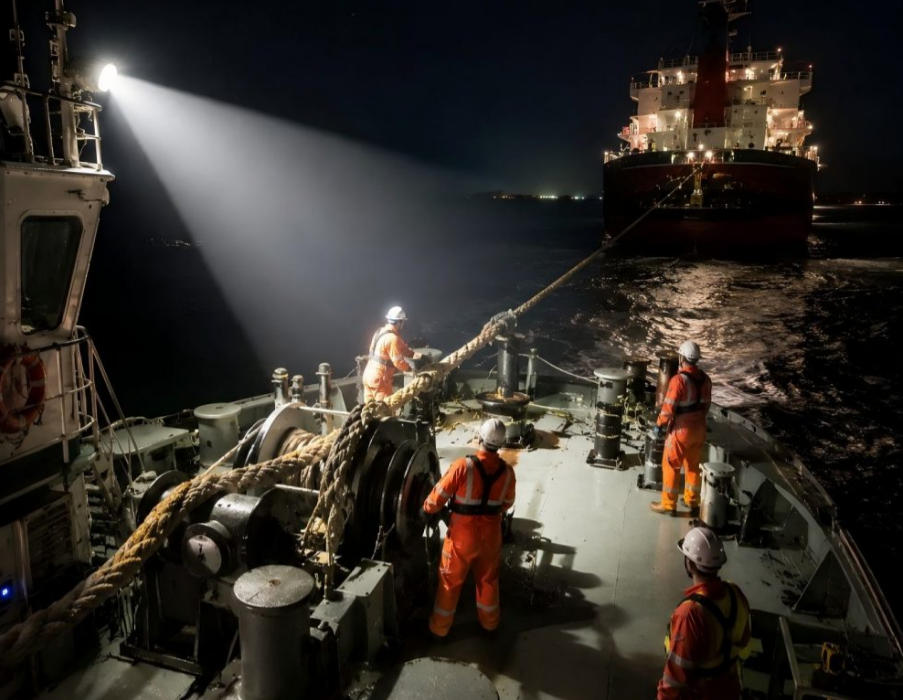
| Towing Operations | Illuminates towing ropes, wires, hooks, and connection points | Allows crew members to monitor towing equipment and identify potential problems | Towing disabled vessels and assisting large ships |
| Floating Object Detection | Illuminates surrounding water to identify floating debris, small boats, and other obstacles | Supports early hazard identification and safer maneuvering | Operating in crowded waterways and restricted harbor areas |
| Deck and Equipment Inspection | Provides focused lighting for deck machinery, winches, fenders, and other equipment | Improves visibility during equipment checks and nighttime maintenance | Inspecting towing systems and deck equipment |
| Emergency and Rescue Operations | Directs powerful illumination toward accident locations, disabled vessels, or rescue areas | Supports visual assessment and nighttime emergency response | Man-overboard incidents, vessel breakdowns, and maritime emergencies |
| Crew Coordination | Illuminates working areas and helps crew members observe operational activities | Improves situational awareness during coordinated tugboat operations | Multi-tug assistance, towing connections, and complex harbor maneuvers |
| Port Infrastructure Monitoring | Illuminates docks, piers, harbor structures, and nearby working areas | Helps crews identify potential obstructions and maintain awareness of surroundings | Operating near terminals, shipyards, and industrial port facilities |
Different Types of Marine Searchlights Used on Tugboats
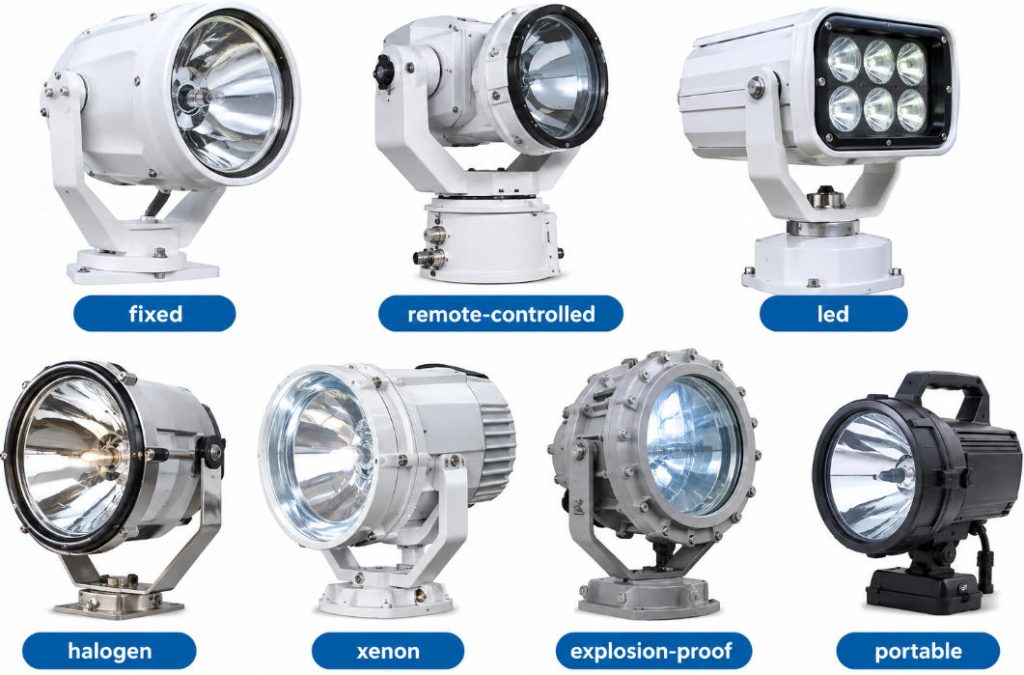
Tugboats have different lighting requirements depending on their size, operational responsibilities, and working environments. Several types of marine searchlights are commonly considered for these applications.
| Type of Searchlight | Main Features | Advantages | Applications on Tugboats |
| Fixed Searchlight | Permanently installed with a fixed illumination direction | Simple structure, stable performance, and easy operation | Forward illumination and routine harbor navigation |
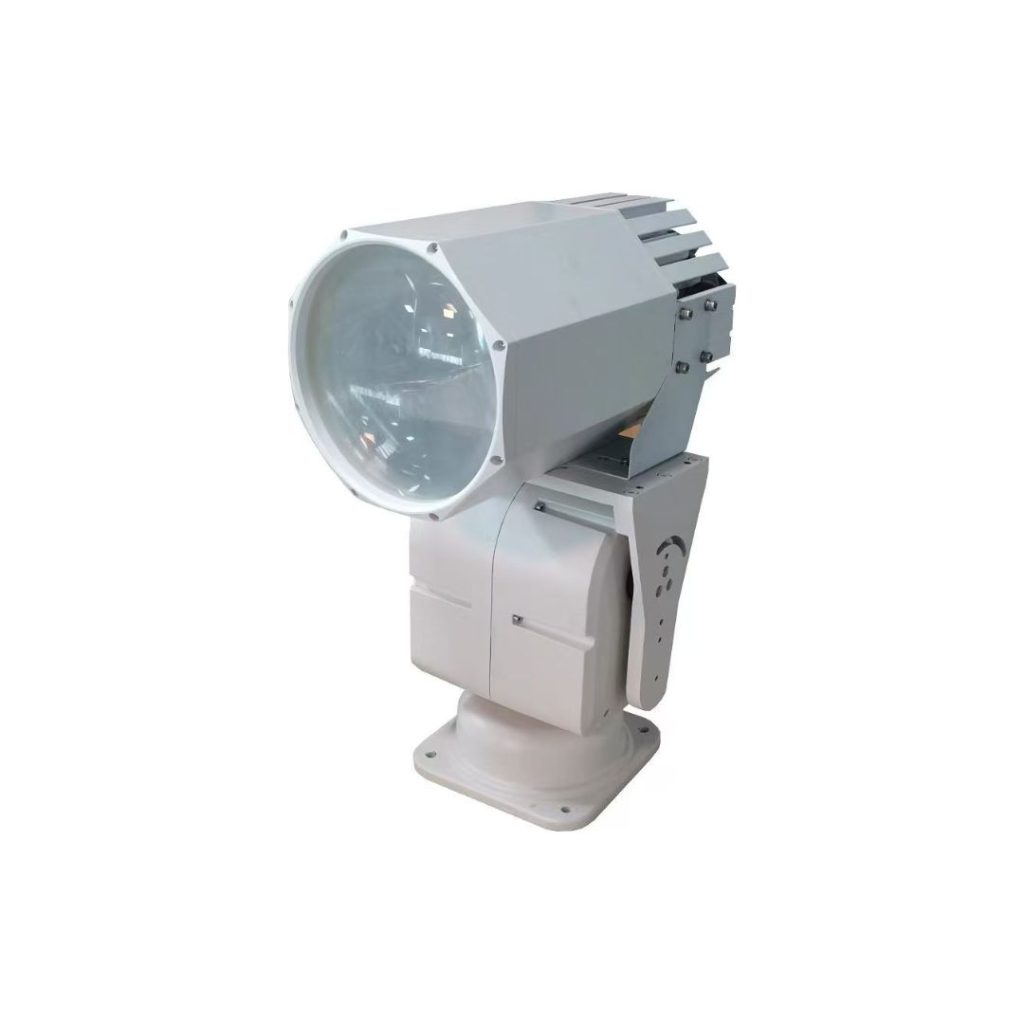
| Remote-Controlled Searchlight | Direction and beam angle can be adjusted remotely | Flexible illumination and convenient operation | Ship docking, undocking, towing, and obstacle detection |
| LED Marine Searchlight | Uses LED technology to produce bright, energy-efficient illumination | Low power consumption, long service life, and reduced maintenance | Continuous nighttime harbor operations |
| Halogen Marine Searchlight | Uses halogen bulbs to provide bright, focused lighting | Established technology and straightforward replacement | General-purpose illumination and existing lighting system upgrades |
| Xenon Marine Searchlight | Produces powerful illumination with a concentrated beam | High-intensity lighting and long-distance visibility | Long-range observation and specialized harbor operations |
| Explosion-Proof Searchlight | Features protective construction designed for specified hazardous environments | Helps reduce ignition risks when properly certified and installed | Tugboats operating in designated hazardous port areas |
| Portable Searchlight | Compact, movable lighting equipment | Flexible positioning and convenient handling | Temporary deck illumination, inspections, and emergency response |
The appropriate searchlight depends on the tugboat’s operational requirements, installation position, power supply, and environmental conditions.
For many modern tugboats, LED searchlights and remote-controlled searchlights are attractive options because they combine practical illumination with convenient operation.
How Tugboat Crews Operate Marine Searchlights
The effectiveness of marine searchlights depends not only on their lighting performance but also on how crews use them during different operational stages.
Before a tug enters a harbor, crew members may turn on a forward light. The goal is to see more clearly along the travel line. If needed, they point the beam at buoys, channel markers, and other key references.
As the tug gets closer to a larger vessel, crews may change the beam angle. They may light the larger ship’s hull, the water beside it, and the docking structures. This makes it easier to judge the area while assisting with docking and other moves.
During towing operations, searchlights can be directed toward towing connections and the areas where crew members are working. If the tugboat needs to change position, remotely controlled equipment allows operators to adjust the beam without repeatedly moving around the deck.
When an emergency occurs, the searchlight can be redirected toward the affected area to support visual assessment and response activities.
However, crews must use searchlights carefully. Excessive brightness or poorly directed beams can create glare for other vessel operators, interfere with visual observations, or reduce night vision. Searchlights should therefore complement, rather than interfere with, navigation lights and other required lighting systems.
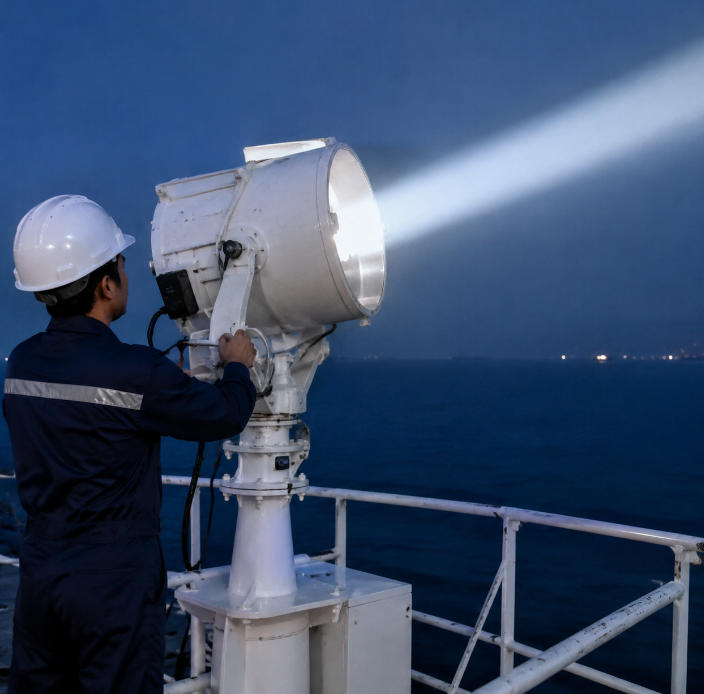
Key Performance Requirements for Tugboat Marine Searchlights
Tugboats usually operate in demanding marine environments where lighting equipment is exposed to saltwater, humidity, vibration, wind, and temperature changes. Consequently, marine searchlights must meet specific performance requirements.
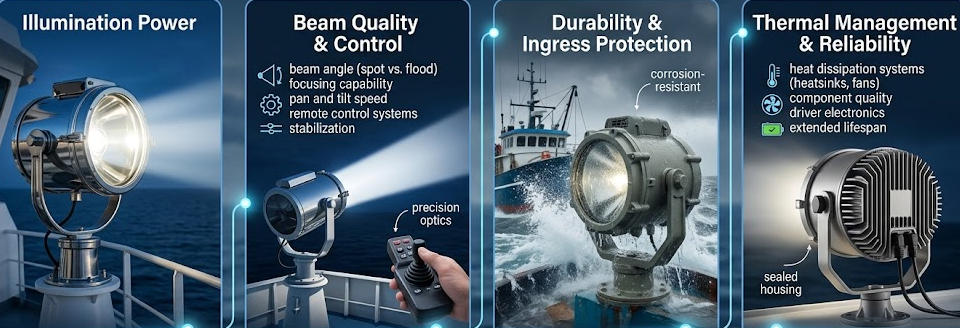
1. High Brightness and Appropriate Beam Distance
A marine searchlight should provide sufficient illumination for the distances and areas involved in tugboat operations. Beam distance, beam angle, and luminous intensity are important factors when evaluating its performance.
A narrow beam is useful for illuminating distant objects, while a wider beam can provide better coverage of nearby working areas.
The ideal configuration depends on whether the searchlight is primarily used for navigation assistance, towing operations, or general observation.
2. Waterproof and Corrosion-Resistant Construction
Saltwater exposure and high humidity can damage electrical components and metal housings. Marine searchlights should therefore feature suitable waterproof protection and corrosion-resistant materials.
Sealed housings, durable mounting brackets, and appropriately protected electrical connections help improve equipment reliability.
3. Vibration and Shock Resistance
Tugboats frequently experience vibration caused by engines, propulsion systems, towing forces, and waves.
Marine searchlights should have a robust structure capable of withstanding normal vessel operating conditions. Secure mounting and vibration-resistant components also help maintain stable illumination.
4. Remote-Control Capability
Remote-controlled LED searchlights make daily work easier. The crew can change the light aim from a safe control spot, instead of going to the lamp itself.
This is useful for tugboats that must watch several spots while docking, towing, or handling an emergency.
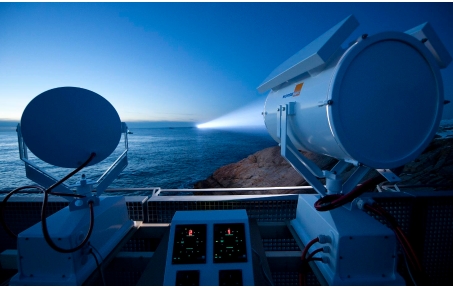
5. Energy Efficiency and Maintenance
On tugboats, lighting is just one part of many onboard electrical loads. Automatic LED marine searchlights can cut power draw and still deliver dependable light.
They also tend to last a long time. Maintenance is usually not heavy, so there is less downtime and lower operating expense.
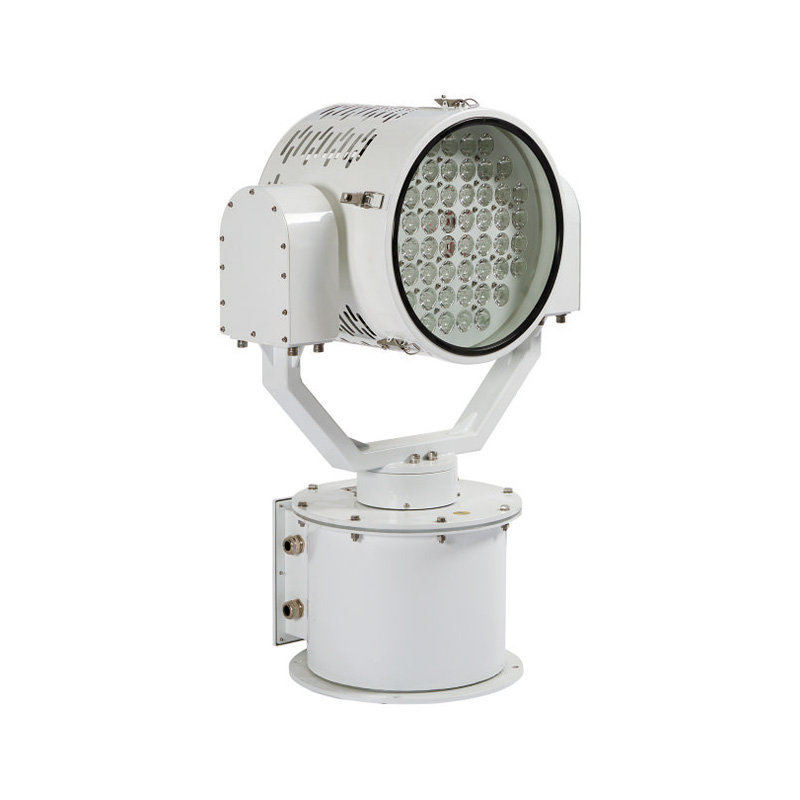
Common Challenges When Using Marine Searchlights on Tugboats
Although marine searchlights improve nighttime visibility, their performance can be affected by several operational and environmental factors.
| Common Challenges | Main Causes | Potential Impacts | Recommended Solutions |
| Glare and Light Reflection | Excessive brightness, incorrect beam direction, and reflection from water surfaces | Reduced visibility and potential distraction for tugboat operators and nearby vessels | Adjust beam angles, use suitable optical designs, and avoid directing beams toward other vessel bridges |
| Saltwater Corrosion | Continuous exposure to salt spray, humidity, and seawater | Damage to housings, mounting brackets, and electrical connections | Choose corrosion-resistant materials and marine-grade protective coatings |
| Water Ingress | Damaged seals, poor housing design, or improper installation | Electrical failures, internal condensation, and reduced lighting performance | Select appropriately rated waterproof marine searchlights and inspect seals regularly |
| Mechanical Vibration | Engine operation, propulsion systems, waves, and towing forces | Loose mounting components, unstable illumination, and mechanical wear | Use secure mounting brackets and vibration-resistant structures |
| Insufficient Illumination | Low brightness, unsuitable beam angles, or excessive distance from the target | Difficulty identifying obstacles, equipment, and surrounding vessels | Select searchlights with appropriate luminous intensity, beam distance, and beam distribution |
| Power Supply Problems | Voltage fluctuations, damaged cables, or electrical system incompatibility | Flickering, reduced brightness, or unexpected shutdowns | Verify electrical compatibility and inspect wiring and power connections |
| Remote-Control Malfunctions | Mechanical wear, control system failures, or communication interruptions | Difficulty adjusting illumination during docking and towing | Choose reliable control systems and conduct regular functional testing |
| Lens Contamination | Salt deposits, dust, oil, and other environmental contaminants | Reduced light transmission and uneven illumination | Clean lenses regularly using suitable materials and cleaning methods |
| High Maintenance Requirements | Poor product quality, harsh operating environments, and aging components | Increased maintenance costs and equipment downtime | Choose durable marine-grade searchlights and establish preventive maintenance schedules |
| Improper Installation | Incorrect mounting position, unsuitable wiring, or obstructed lighting direction | Blind spots, limited illumination coverage, and operational inconvenience | Follow manufacturer installation guidelines and evaluate lighting coverage before operation |
How to Choose the Right Marine Searchlight for Tugboats
Selecting the right marine searchlight depends on how the tugboat works and how the unit will be installed.
Start by looking at the ship’s main tasks. Tugboats that focus on harbor support often need lighting that works well for docking, towing, and tight turning. If a vessel runs longer routes, it may need a searchlight with a longer beam reach.
Next, match the lighting type to the tugboat power setup and real use needs. LED models are commonly a good fit on modern tugboats because they use less energy and last longer.
Also decide between fixed and remote-controlled units. If the light angle must change often during operations, remote control gives more flexibility.
Do not skip the weather and wear factors. Waterproof design, resistance to rust, and vibration tolerance should fit the tugboat’s working environment.
Finally, review product quality and marine searchlight standards. Check installation fit, spare parts access, and after-sales technical support. Choosing a reliable marine searchlight maker can make it easier to get equipment that fits tugboat needs in practice.
Final Words
Marine searchlights are critical in helping tugboats perform harbor operations safely and efficiently, especially during nighttime and low-visibility conditions. From illuminating navigation channels and supporting ship docking to monitoring towing equipment and assisting emergency response, these lighting systems provide valuable visual support for tugboat crews.
Selecting a marine searchlight means checking several things. Look at brightness, beam distance, lighting technology, waterproof performance, corrosion resistance, and remote-control capabilities. After that, do not skip regular maintenance. Clean it as needed and operate it correctly so it stays dependable.
