
LED Marine Searchlights for Tugboats: What Should Operators Consider?
For the case of a tugboat, selection of the LED searchlight based on the wattage of the light or the distance that its beam is supposed to reach could be misleading. More critical would be the ability of the light to have sufficient beam power, range, positioning, and reliability for the operation.
In assessing the LED marine searchlights for use on a tugboat, other factors besides the brightness of the light need to be considered.
Table of Contents
1. Match Beam Performance to the Tugboat’s Working Distance
The first specification to examine is beam performance, rather than nominal LED power.
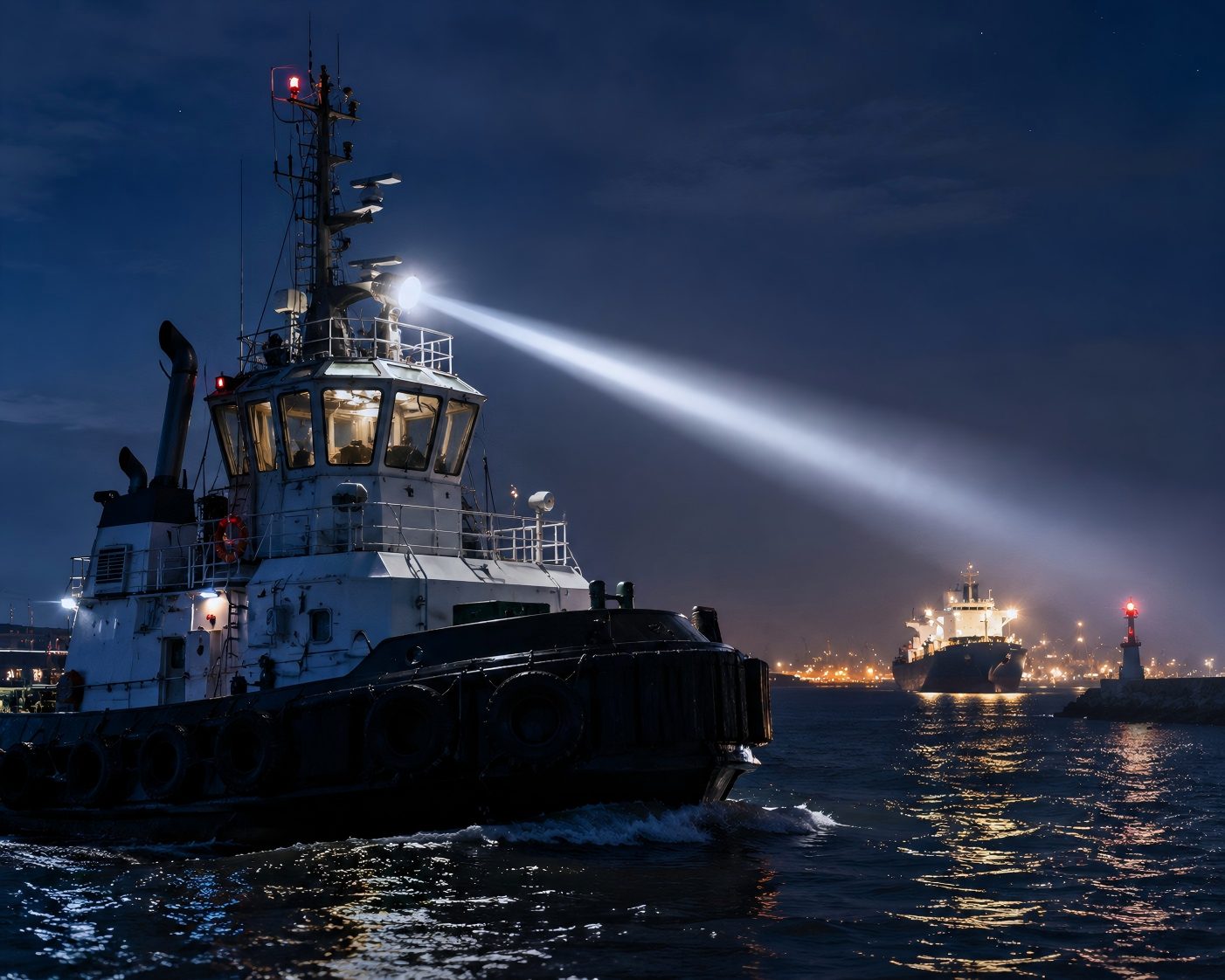
The searchlight on the tugboat could be used in determining which boat needs assistance, checking the tow, inspecting the channel ahead, finding floating objects, and illuminating work areas on deck. These tasks can require significantly different beam patterns.
A narrow, high-intensity beam is generally more suitable when the operator needs to identify a distant target. A wider beam can be more useful when working close to another vessel or illuminating a larger area around the tow.
Procurement teams should therefore request:
- Luminous intensity (candela)
- Beam angle
- Beam distance
- Optical distribution
- Photometric data
Lumens indicate the total amount of visible light produced, while candela indicates light intensity in a particular direction. For a long-range tugboat searchlight, directional intensity is therefore a more useful specification than lumens alone.
For example, Yushuo TZ2 LED marine searchlight is specified with a 300 W LED source and an exposure distance exceeding 1,500 m, while the TZ6 is rated at 800 W with a stated exposure distance of 4,900 m. These specifications demonstrate why LED power should not be used as the sole basis for comparing searchlights.
2. Evaluate What the Crew Actually Needs to Illuminate
The required beam should be determined by the tugboat’s operating tasks, not simply by the size of the vessel.
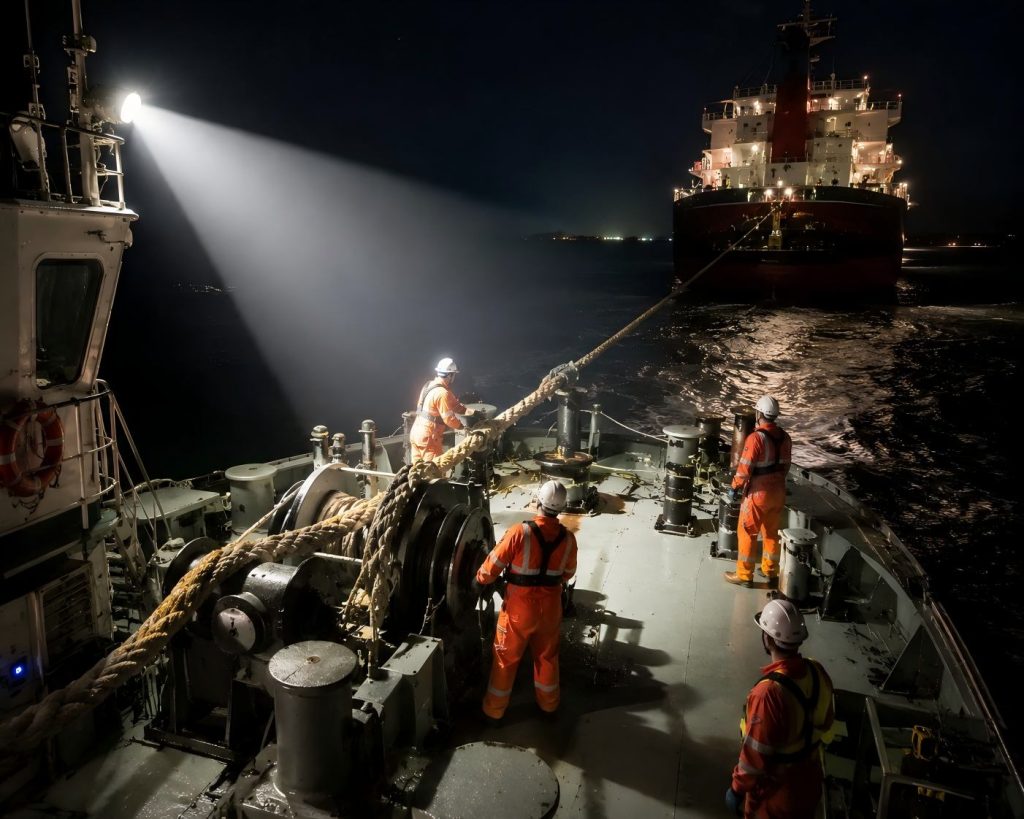
During towing and ship-assistance operations, the crew may need to illuminate:
- The stern of the assisted vessel
- Towlines and towing equipment
- Floating objects
- Buoys and channel markers
- Areas around the tug’s working deck
Although a highly focused beam will produce intense lighting over long distances, it might lack the capability to light up areas within close range. An overly wide beam, on the other hand, will spread the intensity over a large surface area.
This is particularly important in ports and confined waterways, where excessive glare can also affect the crew’s night vision.
The IMO COLREGs requirements for lights and towing operations should be considered when determining how a searchlight will be used alongside prescribed navigation and towing lights. COLREG Rule 24 specifically addresses lights for vessels engaged in towing and pushing.
A searchlight should support operational visibility without being treated as a substitute for required navigation lights.
3. Check Beam Control and Positioning Range
For a tugboat, beam positioning can be as important as beam distance.
The searchlight fitted on either the wheelhouse roof or the mast will have to cover different directions in each case whether it is approaching another ship or vessel, maneuvering at the quay side, towing a vessel, or navigating in a restricted harbor area.
When comparing models, procurement teams should specify:
- Horizontal rotation range
- Vertical elevation/depression range
- Rotation speed
- Manual or remote operation
- Beam focusing
- Control location
A 360° horizontal rotation capability can be particularly useful for harbor-assistance tugs that frequently change working direction.
Yushuo TZ2, for example, provides 360° horizontal adjustment and ±30° vertical adjustment. The important consideration for operators is not simply the numerical range, but whether that range covers the actual search areas required from the proposed mounting location.
4. Assess Environmental Protection at the Installation Location
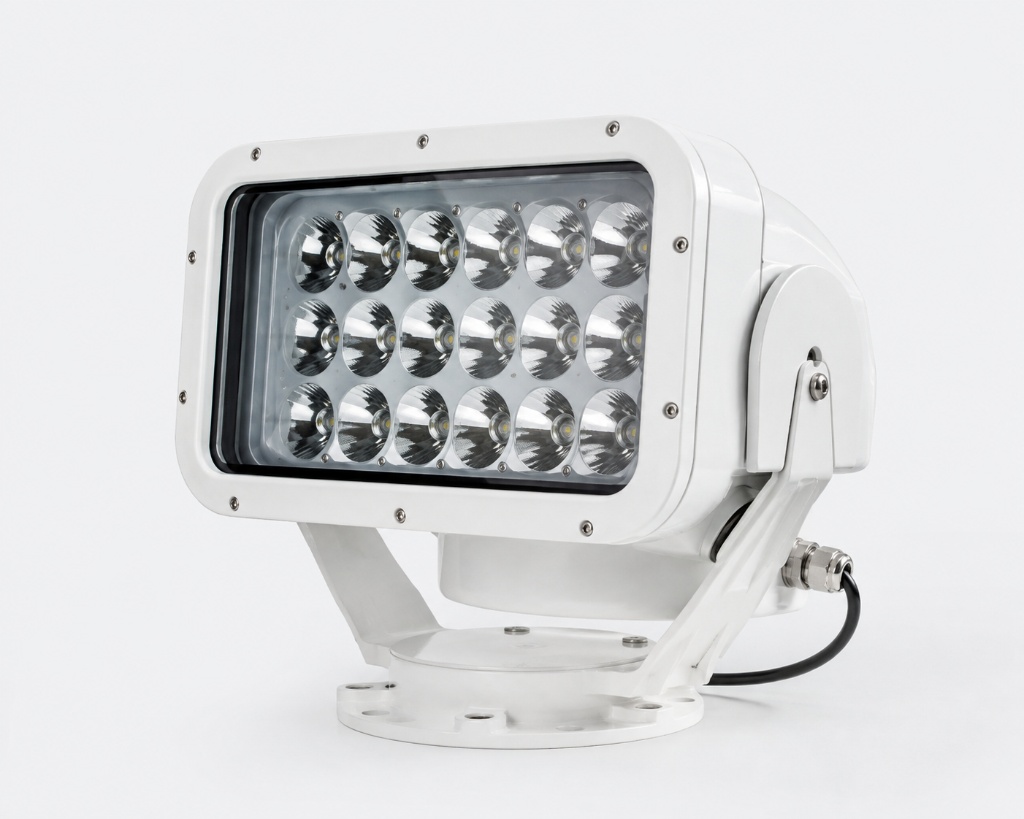
Tugboat searchlights are exposed to salt spray, rain, humidity, vibration, and temperature changes. However, the actual environmental load depends heavily on where the searchlight is mounted.
An exposed unit on a wheelhouse roof or mast may experience substantially more spray and weather exposure than a unit protected by the superstructure.
Procurement specifications should therefore include:
- IP protection
- Housing material
- Lens material
- Corrosion resistance
- Cable-entry design
- Sealing construction
- Fastener material
- Operating temperature
For example, Yushuo TZ6 uses a stainless-steel lamp body and toughened glass shade and is specified for operation from -30°C to +55°C.
Rather than evaluating an IP rating in isolation, buyers should ask the manufacturer for the relevant test basis and certification documentation, particularly for exposed installations.
5. Confirm Electrical Compatibility Before Ordering
Electrical compatibility is especially important when replacing an existing searchlight on an operating tugboat.
The procurement team should confirm:
- AC or DC input
- Rated voltage
- Frequency
- Power consumption
- Power factor
- Cable requirements
- Circuit protection
- Control-system compatibility
For example, Yushuo SD-5A/SD-5B series is available in AC220 V and DC24 V configurations, while the TZ2 operates at AC100–240 V.
For retrofit projects, physical dimensions alone should not determine compatibility. Existing breakers, cables, control panels, mounting arrangements, and vessel power distribution should also be checked before selecting the replacement.
6. Consider Remote Control Based on the Operating Position
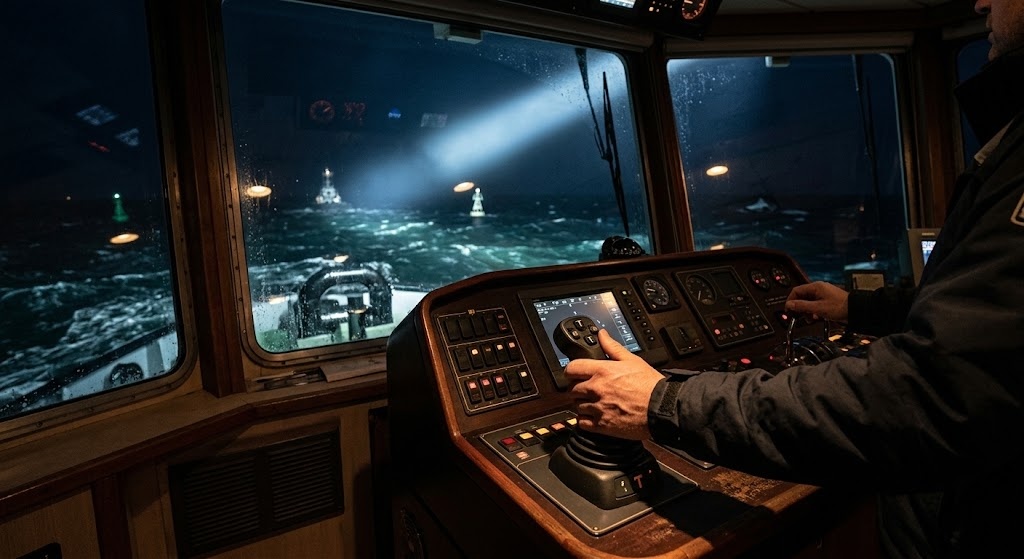
For a working tugboat, remote control is more than a convenience feature. It determines how effectively the crew can use the searchlight while operating the vessel.
A bridge-controlled searchlight should allow the operator to position the beam accurately without requiring access to an exposed deck or elevated mounting location.
Depending on the application, relevant functions can include:
- Pan and tilt control
- Beam focusing
- On/off control
- Dimming
- Preset positions
- Wired or wireless control
Yushuo’s SD-5A/SD-5B series, for example, provides wireless remote control with a stated control distance of up to 100 m.
The practical question is whether the control system allows the operator to adjust the beam quickly while maintaining a proper lookout and managing the tug’s maneuvering operations.
The IMO COLREG framework emphasizes maintaining a proper lookout using sight, hearing, and appropriate available means. Searchlight operation should therefore improve visibility without creating unnecessary distraction or glare.
7. Verify Certification and Project Requirements Early
The searchlight specification should be established alongside the vessel’s project requirements rather than after the model has already been selected.
Before requesting a quotation, buyers should confirm:
- Vessel flag
- Classification society
- Operating area
- New-build or retrofit
- Required certification
- Electrical specification
- Installation location
- Quantity and spare requirements
The IMO’s COLREG technical provisions include requirements concerning lights, shapes, and their positioning. Depending on the vessel and project, additional requirements may also come from the flag state, classification society, or shipyard specification.
For projects involving class requirements, buyers should also check the applicable DNV Rules and Standards or those of the vessel’s designated classification society.
Importantly, a high-intensity searchlight is an operational lighting device. It should not be specified or operated as a replacement for mandatory navigation or towing lights.
Conclusion
Choosing LED marine searchlights for tugboats should commence with the operational profile of the tug itself and not just a generic wattage or brightness specification.
The key considerations for procurement include beam power and spread, working distance, tow visibility, positioning distance, protection, electrics compatibility, control type, mounting criteria, and project requirements.
Providing these details to the manufacturer at the quotation stage allows the searchlight configuration to be matched to the vessel instead of selecting a model solely by LED power or advertised range.
For tugboat applications, the right marine searchlight is ultimately the one that provides the required visibility where and when the crew needs it, while remaining compatible with the vessel’s electrical, mechanical, and operating environment.er safety, and higher operational efficiency for today’s maritime tasks, which in practice helps crews respond faster and manage workloads more smoothly.
