
What Makes Marine Searchlights Effective During Maritime Rescue?
When a marine rescue mission commences, visibility can be the primary factor in determining whether the success of the rescue and long-running search. If it’s finding a person who’s in the water or locating floating debris or navigating a vessel that is disabled in the dark, the efficiency of a marine light directly affects how fast the rescue team is able to assess the situation and react.
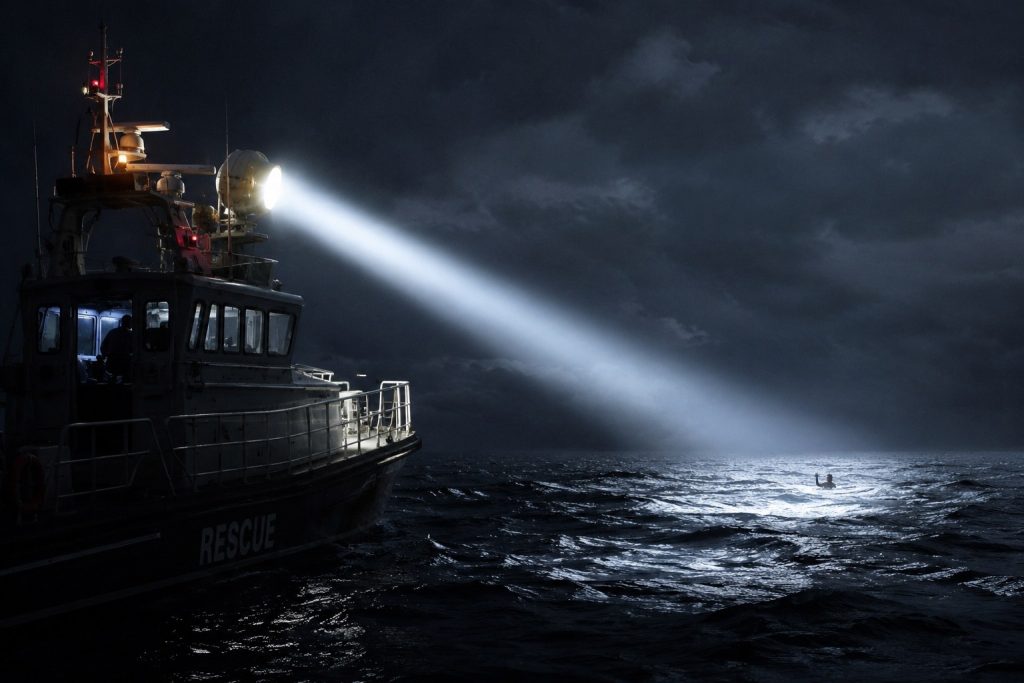
Many people evaluate searchlights based on measuring maximum beam distance as well as lumen output. But these specs do not necessarily reflect the actual performance. In rescue the effectiveness of a flashlight is determined by how it performs in changing conditions of weather, how easily users can manage it, and if it provides adequate visibility throughout the entire operation.
The following factors are the most influential factors on the performance of searchlights in marine rescue operations.
Table of Contents
Beam Quality Determines Whether a Target Can Be Identified
A beam that is long can only be beneficial if it can help rescuers understand the objects they are observing.
If long-distance visibility is a key requirement for your vessel, understanding how beam range and optical design work together is equally important. Learn more about marine searchlights for long-range illumination.
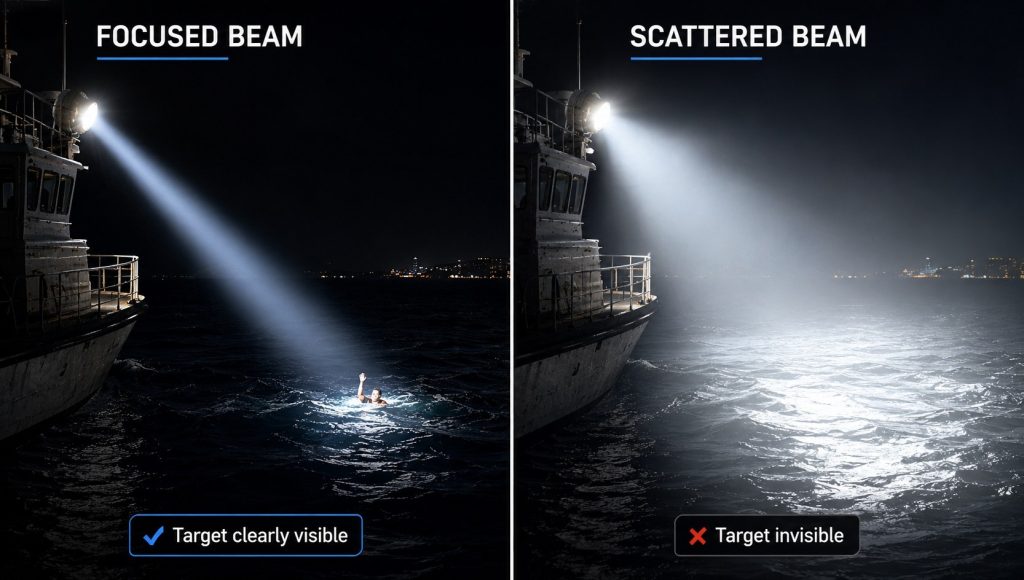
Two searchlights could both boast the range of beams that extend to 1,500 metres but produce completely different outcomes. One can produce a focused and uniform beam that clearly shows the outline of a person swimming in water and another produces scattered light that covers a vast area but gives only a few details.
Several optical characteristics influence beam quality:
- Uniform light distribution without dark spots
- A well-defined central beam for long-distance identification
- Minimal glare and light scattering
- Clear edge definition that helps distinguish objects from waves
To rescue teams, recognizing the target quickly is more crucial than simply directing light across a large distance.
Weather Conditions Can Significantly Reduce Searchlight Performance
Marine rescue is rarely carried out in the perfect conditions of weather. Rain fog, rain sea spray, rain, as well as high levels of humidity affect visibility and alter how light behaves.
For instance dense fog can scatter light before it hits the intended location in the event of heavy rain, and rough seas cause reflections that cause people or objects to be difficult to differentiate. The accumulation of salt on lens can cause optical distortion when equipment isn’t adequately protected.
This is why the performance of a marine searchlight should be assessed in the actual operating environment instead of relying on laboratory standards. A searchlight that has stable visibility in adverse weather conditions is usually more effective than one that offers a higher advertised output.
Beam Control Directly Affects Search Efficiency
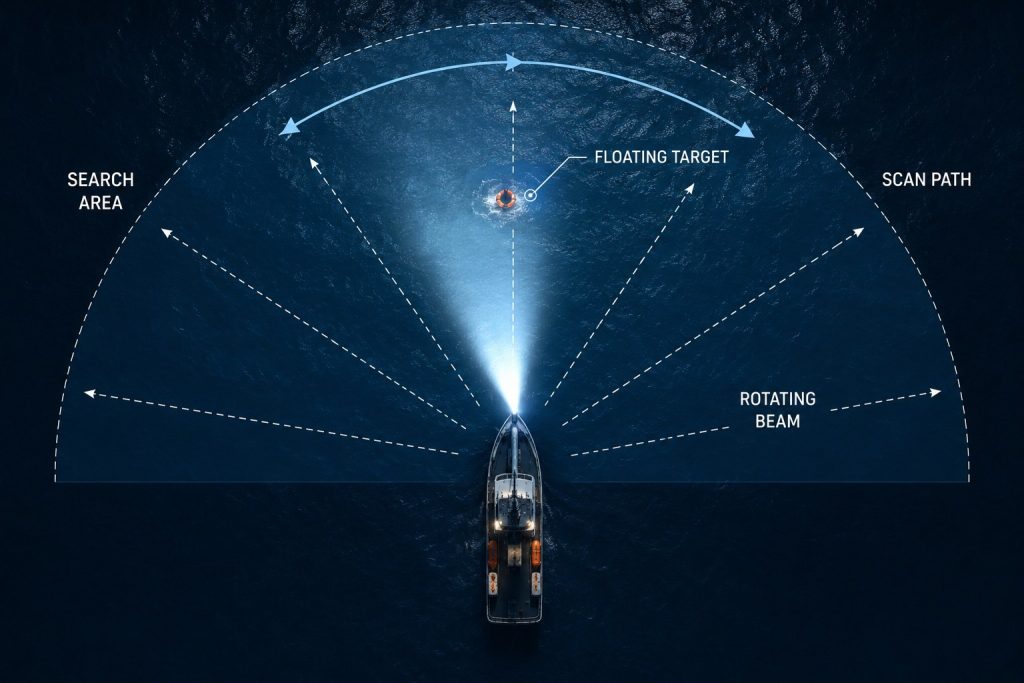
Finding a moving target requires more than a bright light source. Operators need to be able to guide the beam swiftly and precisely.
A slow rotation, insufficient horizontal adjustment or inadequate control accuracy can dramatically make it more difficult to scan an area. In turbulent seas, even minor delay in repositioning the beam could cause rescuers to miss the target.
A well-designed rescue flashlight should permit seamless horizontal movement, accurate vertical motion and steady positioning, so that the operators are able to continuously follow vessels, people or obstructions without interruption.
Stable Performance During Continuous Operation Is Essential
In contrast to normal navigation such as rescue missions, rescue missions might require a flashlight to be on for a long time.
In the course of prolonged usage, excess temperatures, a fluctuating electrical performance, or a decrease in brightness can cause a decrease in the visibility at times when the most. The marine searchlight must therefore have an even beam and brightness throughout the entire time instead of delivering only a brief period of the maximum output.
The long-term stability of operations is especially crucial for patrol boats operating offshore as well as emergency response vessels that often perform extended nighttime operations.
Installation Position Can Improve—or Limit—Performance
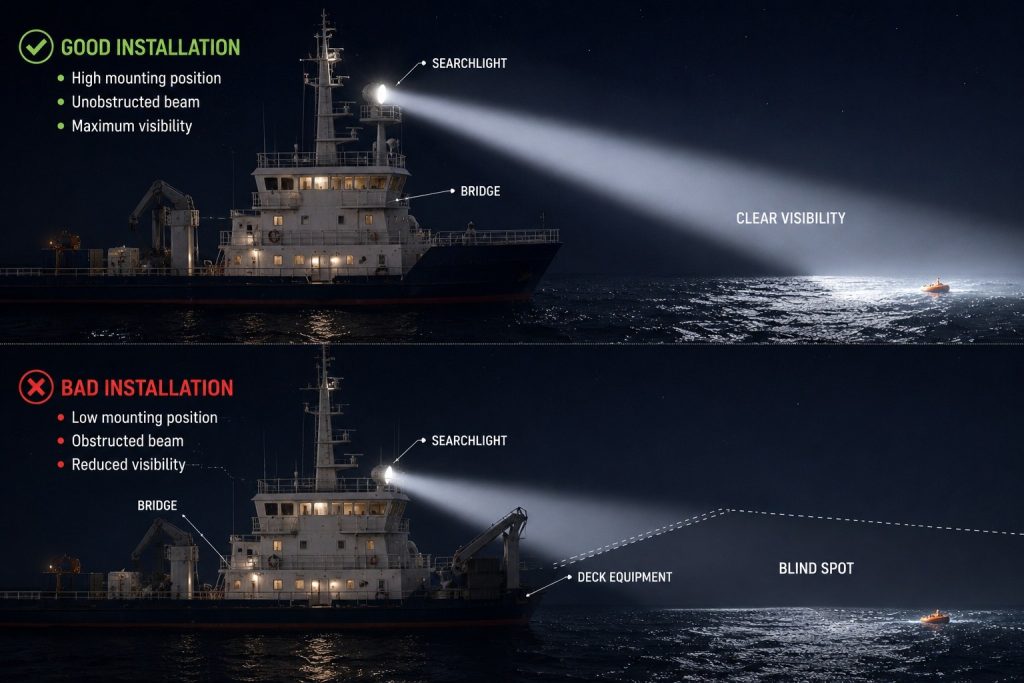
A high-end searchlight will not work effectively if placed in the wrong place.
A mounting location which is too low could let deck equipment or waves to block a portion or all of the beam. If it is placed in a position too near to bridges, reflections of light may cause glare which can affect the night vision of the operator. A poor placement can also cause blind spots on the vessel, which can reduce the search area.
The angle of installation, the height of the mounting, as well as surrounding structures must all be considered in the design of vessels or upgrade of equipment to ensure that the flashlight can be used to shine in the desired area without obstructions that are not needed.
Operator Experience Is Often an Overlooked Factor
The performance of a light is not just dependent on the light itself but also on the way it is utilized.
The most experienced operators are aware that different scenarios require different techniques for searching. A broad beam could be ideal for scanning water in close proximity however a focused beam is better to identify distant areas. The systematic search patterns assist in identifying the chance of missing areas and increase effectiveness during huge-scale operations for rescue.
Learning to teach operators about beam characteristics and search strategies could dramatically improve the efficiency of rescue without modifying the equipment itself.
Looking Beyond Technical Specifications
A lot of purchasing decisions are made based on the important specifications like the output of lumens or beam distance, or the power consumption. While these numbers can be valuable information but they don’t fully reflect the way a flashlight performs in a real rescue mission.
A more comprehensive evaluation should consider questions such as:
- Does the beam appear unobstructed in fog or rain?
- Can beam operators move the beam quickly and precisely?
- Will the searchlight be able to maintain its steady performance throughout extended operation?
- Does the system provide complete search coverage, without blind spots or glare?
- Does the beam pattern work to the mission of the vessel’s rescue?
The answers to these questions provide an accurate assessment of effectiveness rather than simply the comparison of technical specifications on their own.
Conclusion
A successful marine searchlight is the outcome of a variety of factors that work together instead of a single, impressive specification. Quality of beam, environmental adaptability and precise control, as well as continuous operational stability, correct installation and experience of the operator all contribute to the success of marine rescue efforts.
Knowing these aspects allows the owners of vessels and naval architects as well as procurement teams to evaluate the effectiveness of marine searchlights using actual operational results, not on claims made by marketing. The most efficient searchlight is one that aids rescuers in locating and locate targets quickly, efficiently and safely in the conditions that matter the most.
