
How to Test the Performance of Marine Spotlights
Marine spotlights are often put to use for navigation, search and rescue runs, docking guidance, and onboard safety. Since these spotlight work in rough marine surroundings, they really need to keep delivering reliable performance, even when saltwater gets involved, and vibration, rain, and those extreme temperature swings. That’s why performance testing is a key stage; it checks whether the spotlight actually works as expected, holds up physically, and meets marine requirements. If you know how to test marine spotlight performance, manufacturers, shipbuilders, and vessel operators ensure dependable operation at sea.
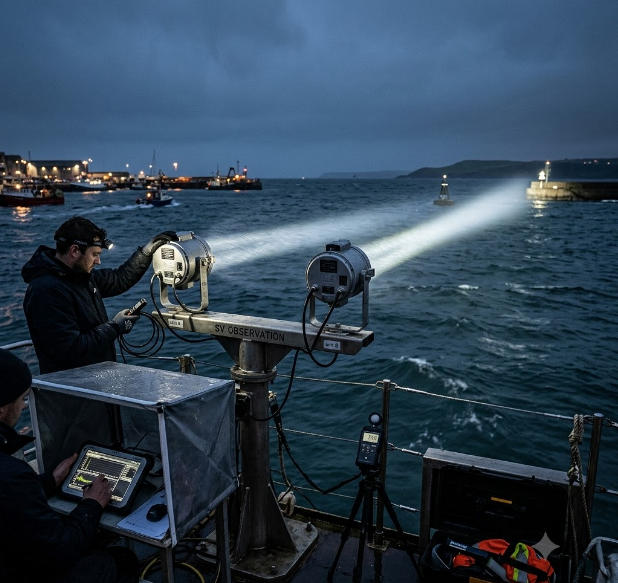
Table of Contents
Understanding the Purpose of Performance Testing in Marine Spotlights
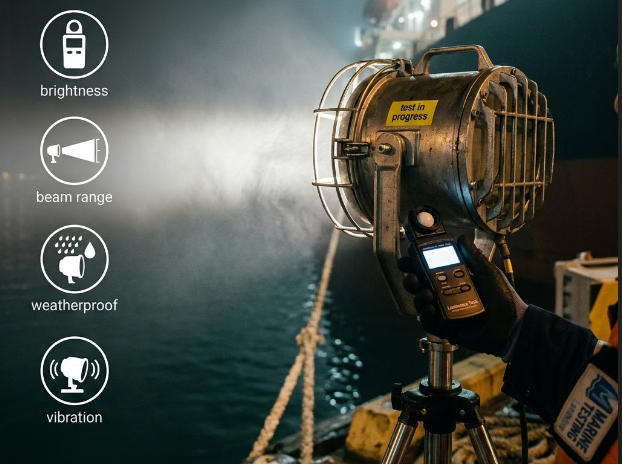
Before actually running any tests, it’s kind of important to set the performance criteria for the marine spotlight first. The testing effort is meant to judge a few central things, like light output, beam distance, how efficiently the power is used, whether it stays waterproof, how well it resists corrosion, its thermal behavior, and mechanical durability too.
The testing should try to mimic real marine working conditions as close as possible. The outcome gives useful clues about the spotlight’s reliability and also helps point out weak spots or improvement needs, before it gets installed on a vessel, for sure.
Key Aspects of Performance Testing in Marine Spotlights
1. Measuring Light Output and Beam Performance
Optical testing is one of the most important aspects of marine spotlight evaluation. T
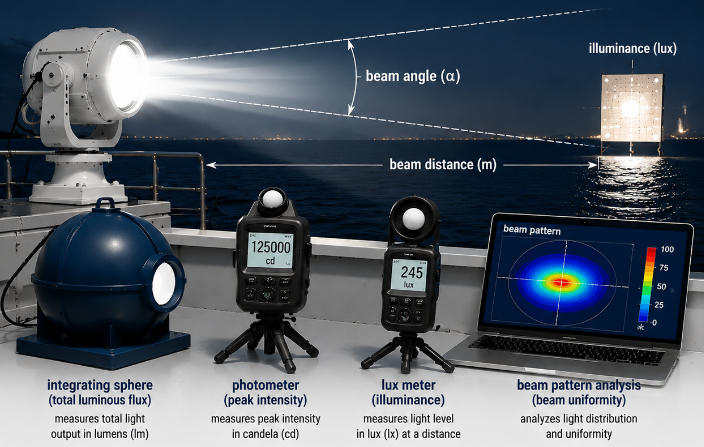
The following chart provides the primary measurements used to evaluate the light output and beam performance of marine spotlights, ensuring reliable visibility, navigation safety, and compliance with maritime operational requirements.
| Test Parameter | Purpose | Testing Method | Performance Indicators |
| Light Output (Luminous Flux) | Measure total amount of light emitted by the spotlight | Operate spotlight under standard conditions and measure total lumens produced | Lumens (lm), Light Efficiency |
| Light Intensity | Determine brightness at a specific point in the beam | Measure peak beam intensity at a fixed distance | Candela (cd), Peak Intensity |
| Illuminance | Evaluate how much light reaches a target surface | Record light level on a test surface at various distances | Lux (lx) at specified distances |
| Beam Distance | Verify maximum effective illumination range | Measure distance at which illumination reaches a predefined lux value | Effective Beam Range (m) |
| Beam Angle | Determine width of the light beam | Measure angle between beam edges at 50% maximum intensity | Beam Spread (°) |
| Beam Uniformity | Assess consistency of light distribution | Analyze illumination levels across the beam pattern | Uniformity Ratio |
| Edge Light Distribution | Evaluate illumination near beam boundaries | Measure light intensity at beam edges | Edge Brightness Consistency |
| Focus Adjustment Performance | Verify effectiveness of adjustable beam mechanisms | Test beam characteristics at different focus settings | Beam Width Variation, Focus Accuracy |
| Color Temperature | Assess light color characteristics | Measure emitted light spectrum | Correlated Color Temperature (K) |
| Color Rendering | Determine visibility and object recognition quality | Analyze spectral output and color reproduction capability | Color Rendering Index (CRI) |
| Optical Stability | Verify consistent optical performance over time | Conduct continuous operation and repeated measurements | Lumen Maintenance, Beam Consistency |
2. Evaluating Electrical Performance
Marine vessels often see power supply swings, so electrical checks are important. Here the spotlight is attached to a variable power source, which mirrors the working voltages commonly met aboard ships.
While the tests run, engineers watch current draw, power efficiency, and how steady the voltage stays. The spotlight should keep its brightness fairly consistent, without flickering or noticeable performance drop across the stated voltage span.
Besides that, extra electrical safety tests are carried out, focusing on insulation integrity, short-circuit protection, and how well the device resists electromagnetic interference. These checks help confirm a dependable and safe fit within marine electrical networks.
3. Conducting Waterproof and Moisture Resistance Tests
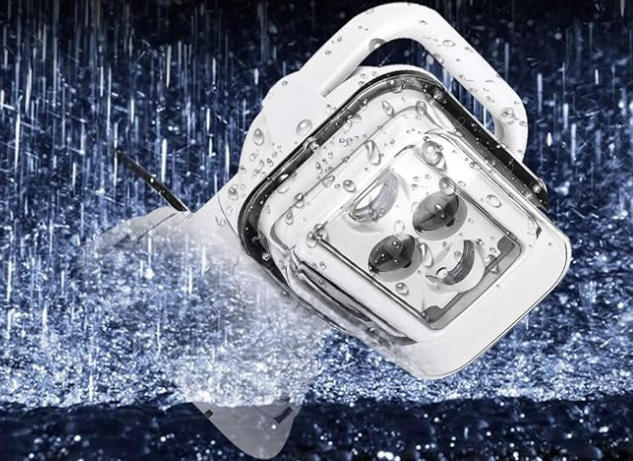
This chart offers the main waterproof and moisture resistance tests used for marine spotlights to ensure the lighting can withstand rain, sea spray, humidity, temporary immersion, and other harsh maritime environmental conditions.
| Test Type | Purpose | Testing Procedure | Evaluation Factor |
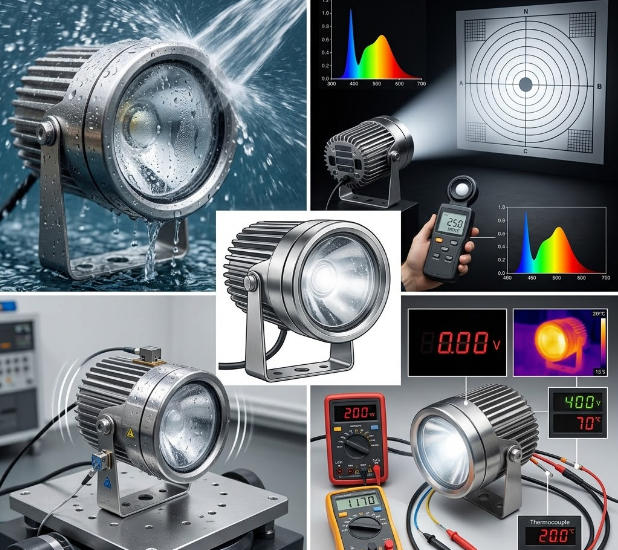
| Water Spray Test | Verify resistance to rain and sea spray | Expose spotlight to water spray from multiple directions for a specified duration | No water ingress, normal operation maintained |
| High-Pressure Water Jet Test | Assess protection against deck washdowns and rough marine conditions | Direct high-pressure water jets at the spotlight housing and seals | No leakage or damage to internal components |
| Immersion Test | Evaluate waterproof capability during temporary submersion | Submerge spotlight in water at specified depth and duration | No water penetration, full functionality retained |
| IP Rating Verification | Confirm compliance with specified ingress protection standards | Conduct tests according to IP code requirements (e.g., IP66, IP67, IP68) | Compliance with designated IP rating |
| Humidity Resistance Test | Assess performance in high-humidity marine environments | Operate spotlight in controlled high-humidity conditions | No condensation-related failures or corrosion |
| Condensation Test | Evaluate resistance to internal moisture buildup | Subject spotlight to temperature and humidity cycling | Lens remains clear, no internal moisture accumulation |
| Thermal Shock Moisture Test | Determine seal integrity during rapid temperature changes | Alternate between hot and cold environments with humidity exposure | No seal failure or moisture ingress |
| Seal Integrity Test | Verify effectiveness of gaskets and sealing systems | Inspect and test sealing components under pressure and moisture exposure | Seals remain intact and leak-free |
| Salt Fog and Moisture Test | Simulate combined exposure to saltwater and humidity | Expose spotlight to salt mist followed by humid conditions | No corrosion affecting waterproof performance |
| Drainage Performance Test | Ensure effective removal of external water accumulation | Expose spotlight to water and assess drainage efficiency | No standing water affecting operation |
| Lens Waterproof Test | Verify lens sealing against moisture intrusion | Subject lens assembly to water and humidity exposure | Clear optics with no internal fogging |
| Cable Entry Waterproof Test | Evaluate protection at wiring and connector interfaces | Expose cable glands and connectors to water and humidity | No moisture penetration through cable entries |
| Long-Term Moisture Exposure Test | Assess durability under prolonged humid marine conditions | Continuous exposure to elevated humidity levels over extended periods | Stable performance and corrosion resistance |
4. Testing Corrosion Resistance
Saltwater is aggressively corrosive, and it can shorten the service life of marine gear. Corrosion resistance testing looks at how long the spotlight materials last, and the effectiveness of protective coatings.
A salt spray chamber is commonly used to simulate long-term exposure to marine environments. The spotlight is exposed to a saline mist for an extended period while inspectors monitor for rust, coating degradation, discoloration, or structural damage.
Materials such as stainless steel, marine-grade aluminum, and specialized protective coatings are often selected based on the results of these tests.
5. Assessing Thermal Performance
Marine spotlights generate heat during operation, particularly high-power LED spotlights. Effective thermal management for the spotlight is necessary to maintain brightness and prevent premature component failure.
Thermal testing involves operating the spotlight continuously while measuring temperatures at critical locations within the housing. Engineers evaluate the efficiency of heat sinks, cooling systems, and ventilation designs.
Infrared thermal imaging is often used to spot hotspots and confirm that the component temperatures stay within safe limits for operation. A good spotlight design should keep its output steady, without accumulating too much heat, or drifting over time.
6. Performing Vibration and Shock Testing
Ships always deal with vibration coming from engines, machinery and wave contact. Marine spotlights need to endure those situations without failing prematurely.
During vibration testing, the spotlight goes through controlled frequencies and amplitudes that mimic actual conditions on a vessel. After the run, it is checked for loose parts, any structural harm, and optical misalignment. This is done so you can be confident the beam pattern remains correct later.
Shock testing looks at how well the spotlight handles abrupt impacts, like harsh seas, docking moves, or even accidental contact. These evaluations support the claim that the unit keeps mechanical stability, and can hold up over the years instead of just short-term use.
7. Verifying Long-Term Reliability
Life cycle testing gives valuable data about the spotlight’s expected service lifespan, and honestly it’s a big deal for what comes next. In this process, the spotlight runs nonstop for long stretches , sometimes hundreds or even thousands of hours.
During the test, engineers watch the light output, the color steadiness, how much power is used, and the temperature, the whole time. If there’s any drop in performance it can reveal weak points in LEDs, the drivers, the switches, or the mechanical parts.
For motorized spotlights, the rotating and tilting assemblies are repeatedly moved through their cycles, so they can check durability, wear resistance, and overall operational dependability over the long run.
Compliance of the Spotlights with Marine Standards
Compliance with these marine lighting standards demonstrates that the spotlights can withstand harsh maritime conditions, operate safely, and meet the requirements of shipowners, classification societies, and international maritime regulations.
| Standard / Regulation | Governing Organization | Scope of Compliance | Importance for Marine Spotlights |
| SOLAS (Safety of Life at Sea) | International Maritime Organization | Maritime safety equipment requirements | Ensures safe operation onboard commercial vessels |
| IEC 60598 | International Electrotechnical Commission | General safety requirements for luminaires | Verifies overall spotlight safety |
| IEC 60945 | International Electrotechnical Commission | Maritime navigation and communication equipment | Confirms suitability for marine environments |
| IEC 60529 (IP Code) | International Electrotechnical Commission | Ingress protection classification | Ensures resistance to water and moisture ingress |
| EMC Standards | International Electrotechnical Commission | Electromagnetic compatibility | Prevents interference with onboard electronics |
| Environmental Testing Standards | International Electrotechnical Commission | Environmental durability evaluation | Verifies long-term marine durability |
| Marine Type Approval | Lloyd’s Register | Certification for marine equipment | Demonstrates compliance for vessel installation |
| Marine Type Approval | DNV | Certification for marine and offshore equipment | Validates product reliability in marine service |
| Marine Type Approval | American Bureau of Shipping | Equipment approval for classed vessels | Supports acceptance by shipowners and shipyards |
| Marine Type Approval | Bureau Veritas | Certification of marine equipment | Confirms compliance with international requirements |
| Corrosion Resistance Standards | International Organization for Standardization | Material and coating durability | Ensures long service life in seawater environments |
| Electrical Safety Standards | International Electrotechnical Commission | Protection against electrical hazards | Enhances operational safety for crew members |
| Vibration and Shock Standards | International Electrotechnical Commission | Mechanical durability assessment | Ensures reliable operation onboard moving vessels |
Summary
When testing the performance of marine spotlights, you really want to look at optical output first, then also electrical stability, waterproof protection, and corrosion resistance, plus thermal management. On top of that, you check mechanical durability, because conditions at sea can be pretty rough. If you run these tests under operating conditions that feel realistic, manufacturers can verify their products meet the strict demands of maritime use. Strong performance testing not only enhances product quality but also supports navigational safety, improves operational efficiency, and keeps long-term reliability higher for vessels working offshore.
