
Low-Voltage vs. High-Voltage Navigation Lights: How to Choose
Navigation lights are a fundamental part of marine safety systems, making sure a vessel stays visible and correctly identifiable when its dark, foggy, or otherwise low visibility. The optical requirements are set by maritime regulations, but the electrical voltage side behind all of it also plays a big role in safety, overall performance, and the way the installation is actually designed. In general, navigation lights run either on a low-voltage DC system (12V / 24V) or on a high-voltage system (110V / 220V).
If you understand the difference between these two systems, vessel operators can then select the most fitting configuration for efficiency, compliance and operational safety.
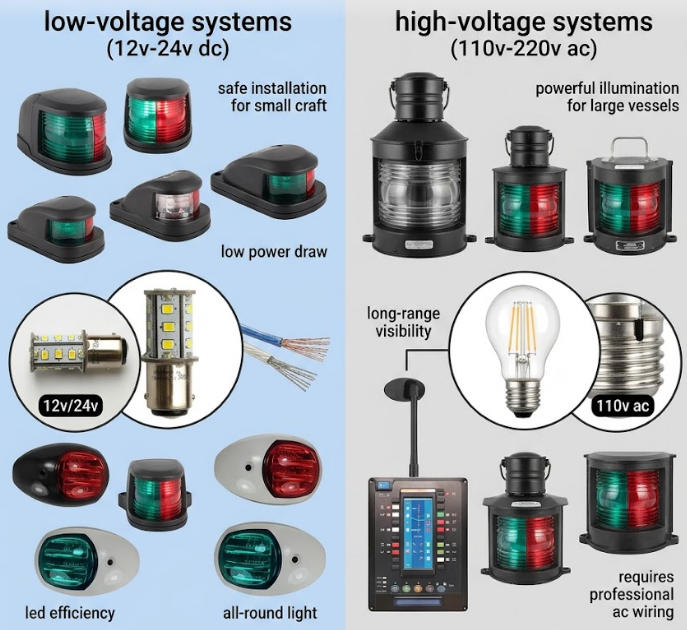
Table of Contents
Understanding Voltage in Marine Navigation Lighting
Voltage determines how power is delivered to marine navigation lights. It affects safety margins, wiring complexity, energy efficiency, and how well the lamps fit the electrical environment already onboard.
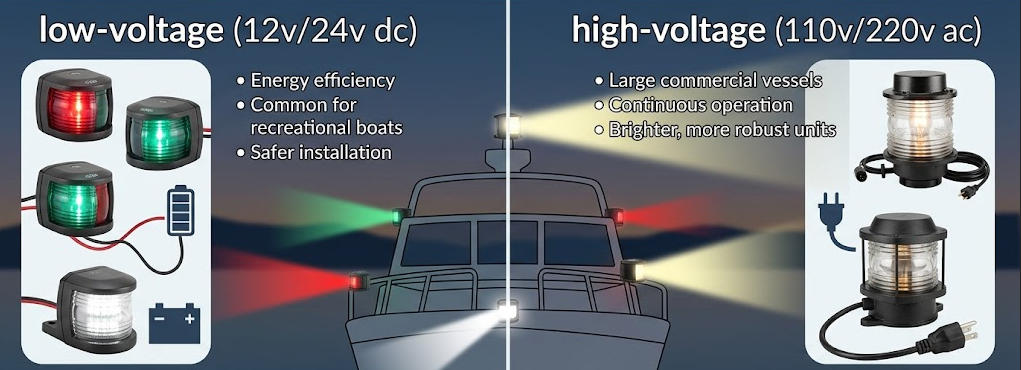
Most small and medium boats run on low voltage DC layouts, like 12V, or 24V, while bigger commercial ships may include higher voltage systems 110V/220V in the middle of a wider electrical routing network.
Understanding Low-Voltage Navigation Lights
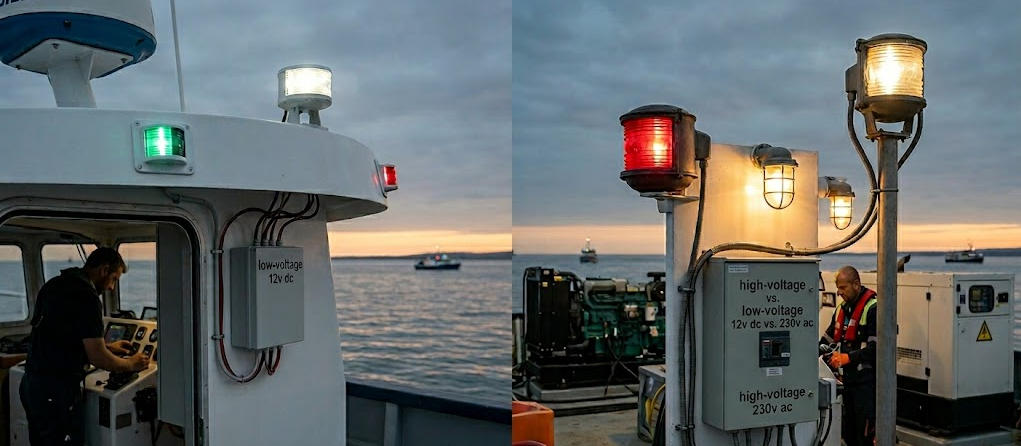
Low-voltage navigation lights are sea lighting units powered by low direct current (DC) electrical sources. They are usually stitched into the vessel’s onboard battery arrangement and meant to give clear signals for navigation, such as port (red), starboard (green), stern (white), and masthead lights. They are especially frequent in current vessels because they fit LED technology well, use less energy, and have safer electrical traits.
Advantages
- Safety in Electrical Systems: Low-voltage operation reduces the chance of electric shock compared to high-voltage setups. In turn, this tends to be safer for crew during installation, upkeep, and daily operation, in particular in wet marine surroundings.
- Energy Efficiency: Most low-voltage navigation lights rely on LED technology, it uses comparatively little power, which matters a lot. For battery-powered vessels energy saving becomes directly tied to how long the trip lasts and how steady the whole system stays.
- Compatibility with Modern Marine Batteries: These lights usually fit well with typical marine battery banks such as 12V, 24V, so you do not need extra voltage conversion gear, or at least not the complicated kind.
- Reduced Heat Generation: Low-voltage options tend to produce less heat, this helps component life and also lowers the chance of heat driven malfunctions, especially in cramped onboard spaces where ventilation is limited.
- Ease of Installation and Maintenance: The wiring approach is less complicated, and the parts are often more compact too. That in turn makes mounting faster and fault finding a bit easier, even when conditions are tight.
- Improved Reliability with LED Systems: low-voltage LED navigation lights tend to last a long while, they resist vibration pretty well and keep their performance steady even when marine conditions get really harsh.
Limitations
- Voltage Drop Over Long Distances: On larger vessels, low-voltage layouts can see a voltage sag across long cable runs. That can, in turn, lower light output if the wiring is not sized properly.
- Limited Power Capacity: These low-voltage setups are not ideal for very high power lighting requirements unless there is added conversion, or some extra reinforcement. That can reduce scalability when you move to larger ships.
- Dependence on Battery Health: Because the system depends on onboard batteries, performance may slip if the battery is weak, not well maintained, or simply not charged enough.
- Cable Thickness Requirements: To reduce electrical losses, thicker conductors might be needed for longer installs. That raises both cost and also the amount of space required during installation.
- Sensitivity to Electrical Faults: While generally safe, these low-voltage systems can still show performance hiccups because of corrosion, flimsy connections, or moisture getting in , which are common problems in marine settings.
- Limited Range Without Proper Design: Without careful electrical planning, the light output and even the signal legibility can be reduced , particularly when weather turns rough, or when long-distance viewing is needed.
Understanding High-Voltage Navigation Lights
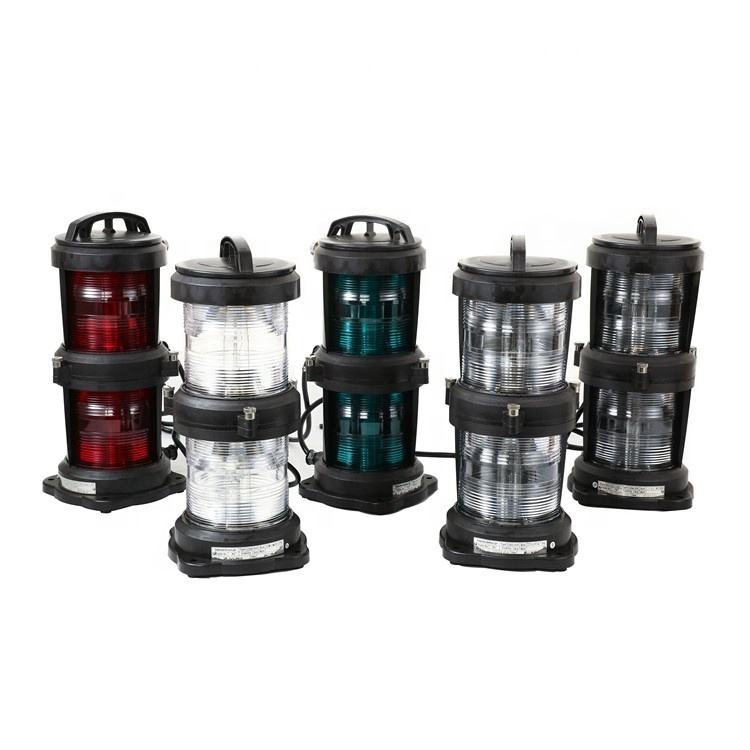
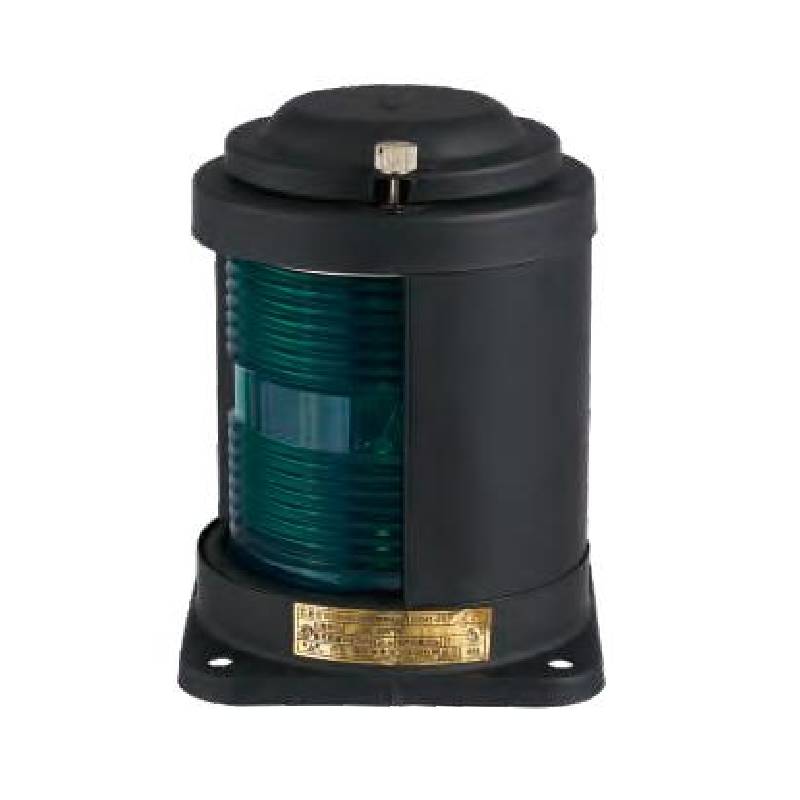
High-voltage navigation lights run straight from a ship’s main power distribution network rather than battery-based low-voltage setups. They typically rely on transformers, ballast circuits, or LED drivers to rework voltage levels and keep operation steady. In practice, they are built for longer throw power transmission and broader marine electrical arrangements.
Since they are integrated with onboard power plants or generators, they are especially useful on vessels needing steady high reliability across long passages.
Advantages
- Efficient Power Distribution over Long Distances: Using high voltage helps reduce the current even if the power output stays the same, which means less energy loss along the long cable routes. This is especially useful in large ships where the lighting is spread out across wide zones, not all connected in one compact area.
- Better Suitability for Large Vessels: They fit well for cargo ships, tankers, cruise liners, and naval units that already rely on high voltage AC distribution systems as a routine piece of their electrical setup. So the change is more natural, less disruptive to what is already there.
- Stable and Continuous Power Supply: Because the system is tied into the onboard main power network it does not rely on battery charge states. That keeps things consistent while at sea, even when the trip is very long or the operating profile shifts.
- Ability to Support High-Power Lighting Systems: With this arrangement, you can drive stronger lighting layouts and even several lighting circuits at once, without running into serious voltage drop worries.
- Reduced Cable Size for Equivalent Power: Higher voltage usually means lower current, so you can often get away with using thinner cables, even when the power has to travel the same distance like with low-voltage setups.
- Integration with Centralized Control Systems: These setups can be linked into ship-wide monitoring and automation routines, so you get remote diagnostics, quicker fault detection, and centralized switching all in one place.
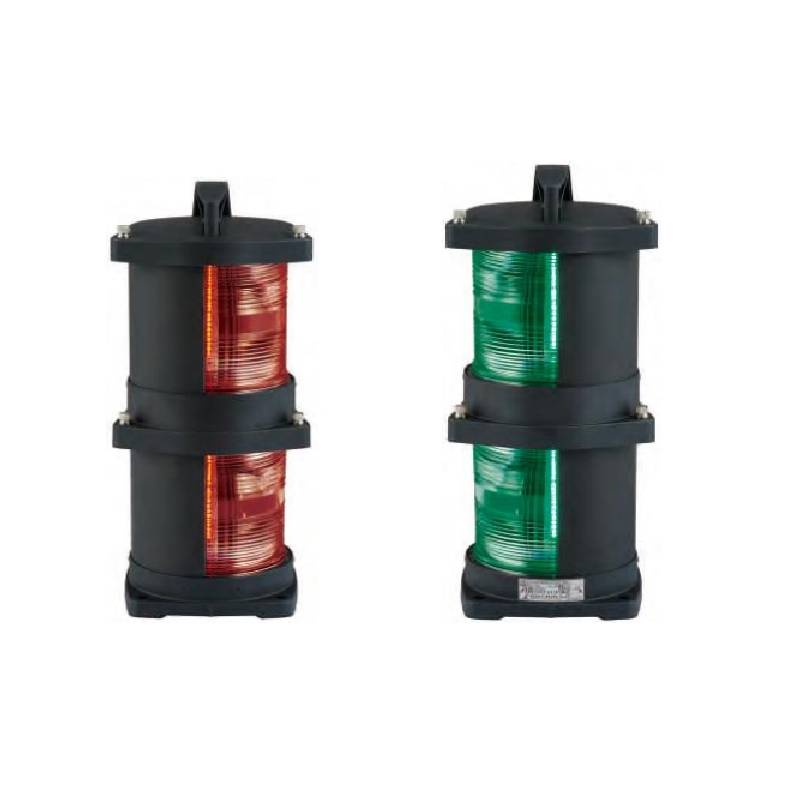
Limitations
- Increased Electrical Safety Risks: With high-voltage systems, the probability of electric shock and arc faults is higher, so you need stricter safety procedures, stronger insulation requirements and maintenance staff that are properly trained.
- More Complex Installation and Maintenance: Installation requires specialized electrical design, protective devices, and compliance with marine electrical regulations, making setup more complex than low-voltage systems.
- Higher Cost of Components and Protection Systems: Transformers, switchgear, insulation systems, and protective relays all push the initial budget up too, and they also drive ongoing maintenance expenses.
- Greater Heat and Insulation Requirements: High-voltage cables and the related equipment might need extra insulating layers and enhanced cooling planning, so that everything stays safe when installed in tight ship spaces.
- Risk of System-wide Impact from Faults: Electrical faults in high-voltage circuits can potentially affect larger sections of the vessel’s power system, requiring robust isolation and protection mechanisms.
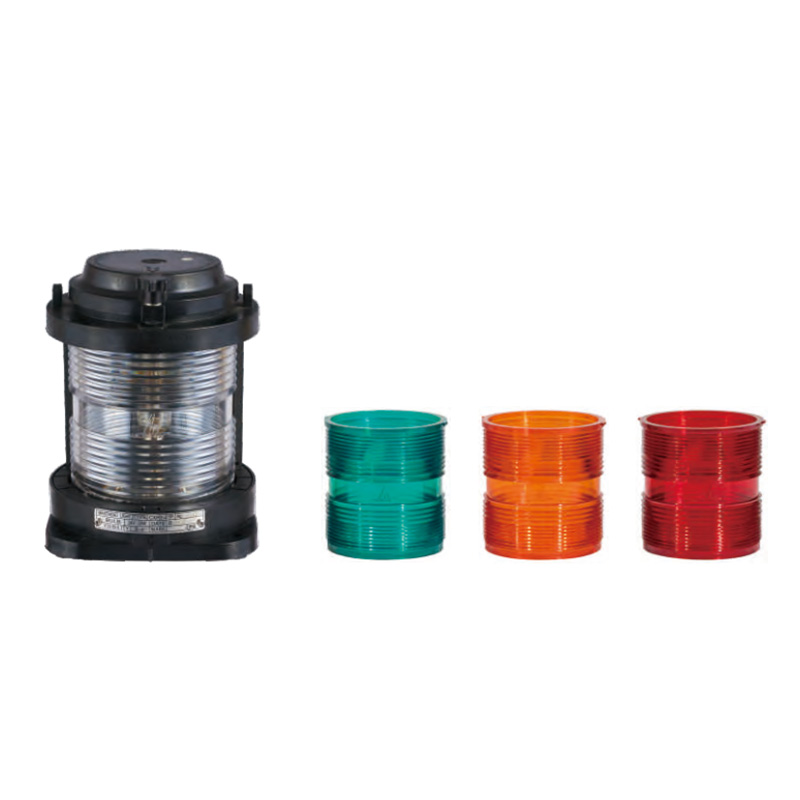
Key Differences Between Low-Voltage and High-Voltage Navigation Lights
| Aspect | Low-Voltage Navigation Lights | High-Voltage Navigation Lights |
| Operating Voltage | Typically 12V / 24V / 48V DC | Typically 110V / 220V AC or ship distribution voltage |
| Power Source | Battery-based onboard DC systems | Main ship power generators or AC distribution system |
| Primary Application | Small boats, yachts, small-to-medium vessels | Large commercial ships, tankers, cruise ships |
| Energy Efficiency | High efficiency (especially with LED systems) | Efficient over long distances due to lower current |
| Safety Level | Safer due to low voltage, reduced shock risk | Higher risk; requires strict insulation and safety controls |
| Installation Complexity | Simple wiring, easier installation | Complex system integration with switchgear and protection |
| Cable Requirements | May require thicker cables for long runs | Thinner cables possible due to lower current |
| Voltage Drop Issue | More likely over long distances | Less affected due to higher voltage transmission |
| Maintenance | Easier and lower-cost maintenance | Requires skilled technicians and safety procedures |
| Reliability Source | Dependent on battery condition | Stable supply from ship’s main power system |
| System Integration | Limited integration with central systems | Easily integrated into ship-wide control systems |
| Cost | Lower initial cost | Higher installation and equipment cost |
| Suitability | Best for small to medium vessels | Best for large-scale marine vessels |
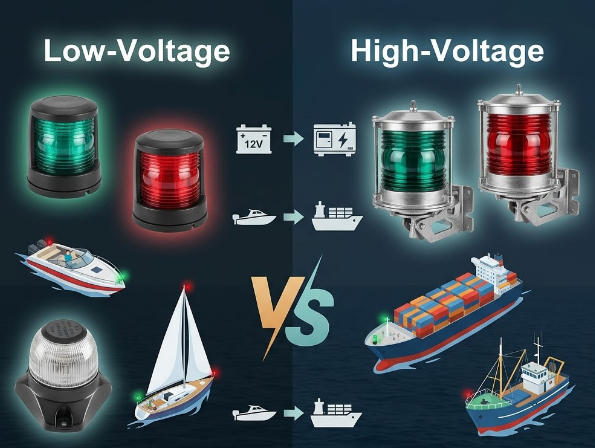
Key Factors to Consider for Choosing Between Low-Voltage and High-Voltage Navigation Lights
Each option of low-voltage and high-voltage navigation lights is built around a different electrical philosophy, and the right choice depends on multiple operational and design considerations.
1. Vessel Scale and Intended Operation
One of the first aspects to evaluate is the size and mission profile of the vessel. Smaller boats, yachts, and fishing vessels usually run compact onboard electrical systems that are naturally aligned with low-voltage lighting solutions. These arrangements are well-suited to short wiring runs and limited power draw aboard.
On the other hand, large commercial ships, tankers, and offshore platforms need lighting systems that can stretch across extensive structures and keep working reliably over long spans. In those cases, high-voltage navigation lighting becomes more practical because it supports broad distribution of electricity without excessive energy loss.
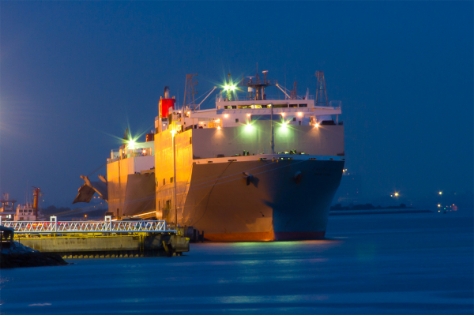
2. Electrical System Architecture on Board
The existing power setup of a vessel really steers the decision about lighting . Low-voltage navigation lights are usually slotted into DC battery systems, which you often see on smaller craft and in hybrid marine configurations. Those arrangements are fairly straightforward, also modular, so you can configure and service them without too much trouble.
High-voltage options tend to link with centralized AC power generation units, a pattern that shows up on bigger ships. Since these ships already depend on onboard generator plants plus distribution panels , the high-voltage navigation lights fit more naturally into the whole electrical web.
3. Safety Considerations in Marine Environments
Safety is always one of the primary concerns in marine electrical work. Low-voltage navigation lights create a safer working environment since the reduced electrical potential lowers the risk of electric shock, especially when conditions are wet or corrosive, which are common at sea. In practice this makes the installation and ongoing servicing less dangerous for crew members.
High-voltage setups , on the other hand, demand more strict safety protocols. Correct insulation, solid grounding, protective relays and personnel that are well trained are vital in order to stop electrical accidents. Even though these systems can be safe when they are engineered properly, they still require a higher degree of operational discipline.
4. Efficiency and Power Transmission Behavior
The efficiency of power delivery becomes more critical as a vessel gets larger. Low-voltage arrangements work well over short runs but can see energy losses when cables are routed across big sections of the structure. That situation may cause voltage drop and can weaken lighting output unless the whole system is carefully designed.
High-voltage systems manage to keep current down while still delivering the same power output, which really helps to reduce transmission losses, a lot. In practice this becomes especially useful for big vessels, where the navigation lighting circuits, often run across long cable stretches and the runs can become long-ish before they get back to the distribution point.
5. Installation Requirements and System Complexity
Low-voltage navigation lighting systems are usually easier to install. They need simpler wiring arrangements and fewer protective devices, so the installation time drops and the technical complexity feels smaller, overall.
High-voltage systems, on the other hand, depend on a more demanding setup. That can mean extra protective equipment, control panels, and in some cases voltage transformation gear. Because of this, the installation ends up being more involved and it typically means you need specialized marine electrical engineers.
6. Cost Structure and Lifecycle Investment
Cost is another important factor in decision-making. Low-voltage setups generally show lower upfront costs, and they tend to be more economical for smaller vessels. Their parts are widely accessible and easier to swap out, which can also help reduce those recurring maintenance expenses.
High voltage systems, on the other hand, come with a larger first investment because the electrical infrastructure is more sophisticated. Still, for bigger vessels, they may deliver stronger long-term efficiency and easier scaling, so the initial cost can be balanced during the ship lifecycle.
7. Reliability and Power Continuity
Reliability needs to change based on how the vessel is operated. Low-voltage systems rely heavily on the health of onboard batteries or other DC power sources. When battery performance declines, lighting stability can be impacted.
High-voltage systems usually have an advantage because they can connect directly to ship generators or the main power distribution network. That arrangement supports continuous and steady operation, especially on long voyages or during demanding offshore missions.
8. Integration with Modern Marine Automation Systems
Modern vessels are starting to lean on integrated monitoring and automation platforms more and more. In that kind of setup, low-voltage systems can be plugged in, yet in practice their capabilities tend to stay narrower, and often stay tied to local command. You end up seeing a lot of focus on immediate, on-site response rather than broad, ship wide oversight.
Meanwhile high-voltage navigation lighting systems are usually easier to weave into the centralized ship management environment. This allows remote watching, fault finding, and automated actuation tasks, which really helps when you manage large scale marine operations where everything needs to line up and stay consistent.
9. Environmental Conditions and Operational Demands
The marine world is harsh all the time, with moisture around, vibration in the background, salt in the air, and temperature swings that never fully stop. Low-voltage LED marine navigation lights typically keep working properly in those conditions, especially on smaller boats, where the environmental stress is spread out differently across equipment.
High voltage systems are built for industrial level marine settings where a solid infrastructure keeps electrical components safe, even when the conditions feel harsh. Whether they are a good match depends a lot on correct engineering and on environmental isolation that is done properly, not rushed.
Summary
- Low-voltage navigation lighting systems prioritize safety, efficiency, and simplicity, making them ideal for small to medium vessels.
- High-voltage navigation lighting systems focus on power distribution efficiency and scalability, making them suitable for large commercial and industrial ships.
- In most modern vessels, there is also a growing trend toward hybrid systems, where low-voltage LED navigation lights are powered through DC converters even in larger ships, combining efficiency with safety.
Final Thoughts
Low-voltage and high-voltage marine navigation lights each serve distinct roles in maritime operations. As marine technology keeps evolving, especially with LED adoption and smart power management systems, the field is slowly moving toward safer, more energy-friendly low-voltage lighting setups, even on bigger vessels.
