
Military Searchlights vs Commercial Marine Searchlights: What Are The Differences?
While the military searchlights as well as commercial marine searchlights each belong to the same category that comprises marine searchlights however, they were made for completely different purposes. For ship designers and marine equipment buyers as well as maritime engineering professionals, knowing the distinctions is crucial in deciding on the best lighting system that meets your particular operating requirements.
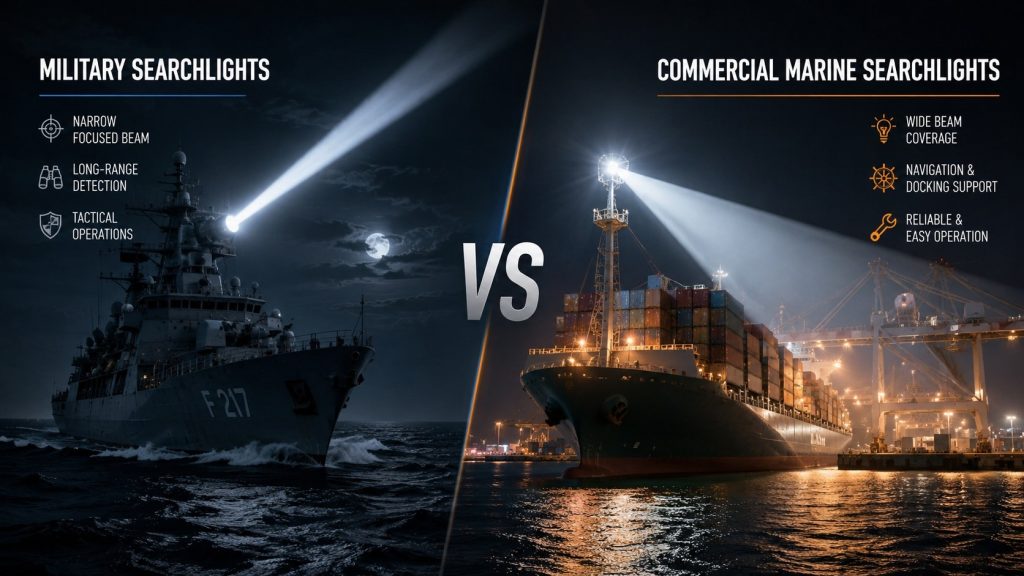
Table of Contents
Key Differences Between Military and Commercial Marine Searchlights
Despite the fact that both military and commercial marine searchlights are created with a view to enhancing vision at sea, there are significant differences in the design requirements of these devices.
Purpose and Operational Focus
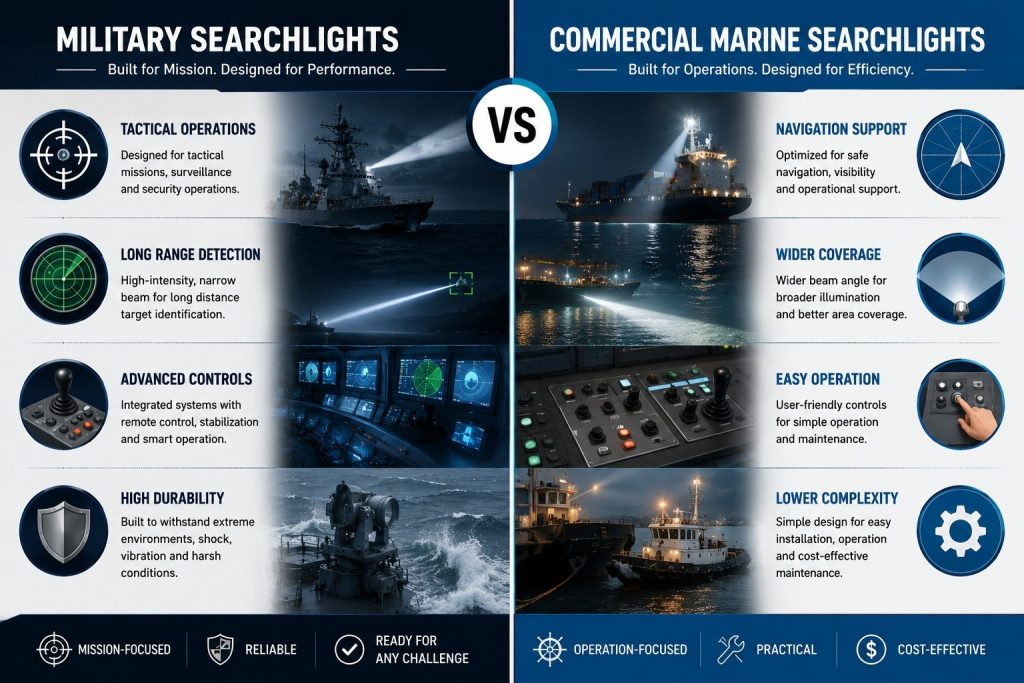
The main purpose of military lights is tactical assistance. It involves the usage of the searchlights to identify the targets, conduct surveillance, secure the coastlines and perform naval operations where fast threat detection is necessary.
Conversely, the main function of commercial marine searchlights is related to navigational and docking activities.
Beam Range and Precision
Military boats normally need capabilities to detect objects from a much larger range. That is why military searchlights tend to have very intense beams with a large luminous intensity to achieve better visibility over long ranges.
On the other hand, commercial boats have a certain balance between the distance of illumination and the area of illumination. That is why commercial marine searchlights usually have wide beams.
Control and Integration Systems
Modern naval searchlights often form part of the bridge management system and may comprise of remote control, stabilization features, and improved directional controls.
Commercial searchlights for marine use on the other hand tend to have more basic control systems designed for operational simplicity and ease of maintenance.
Structural Durability
In military operations, it is crucial that the equipment can withstand vibrations and shock forces. Hence, military searchlights are designed to be more mechanically durable.
Commercial searchlights are also developed for marine operations, where they can withstand corrosion and saltwater, although not as much as military equipment.
Cost and Lifecycle Considerations
Military systems often require deeper integration with vessel equipment and operational networks.
Commercial systems are typically easier to install, operate, and maintain.
| Feature | Military Searchlights | Commercial Marine Searchlights |
| Primary Mission | Tactical and security operations | Navigation and operational safety |
| Beam Performance | Long-range, high precision | Balanced range and coverage |
| Control Systems | Advanced and integrated | Standard and user-friendly |
| Durability | Enhanced shock and vibration resistance | Standard marine-grade protection |
| System Complexity | High | Moderate |
| Typical End Users | Navy, coast guard, patrol vessels | Cargo ships, ferries, tugboats |
| Cost Level | Higher | Lower |
Application Requirements Drive Design Priorities
Military searchlights are typically used for law enforcement and military tasks. They are typically mounted on patrol boats, as well as coast guard vessels. Their primary functions are detection of targets, surveillance from the surface illumination for tactical use, and security activities. In nighttime patrols or long-range observation missions searchlights are required to pinpoint targets and provide highly focused light.
However, commercial searchlights for marine use are commonly employed on cargo vessels as well as tugboats, tankers ferry boats, offshore vessels to support ships. They are used to aid in docking, detection of obstacles as well as man-overboard search. Commercial vessels use they are functional and safe tools instead of tactical equipment.
Simply stated, military applications concentrate on identifying and detecting targets, whereas commercial applications concentrate on ensuring the safe operation of vessels.
Procurement Decisions Should Be Based on Mission Requirements
A frequently made buying mistakes is to compare between two types solely on the brightness.
If a vessel is designed to be used for surveillance, patrol border security, patrol, or military purposes, the latest control systems as well as the long-range beam capabilities and robust design are typical military searchlights and naval searchlights are typically more appropriate to the requirements of operational use.
For ports operation, offshore supporting and other regular navigational tasks, commercial maritime searchlights typically offer a better efficient balance of efficiency, simplicity of operation and cost efficiency.
| Comparison Category | Military Searchlights | Commercial Marine Searchlights |
| Primary Purpose | Operational tactics and the identification of targets | Operational support and navigation |
| Beam Characteristics | Longer-range and narrower | Greater and more practical coverage |
| Control Systems | Advanced remote control and integrated controls | Standard control systems |
| Shock Resistance | Enhanced | Standard marine-grade |
| System Integration | More complicated | Relatively simple |
| Typical Users | Navy Coast Guard and patrol vessels | Cargo vessels, tugboats, offshore vessels |
Conclusion
From a technical standpoint, military searchlights as well as commercial marine searchlights are not intended to perform better than one another. they are designed to meet different operational goals. They are geared towards the performance of their tactical systems, the ability to target and environmental durability, commercial systems focus on the safety of navigation, operational efficiency as well as long-term reliability. Procurement professionals knowing the application-specific distinctions is more important than the comparison of brightness or power ratings by themselves.
