
How to Select a Marine Searchlight Based on Beam Distance
Marine searchlights are widely used on ships, boats, offshore platforms and other marine vessels. Their functions range from aiding nighttime navigation and spotting obstacles to assisting with emergency operations and search and rescue efforts. Marine searchlights used on vessels serve a different purpose than standard marine lights, in that they illuminate targets at longer distances and in harder-to-reach areas of the ocean.
An important factor when choosing a searchlight is beam distance. This is important as marine operations vary in their need for range, from small boat owners needing a searchlight with a range to see obstacles, to commercial boat operators and even those aboard offshore support vessels needing to illuminate long-distance hazards.
Choosing a marine searchlight based on beam distance requires properly understanding beam distance for searchlights, including beam intensity, light output, beam angle, environmental conditions, and operational requirements. This article explains how to evaluate these factors and select a suitable marine searchlight for different applications.
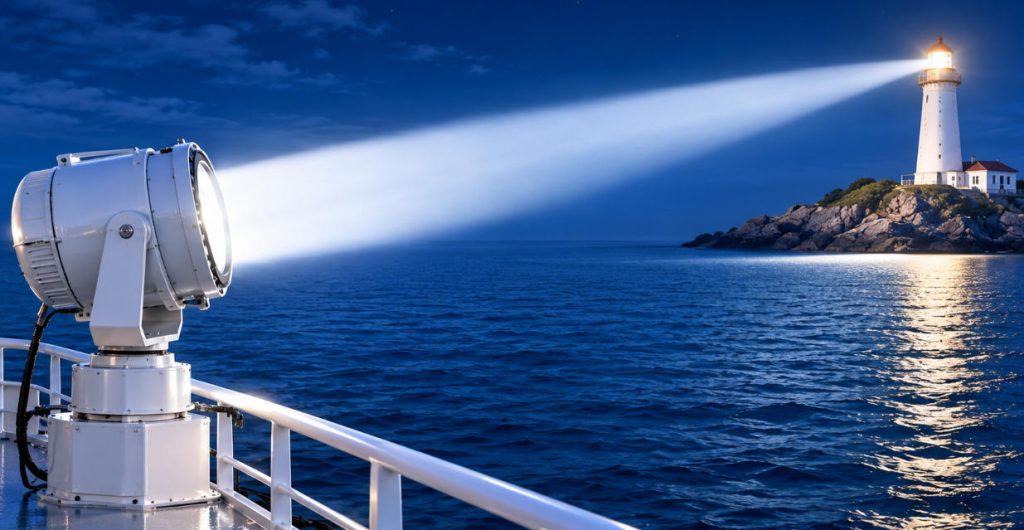
Table of Contents
Understanding What Beam Distance Means in Marine Searchlights
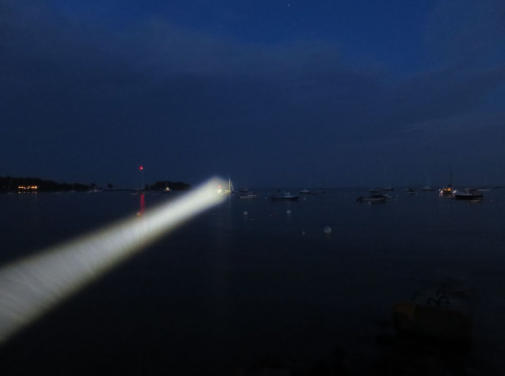
Beam distance refers to how far a searchlight can effectively illuminate an object or area. Because searchlights are an important tool used to spot hazards in dark conditions, beam distance is an important performance metric for determining how quickly hazards can be identified, and for navigation purposes.
It is a mistake to assume beam distance is a function of only wattage or brightness. Several other factors play a large role, including intensity and optical and reflector design.
In general, searchlights with a narrow, focused beam can light targets further away than searchlights with the same total brightness but a wider beam.
When considering beam distance, potential purchasers should also consider the maximum beam distance versus the practical working distance. In most cases, maximum beam distance is a calculation of when the light has dimmed to a certain point. The practical working distance is the distance at which an individual is able to recognize an object and is able to perform tasks.
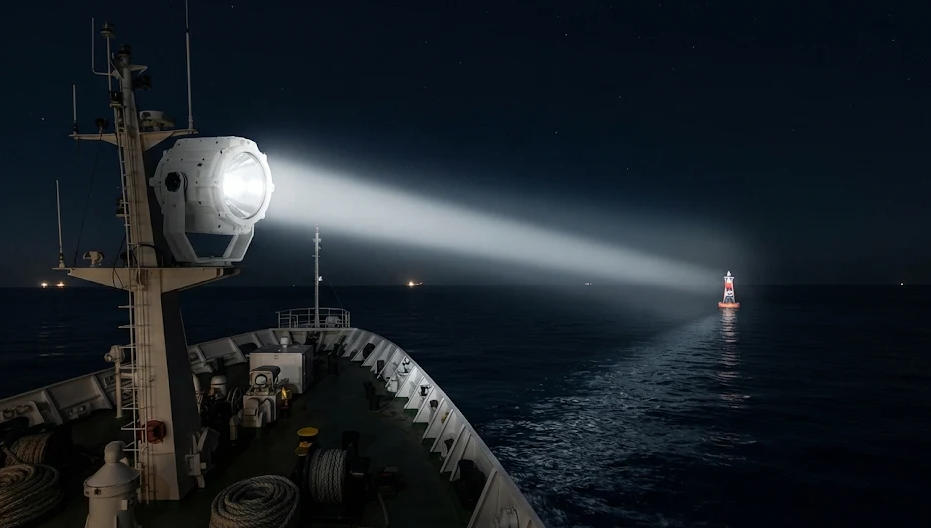
For marine use, maximum practical working distance is more important than the maximum beam distance that is advertised.
Key Considerations for Selecting a Marine Searchlight Based on Beam Distance
1. Identifying the Required Beam Distance for Different Marine Applications
The appropriate beam distance depends primarily based on the size of the boat and the working environment, the operating and navigation speed, and the type of work being conducted.
Lighting requirements can vary based on a vessel’s size and mission. Fishing boats on the coast need different lighting than a large cargo ship navigating heavily trafficked areas. Offshore vessels servicing offshore structures require long-distance searchlights to help illuminate far-away working zones.
Operators should determine the maximum distance they need to identify objects and hazards at before purchasing searchlights.
For example, shorter range searchlights can aid with looking at decks, lines and mooring areas. A medium-range searchlight is good for coastal cruising and finding nearby boats. A long-range searchlight is good for offshore cruising, searching for hazards and identifying distant targets.
Selecting a searchlight with the appropriate range avoids purchasing unnecessary equipment and spending more on power.
2. Beam Angle and Light Concentration
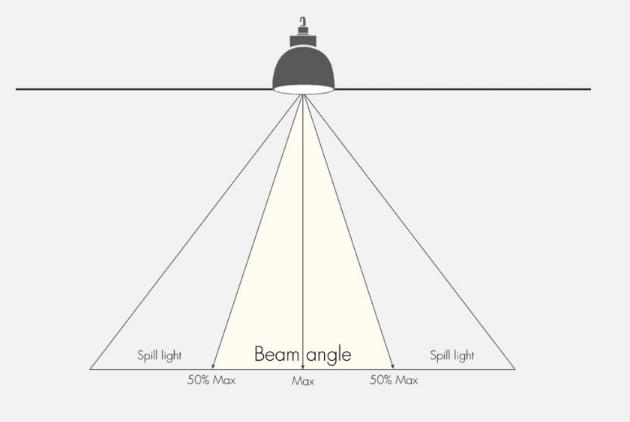
Operators should also think about beam angle when choosing marine searchlights. Beam angle represents the spread of light from the searchlight.
The design of searchlights is based on how they will be used and what the boat operators need to see. Beam angles in marine searchlights can be narrow, medium, or wide.
A narrow beam pattern illuminates a small area and works for long-distance targets. Narrow beams allow operators to see markers, ships, or other hazards far away.
A medium beam pattern offers both long-distance target illumination and distance coverage. It works for cruising and identifying targets far away.
The wide beam pattern illuminates a wide area and works for closer-distance target inspection, like decks, docking, or even closer targets.
Beam angles for specific operational needs can vary. Longer range, narrow beam searchlights may be better suited for boats that mainly work open ocean. A wide beam pattern searchlight may be better suited for boats that mainly work harbor environments.
3. Evaluating Luminous Intensity Instead of Relying Only on Wattage
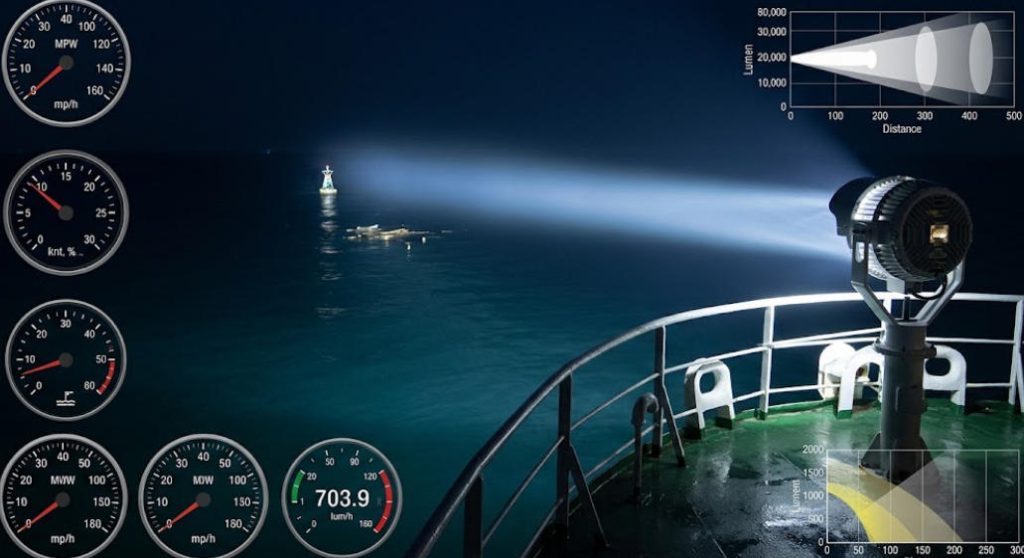
When comparing marine searchlights, buyers should pay attention to luminous intensity, which is commonly measured in candela (cd).
Luminous flux, measured in lumens (lm), indicates the total amount of visible light emitted by a light source. Candela measures the intensity of light in a particular direction.
For long-range marine searchlights, luminous intensity is especially important because it determines how effectively the light can illuminate a distant target.
Searchlights with high lumen ratings may have high beam distances; however, the light from these searchlights may have a tendency to spread across a large area. Because of this, the intensity of light produced is low when used at longer distances.
With the right design, searchlights with optics are able to output a concentrated beam that has greater long-range performance.
It’s better to look at candela, beam angle, and manufacturer beam-distance ratings than relying solely on wattage or lumens when selecting equipment.
4. Choosing the Appropriate Light Source
The type of light source will impact how your searchlight performs, how much energy it uses, the frequency with which maintenance will be needed, and how long the unit will last.
Different light sources provide varying benefits to short- and long-range illumination.
LED searchlights is energy efficient and maintenance is relatively low. Rapid start-up and the lack of a traditional high energy draw make them perfect for modern marine vessels.
Halogen searchlights have traditionally been used in marine applications because of their straightforward operation and familiar lighting characteristics. However, they generally consume more power and produce more heat than LED marine searchlights.
If high-intensity and high-power illumination is required, then xenon searchlights may be the right choice. However, as with other solutions, their maintenance and replacement costs should be weighed.
Operators must consider both the light’s intensity as well as its beam distance in real-world scenarios.

5. Accounting for Marine Environmental Conditions
Searchlights are used on vessels that operate in environments that are challenging in several ways: saltwater, humidity, high levels of vibration, high temperature, and high-velocity winds. These environments create issues for both lighting and equipment.
For example, when saltwater accumulates on optical lenses, it lessens the transmission of the light, thus shortening the distance of the light’s beam. Corrosion also impacts the mounting and mechanical parts.
As part of their purchasing process, buyers should evaluate equipment based on the marine-environment-specific attributes described below:
- Waterproof protection: Choose an appropriate IP protection level.
- Corrosion protection: Choose equipment with saltwater resistant coatings.
- Vibration protection: Equipment should be chosen based on the vibration profile of the vessel.
- Temperature protection: Equipment should be chosen based on the expected vessel operating temperature range.
- Optical protection: Choose protective lenses that resist moisture and dust.
A searchlight can have excellent specs for beam distance, but contamination or damage of its optics during operation will cause performance to be poor. Therefore, to ensure consistency of illumination, environmental durability must be built into the searchlight design.
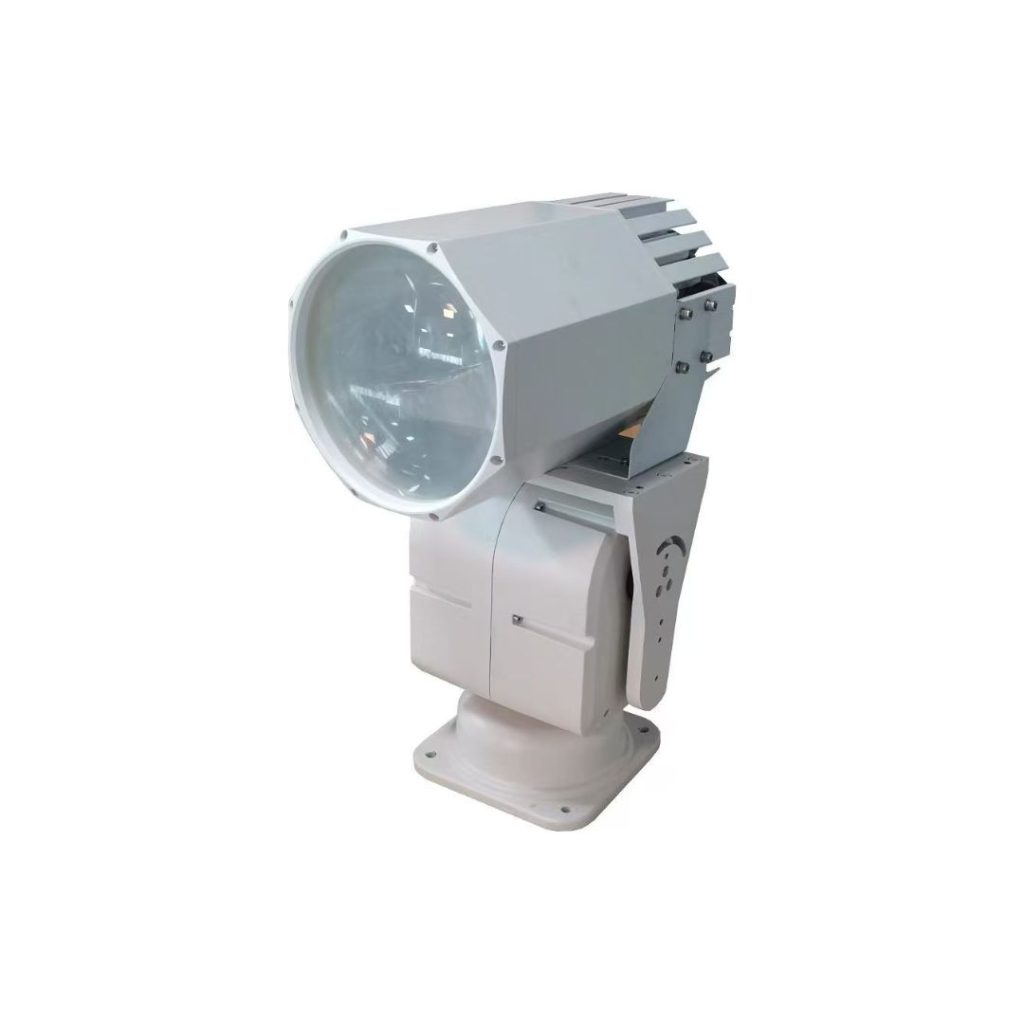
6. Considering Remote-Controlled Operation and Adjustment
Beam distance is important, but operators must also be able to direct the searchlight toward the correct target.
There are some use cases in the marine industry where the direction of the searchlight needs to be changed quite often. In such use cases, remote-controlled marine searchlights can improve the convenience of searchlight operations for their users. Marine searchlight users do not have to leave their station to change the vertical and horizontal angles of the searchlights.
Such a feature can be especially useful for larger vessels and support boats, patrol boats, search and rescue vessels, etc.
Remote control allows searchlight operators to change the direction of the beam and track moving objects or inspect different zones to meet the changing operating conditions.
When evaluating remote-controlled searchlights, buyers should take into consideration the searchlight’s rotation, elevation control, the response of control to users’ inputs, and control system operating distance, in addition to control system reliability.
A searchlight having excellent specs for beam distance might not be as operationally flexible as a remote-controlled marine searchlight with good beam performance and some limited adjustment capabilities.
7. Matching Beam Distance to Vessel Type and Operating Requirements
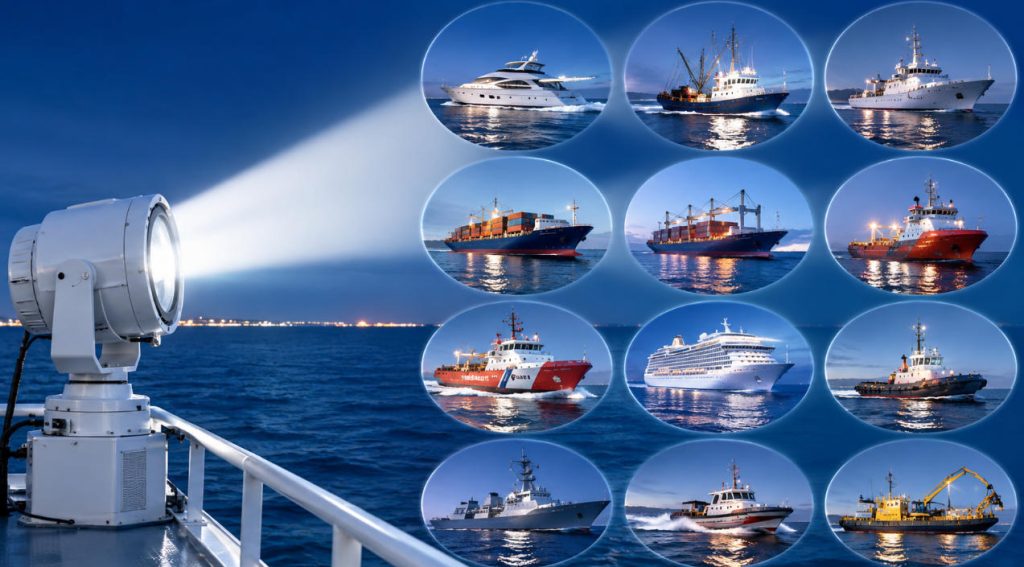
Different vessels have different illumination requirements. Selecting the correct marine searchlight requires matching its beam distance and optical characteristics to the vessel’s size and primary operations.
| Vessel Type | Operating Environment | Recommended Beam Distance | Suitable Beam Characteristics | Applications |
| Small Recreational Boats | Lakes, rivers, and coastal waters | 100–300 m | Wide to medium beam, adjustable direction | Docking, identifying nearby obstacles, and nighttime navigation |
| Fishing Boats | Coastal and offshore fishing areas | 200–500 m | Medium to long-range beam with good coverage | Illuminating fishing areas and detecting nearby vessels |
| Patrol Boats | Coastal waters, ports, and security zones | 500–1000 m | Narrow, concentrated beam with remote control | Surveillance, vessel identification, and security patrols |
| Cargo Ships | Commercial shipping routes and busy ports | 500–1000 m | High-intensity beam with medium-to-long-range coverage | Detecting navigation hazards and identifying nearby vessels |
| Container Ships | Open seas and commercial shipping channels | 500–1200 m | Powerful, focused beam with adjustable elevation | Nighttime navigation and obstacle detection |
| Offshore Support Vessels | Offshore platforms and oil and gas fields | 500–1500 m | Long-range, high-intensity beam | Inspecting offshore structures and supporting marine operations |
| Search and Rescue Vessels | Open waters and emergency response areas | 500–1500 m or more | Narrow, powerful beam with flexible directional adjustment | Locating people, lifeboats, and floating objects |
| Passenger Ships | Coastal routes, ports, and open waters | 200–600 m | Medium beam with balanced illumination coverage | Navigation assistance and nighttime inspections |
| Tugboats | Harbors, terminals, and nearshore waters | 200–500 m | Adjustable medium-range beam | Illuminating towing equipment and nearby vessels |
| Naval and Security Vessels | Open seas and restricted maritime areas | 1000–2000 m or more | Highly concentrated long-range beam with precise control | Long-distance surveillance and target identification |
| Pilot Boats | Harbors, channels, and coastal waters | 300–600 m | Medium-to-long-range beam with flexible adjustment | Identifying vessels and assisting pilot transfers |
| Dredgers | Ports, rivers, and dredging construction sites | 200–500 m | Medium beam with broad working-area coverage | Illuminating dredging equipment and surrounding work areas |
Selection Recommendations
- Small vessels: Prioritize compact, energy-efficient searchlights with sufficient short-to-medium beam distance.
- Commercial vessels: Choose reliable medium-to-long-range searchlights for navigation and obstacle detection.
- Offshore vessels: Consider high-intensity searchlights with long beam distances and corrosion-resistant construction.
- Rescue and patrol vessels: Prioritize concentrated beams, high luminous intensity, and remote-controlled directional adjustment.
These recommendations are general selection guidelines rather than fixed distance specifications. Actual requirements should be determined according to vessel operating conditions, navigation procedures, and applicable marine regulations for searchlights.
Common Mistakes to Avoid When Selecting Marine Searchlights Based on Beam Distance
Some buyers focus too heavily on maximum beam distance while overlooking other factors that influence actual lighting performance.
| Common Mistakes | Why It Is a Problem | Potential Consequences | How to Avoid It |
| Focusing Only on Maximum Beam Distance | Maximum distance does not always represent practical illumination performance | Objects may be difficult to identify clearly at the advertised distance | Evaluate practical working distance and the required illumination level |
| Ignoring Beam Angle | A narrow beam provides long-distance illumination but covers a smaller area | Nearby obstacles and surrounding areas may remain poorly illuminated | Select a suitable beam angle based on navigation and operational requirements |
| Choosing Based Only on Wattage | Higher power consumption does not necessarily mean greater luminous intensity | Unnecessary energy consumption without improved beam performance | Compare luminous intensity (candela), luminous flux (lumens), and optical efficiency |
| Overlooking Luminous Intensity | Total light output alone cannot determine long-range illumination capability | Insufficient brightness when illuminating distant objects | Check candela ratings and manufacturer photometric data |
| Selecting an Inappropriate Light Source | Different light sources have different efficiency, brightness, and maintenance characteristics | Higher operating costs or inadequate lighting performance | Compare LED, halogen, and xenon technologies according to application requirements |
| Ignoring Vessel Size and Operating Environment | Different vessels require different illumination distances and coverage | Searchlights may be unsuitable for actual working conditions | Match beam distance to vessel type, operating speed, and navigation environment |
| Neglecting Environmental Protection | Marine equipment is exposed to saltwater, humidity, vibration, and temperature changes | Corrosion, water ingress, and reduced lighting performance | Choose marine-grade materials and appropriate waterproof and corrosion-resistant protection |
| Overlooking Remote-Control Functions | Operators may have difficulty directing fixed or manually adjusted searchlights | Delayed target identification and reduced operational flexibility | Consider remote-controlled horizontal and vertical adjustment |
| Ignoring Power Consumption | High-power searchlights may place additional demands on vessel electrical systems | Increased energy consumption and potential electrical system overload | Check voltage, rated power, current requirements, and vessel power capacity |
| Relying Only on Advertised Specifications | Manufacturers may use different testing conditions to calculate beam distance | Misleading comparisons between different searchlight models | Request photometric reports, beam-pattern information, and standardized test data |
| Choosing an Excessively Narrow Beam | Concentrated light may illuminate distant targets but provide limited surrounding coverage | Reduced visibility of nearby objects and obstacles | Balance long-range illumination with adequate surrounding-area lighting |
| Overlooking Maintenance Requirements | Dirty lenses, damaged seals, and aging light sources can reduce performance | Shorter service life and declining illumination distance | Choose easy-to-maintain designs and establish regular inspection and cleaning procedures |
Final Thoughts
Selecting a marine searchlight based on beam distance requires more than simply choosing the model with the longest advertised range. Factors to consider are actual operating distance, beam angle, luminous intensity, light source, environmental protection, and vessel-specific requirements.
Short-range searchlights are suitable for nearby inspections and docking operations, while medium-range models support general navigation and coastal activities. Long-range searchlights are more appropriate for offshore operations, patrol activities, and search and rescue applications.
A well-selected marine searchlight should provide sufficient illumination distance, appropriate beam coverage, reliable operation, and convenient directional control. By carefully evaluating these factors, vessel operators can improve nighttime visibility, support safer marine operations, and achieve better long-term equipment performance.
Ultimately, the best marine searchlight is not necessarily the one with the longest beam distance, but the one that delivers the right illumination performance for the vessel’s actual working conditions.
