How Marine Searchlights Are Tested for Waterproof Reliability
When applied in marine engineering, marine searchlight needs to withstand various kinds of stress for a long time, such as salt spray corrosion, high humidity, sudden temperature change, and mechanical vibration. As a result, the water resistance of marine searchlight cannot be assessed by simply using one kind of “protection level” but should use an engineering verification system from multiple dimensions.
Based on the engineering reliability viewpoint, the key point of the waterproof test does not lie in the “absence of water penetration” but lies in the assessment of the stability of sealing structure.
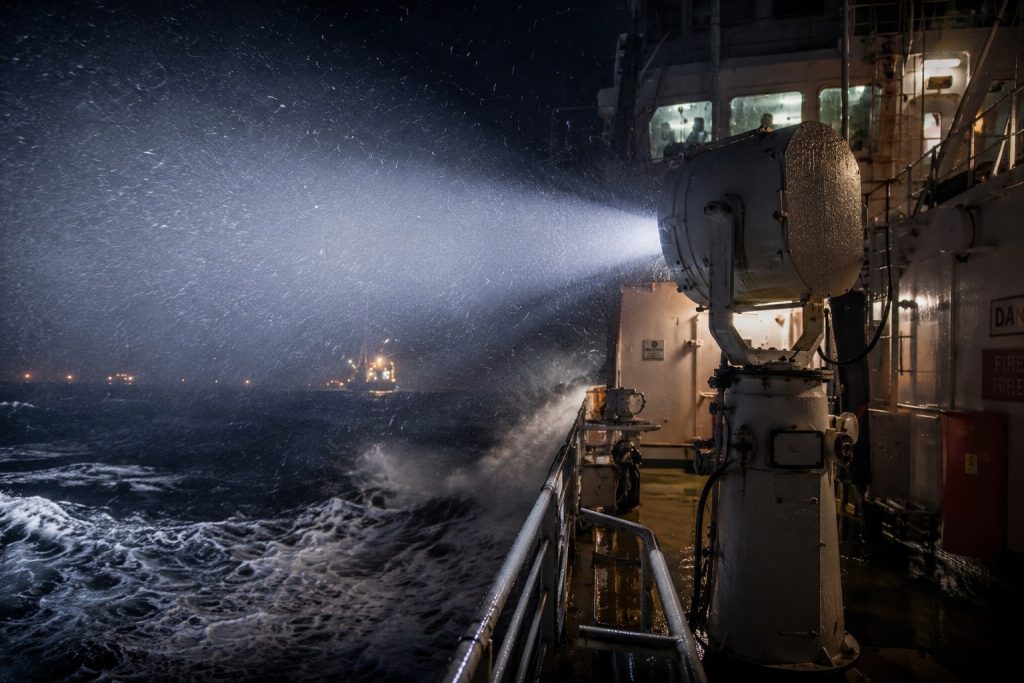
Table of Contents
IP Ingress Protection Testing: The First Layer of Basic Sealing Validation
The classification of IP ratings is done by International Electrotechnical Commission (IEC) 60529. These ratings measure the protection provided by the enclosure from solid objects and liquid entry.
In marine searchlights, common ratings include:
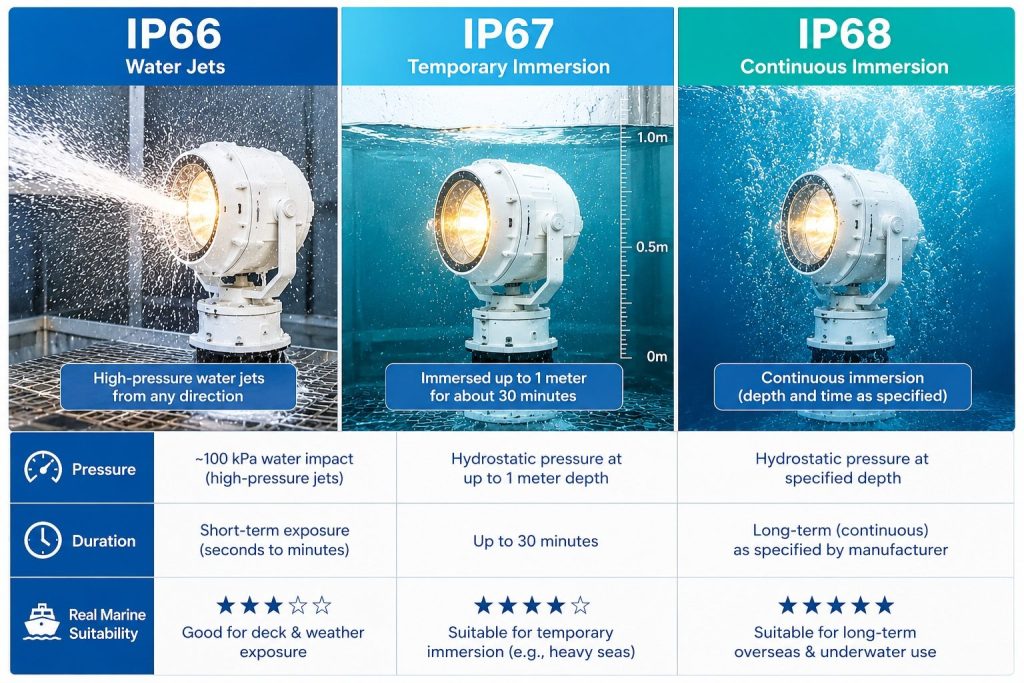
- IP66: Resistance to high-pressure water jets (~100 kPa water impact)
- IP67: Temporary immersion in up to 1 meter of water for about 30 minutes
- IP68: Continuous immersion (depth and duration specified by the manufacturer)
Engineering Key Point
IP testing is fundamentally a static-condition validation method, characterized by:
- Stable water pressure
- Constant temperature (typically 15–25°C)
- No vibration
- No salinity
- No thermal cycling
Therefore, even if a product passes IP67 testing, it does not guarantee long-term reliability in real marine environments.
Common Failure Modes (Engineering Reality)
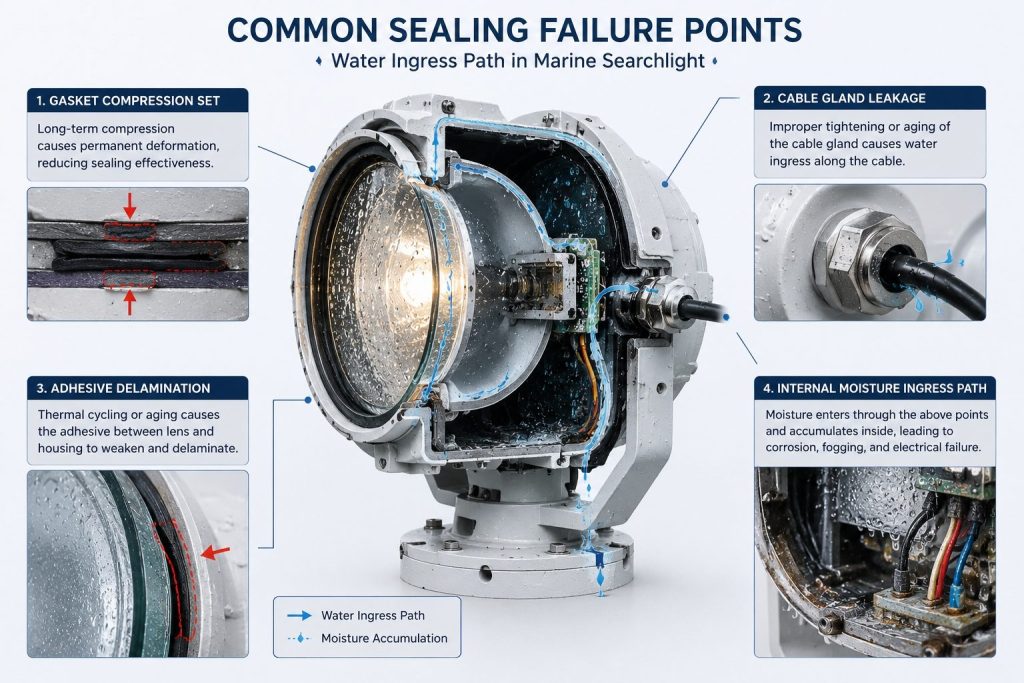
Even products that pass IP testing may still experience:
- Compression set of sealing gaskets (>25% permanent deformation)
- Micro-gap leakage at cable entry points
- Thermal-induced delamination of lens adhesive layers
This is clear evidence that IP ratings are merely basic requirements, and not complete indicators of reliability.
Salt Spray Corrosion Testing: A Core Method for Material Durability Evaluation
Salt spray tests are typically performed using ASTM B117 standards. This test makes use of a 5% solution of sodium chloride at 35°C.
Typical Engineering Parameters
- Salt deposition rate: 1–2 mL / 80 cm² / hour
- Temperature: 35°C ±1°C
- Exposure duration: 240h / 500h / 1000h / 2000h (depending on grade requirements)
Engineering Purpose
Salt spray testing is not intended to predict service life, but to:
- Compare coating system performance
- Identify early corrosion sensitivity
- Evaluate electrochemical corrosion risks in fasteners and housings
Typical Failure Modes
- Pitting corrosion in aluminum housings
- Coating blistering and peeling
- Crevice corrosion in stainless steel components
- Salt crystallization-induced seal degradation
In real engineering practice, corrosion-related degradation often occurs before actual water ingress failure.
Thermal Cycling Testing: Structural Stability Under Thermal Stress
Marine equipment operates across different climate zones, often experiencing extreme temperature variations.
- Standard Test Conditions (Typical Industrial Range)
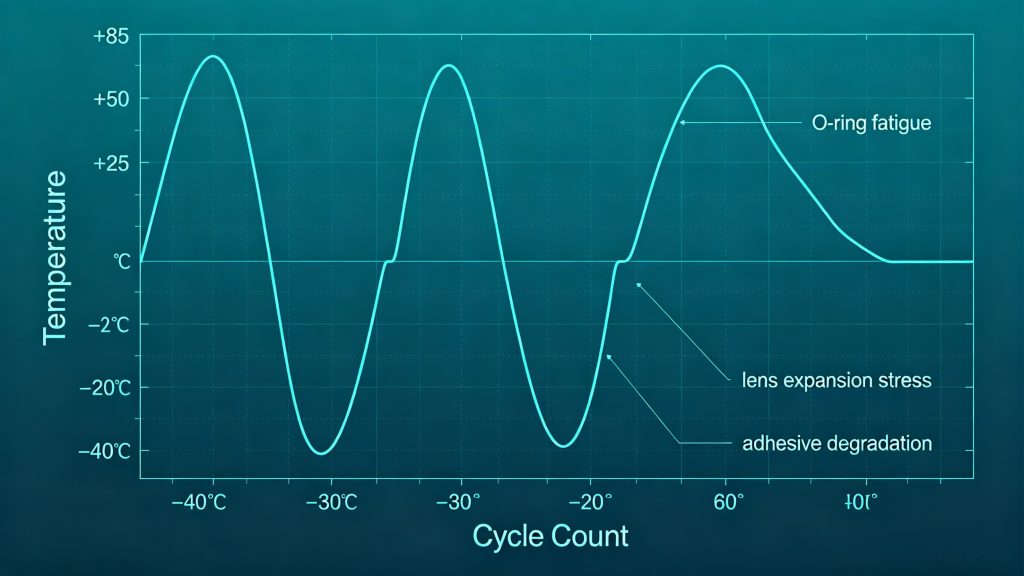
- Temperature range: -40°C ↔ +85°C
- Cycle duration: 2–6 hours per cycle
- Number of cycles: 50–200 cycles
Engineering Function
Thermal cycling simulates:
Differences in thermal expansion coefficients
- Elastic degradation of sealing materials
- Stress concentration at glass-metal interfaces
- Internal condensation formation
Real Engineering Failure Modes
After prolonged thermal cycling, common issues include:
- Permanent compression set of O-rings (loss of elasticity)
- Micro-crack propagation at lens edges
- Adhesive fatigue and delamination
- Accumulated internal condensation
Many “waterproof failures” are actually caused by structural fatigue from thermal cycling rather than direct water ingress.
Vibration and Mechanical Shock Testing: Simulating Real Shipboard Conditions
Marine searchlights are continuously subjected to mechanical vibration during operation, including:
- Low-frequency engine vibration (10–50 Hz)
- Hull structural resonance
- Transient wave impact loads
Typical Test Parameters
- Frequency range: 5–200 Hz
- Acceleration: 1–5 g (depending on requirement level)
- Axes: X / Y / Z
- Duration: 8–24 hours per axis
Engineering Function
Vibration testing evaluates:
- Loss of fastening preload force
- Micro-displacement at sealing interfaces
- Fatigue failure at cable entry points
- Structural fatigue in welded or jointed components
Typical Failure Path
Vibration-induced waterproof failure is usually progressive:
Micro-loosening → Reduced sealing pressure → Micro-leakage → Internal condensation → Electrical failure
This failure mode is not detectable in static IP testing.
Multi-Environmental Coupled Validation: From Single Tests to System Reliability
Single-factor testing cannot fully represent real marine environments. Therefore, modern validation systems combine multiple tests:
- IP ingress protection testing (static sealing performance)
- Salt spray corrosion testing (material durability)
- Thermal cycling testing (structural fatigue resistance)
- Vibration testing (dynamic reliability)
Engineering Logic
Real-world marine failures are typically not caused by a single factor, but by environmental coupling effects:
Salt spray + vibration + thermal cycling → gradual degradation of sealing systems
Therefore, multi-factor simulation provides a more realistic reliability assessment.
Limitations and Engineering Significance of Testing Systems
Although comprehensive, these testing systems still have limitations:
1. Inability to fully replicate real marine coupling environments
Laboratory testing is typically controlled and isolated, whereas real environments involve simultaneous stress factors.
2. No direct correlation between test standards and service life
For example:
- 500h salt spray ≠ 5 years of marine operation
- IP68 ≠ long-term underwater reliability
3. Failure is often a nonlinear accumulation process
In real engineering, failures are typically caused by multiple interacting minor degradation factors.
Conclusion
The waterproof reliability validation of marine searchlights is not defined by a single test result, but by a multi-layer engineering system, including:
- IP ingress protection testing (baseline sealing capability)
- Salt spray corrosion testing (material durability)
- Thermal cycling testing (structural thermal stability)
- Vibration and shock testing (dynamic reliability)
From an engineering perspective, the value of this multi-dimensional validation system is not to predict exact service life, but to identify structural weaknesses and potential failure mechanisms through standardized methods, thereby assessing long-term stability under complex marine conditions.
