
How to Choose Marine Engine Room Lights for Tight Spaces
Selecting the appropriate marine engine room lights in confined areas calls for thorough evaluation of several factors. In the small engine rooms, large fixtures can obstruct other machinery, while incorrectly placed lighting will leave some areas unlit.
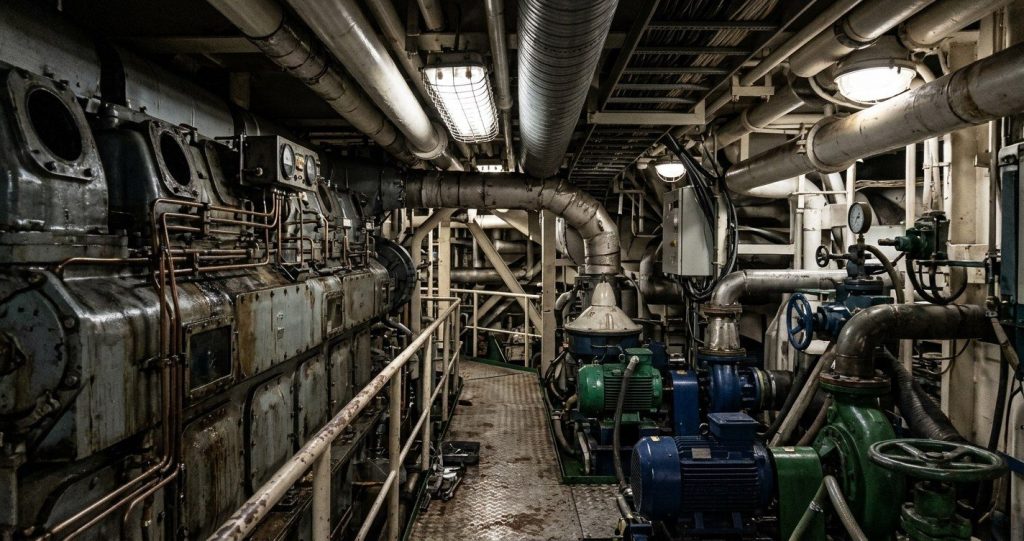
When it comes to marine engine room lighting in confined areas, the best way for the shipbuilders, marine equipment purchasing organizations, and vessel maintenance teams is to evaluate the environment and then choose the appropriate fixtures.
Table of Contents
Start by Measuring the Available Installation Space
Identify where the light fixtures will be mounted before comparing LED marine engine room lights. Engine rooms have many pipes, exhausts, cable tray systems, pumps, and support beams very close together, leaving little space for any type of lighting.
Take into account how much space there is for mounting the lighting, the width and the depth of the lighting area and how much space there is around any other equipment near the light.
Compact LED marine engine room lights are generally appropriate for tight areas as they offer low projection from walls or any other ceiling structure. Linear lighting fixtures can track bulkheads and equipment rows, while small surface lighting fixtures can provide illumination for particular inspection points.
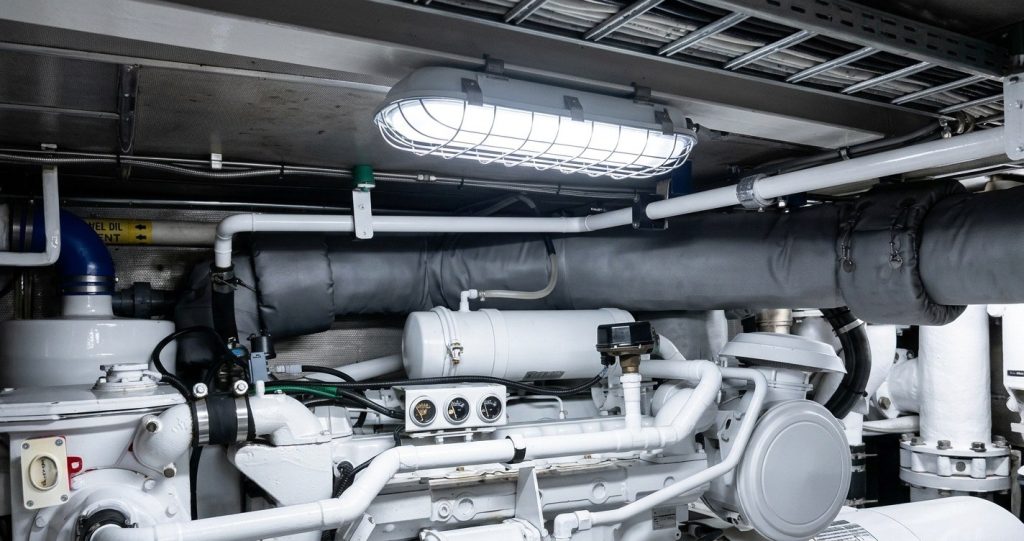
It is also important to consider the installation surface in deciding on the lighting fixture. One should check if the lighting fixture can be properly mounted onto the available surface and if the cable routing will affect any machinery or passage service.
The goal is not only to use the smallest fixture but to use an appropriately sized fixture which gives enough illumination and easy access to maintenance.
Choose the Lighting Type According to the Space Layout
Different fixture types will be appropriate for different engine room arrangements. Comparing the benefits of each installation can assist in narrowing down one’s options.
Small surface mount fixtures can be used for local installation on bulkheads, ceiling surfaces, or even on equipment cases. They may serve to focus or illuminate according to their optical construction and position of installation.
Long linear marine LED fixtures can be handy for narrow spaces, passages, and equipment. The length of their light emitting surfaces allows for illumination over a larger area without using several heavy fixtures.
LED strips have applications for places that are highly restrictive in terms of space, where the installation of housing is a problem. But it should be remembered that the decision-making process should be based on criteria such as mechanical, thermal protection, wiring, and mounting security rather than on the flexibility of LED strip lights.
There are portable inspection lights that help with additional lighting when inspections of connections, valves, or other hidden elements require extra illumination beyond what fixed lights offer.
The optimal solution would depend on the layout of the engine room. The fixed lights should provide main work illumination; the portable ones will cover inspection tasks.
Evaluate Brightness and Light Distribution Together
In the selection of marine engine room lights, avoid selecting a fixture only based on its lumens rating. Lumens denote the amount of visible light output but not the extent of coverage of that output on the work area.
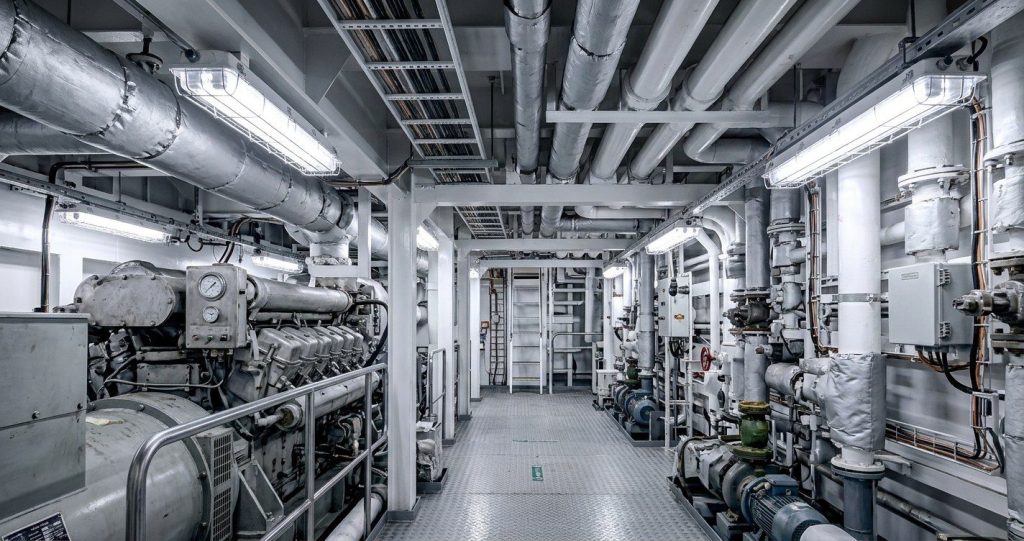
The engine room can have shadowing effects in spite of having enough light output from the installed fixtures due to engines, pipes, bracket and cable tray. The purchaser must take into account the beam angle, mounting height, distance between fixtures, and the location of important inspection points.
Linear fixtures could be useful to distribute light output for narrow engine rooms across equipment rows. For the purpose of directional lighting, additional light output can help around gauge instruments, filters, valves, and mechanical joints.
It will be best if there is a chance to look at the light output layout or photometrics prior to making decisions on fixture layout. A proper layout will allow practical visibility for inspection, finding leaks, label reading, and maintenance of equipment without leaving any dark spots.
Match Environmental Protection to Actual Conditions
The marine engine room lights have to function properly within the setting where they are installed. This includes moisture, humidity, splashes of water, salty air and high temperatures, which may influence fixture performance and lifespan.
It is essential to compare IP rating and the extent of expected exposure. The equipment with IP65 rating is protected from dust and splashing water jets. IP68 equipment provides protection from dust as well as from complete submersion in water at the conditions described by the manufacturer.
Higher IP rating does not mean that the fixture is suitable for each engine room. It is important to check the protection of the connector, cable entry, installation interface, as well as the fixture casing.
High temperature resistance is as important as moisture and vibration resistance. It is crucial to specify the maximum allowed temperature and installation restrictions of the light if it is installed close to engines or exhausts. The fixture should not exceed temperature rating in the process of its normal functioning.
For boats, which are exposed to constant vibration, it is necessary to inspect the fixture mounting system, cable strain relief, fixture casing and vibration testing documentation.
Check Electrical Compatibility and Maintenance Requirements
First, check that the fixture corresponds to the electrical input on the vessel. Consider the voltage, AC/DC input, power consumption, connectors, and whether the fixture can work with the existing protective electrical devices.
In case dimming is needed, make sure the fixture and the driver are compatible with the chosen control mechanism. An incorrect driver or dimmer may cause unwanted results such as flickering.
Provisional access for maintenance needs to be considered too. Make sure that the fasteners, connectors, and the driver are accessible without disassembling the adjacent equipment. Although an external driver may give installation advantages, the location of this device should correspond to its requirements.
In case the vessel has certain classification, electromagnetic compatibility, or hazardous-area specifications, consult them before making your selection. Marine LED lights which are not specifically approved for the hazardous areas should not be used in those areas.
Use a Practical Checklist Before Placing an Order
Once the installation conditions are clear, compare shortlisted products against the same criteria.
- Dimensions: Does the fixture fit the available mounting space without obstructing equipment access?
- Illumination: Does its light output and distribution support the intended inspection or maintenance tasks?
- Environmental protection: Are the IP rating, operating temperature, and corrosion resistance appropriate?
- Mechanical durability: Can the mounting arrangement withstand the expected vibration and operating conditions?
- Electrical compatibility: Does the rated supply match the vessel’s electrical system?
- Maintenance: Can the fixture, driver, and connections be inspected or replaced conveniently?
- Documentation: Are technical datasheets, installation instructions, and required certificates available?
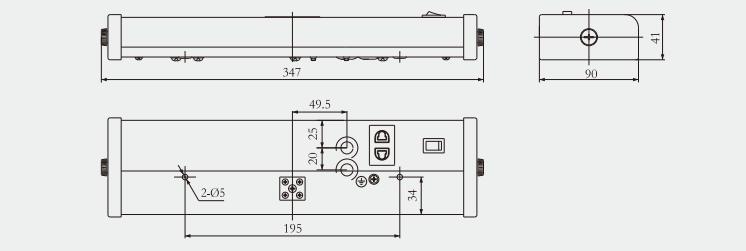
Comparing these criteria helps buyers avoid selecting fixtures based on price, size, or brightness alone.
Conclusion
Selecting the best marine engine room lights involves thorough planning, including aspects like mounting space, lighting needs, electricity compatibility, and operational conditions. Surface-mount compact lights, LED strip lights, and LED linear lights may be suitable in various ways depending on the engine room design.
Before ordering, consider fixture dimensions, light pattern, IP rating, operating temperature, vibration resistance, and maintenance of the selected light fixtures.
Are you searching for trustworthy marine LED lights for your vessel project? Reach out to Yushuo for more information regarding your needs and possible lights. Tell us about your mounting dimensions, vessel supply voltage, light installation place, and operational conditions. We will help you find suitable marine lights and offer product specifications for your evaluation.
