LED Boat Spotlight vs HID: How to Choose a Commercial Vessel?
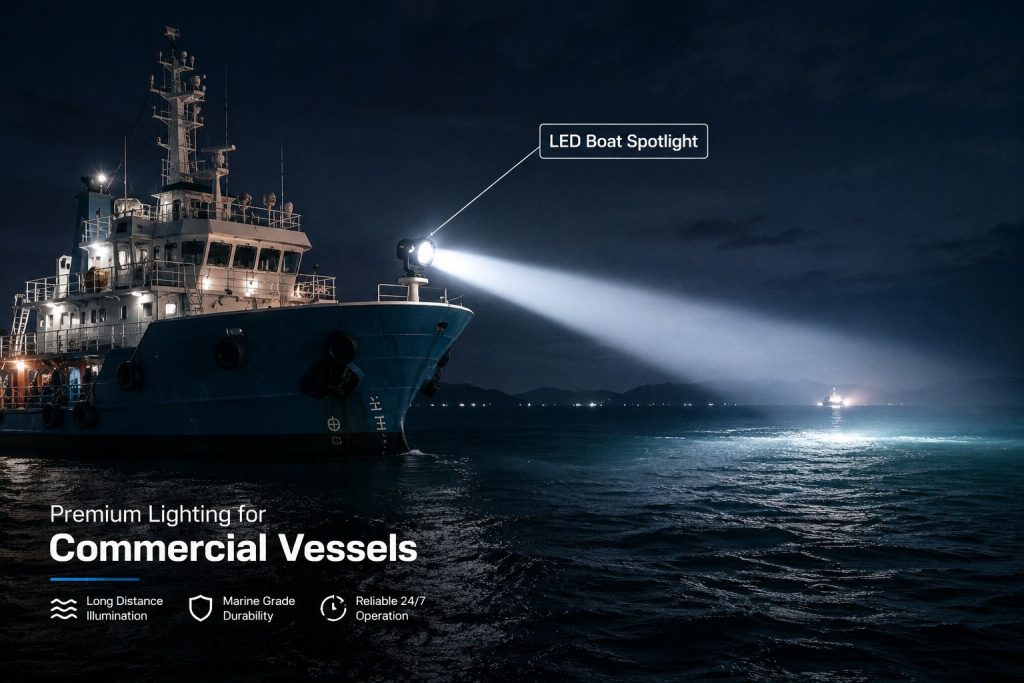
A LED boat spotlight normally uses low power in comparison with an HID boat spotlight, which means that the load to the generator will be smaller. If you consider a boat that works for many hours, lower power usage may save your money on fuel expenses.
HID boat spotlights usually require high power input, so it is a good choice when there is an existing HID system. But if you are considering buying HID spotlights for new boats, nowadays energy saving plays a crucial role in the buying process.
In case of buying a boat spotlight, one must consider not only brightness but power consumption and generator load as well.
Table of Contents
Understand Your Commercial Vessel’s Operating Requirements
Before comparing lighting technologies, it is important to understand how the spotlight will actually be used. Different commercial vessels face different operating environments, and those differences directly influence the most suitable boat spotlight.
| Commercial Vessel | Key Spotlight Priority |
| Fishing Vessel | Long operating hours |
| Tug Boat | Instant start & stable beam |
| Pilot Boat | Fast target recognition |
| Patrol Vessel | Reliable 24/7 operation |
| Offshore Support Vessel | Corrosion & vibration resistance |
| Cargo Vessel | Lower TCO & energy consumption |
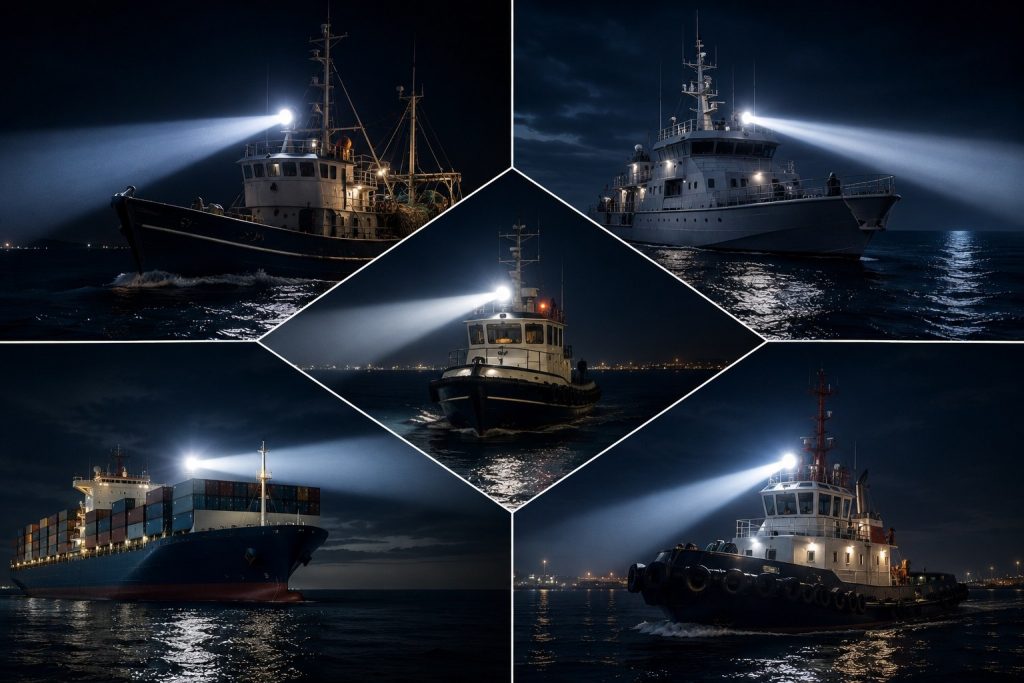
Ultimately, the vessel’s operating profile—not brightness alone—should determine the most appropriate boat spotlight technology.
Energy Efficiency Comparison
The use of energy by lights is one factor that should be considered in commercial fleets where the lighting systems can be on for several hours each day.
An LED boat spotlight uses less electrical power and hence reduces the electrical demand from the generator. Lower power demand can contribute to improved fuel efficiency, particularly for vessels running multiple lighting systems simultaneously.
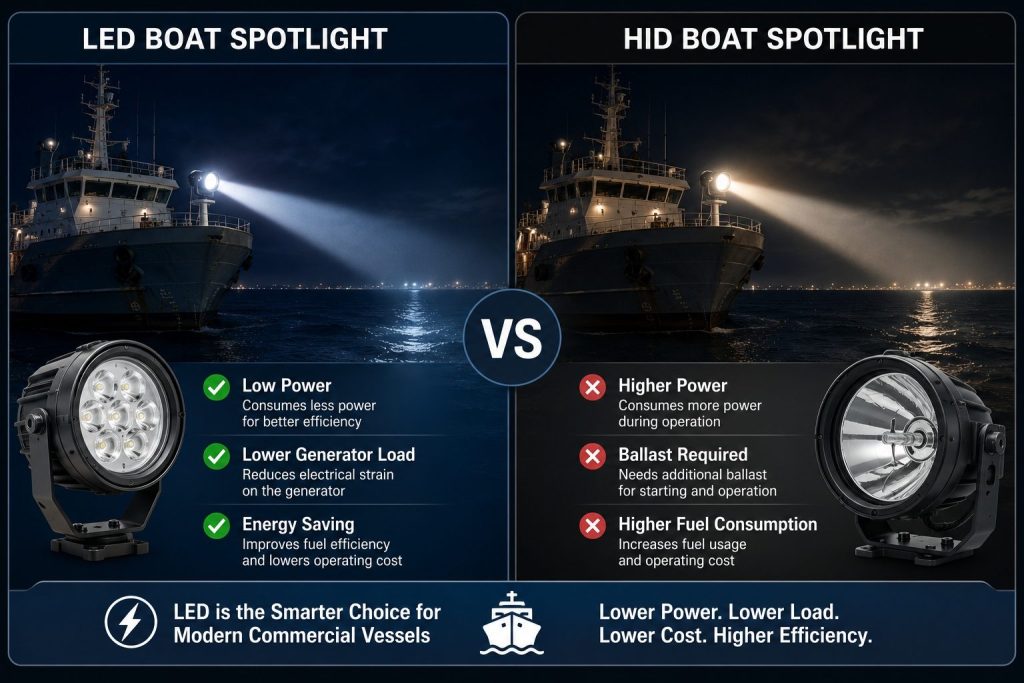
The HID boat spotlight will certainly produce a high output of lights but usually consumes more electricity and requires additional parts such as ballasts to work.
Continuous usage of the product may lead to a larger amount of energy consumed, thus increasing generator strain and fuel consumption.
Commercial boats that operate daily and throughout their offshore work require any savings in electricity, which could lower their expenses.
Instead of considering only the luminosity, the buyer should take into account the energy consumption and work time per year.
Maintenance Costs
Initial purchase price represents only one portion of a lighting system’s overall cost. For commercial operators, maintenance expenses often become the larger financial consideration over time.
Initial Purchase Cost
HID boat spotlights may offer a lower initial equipment price in some applications. However, purchase price alone rarely reflects long-term operating costs.
Replacement Components
Traditional HID systems typically include consumable or serviceable components such as:
- Lamps
- Ballasts
- Igniters
These components require periodic replacement, increasing maintenance frequency throughout the equipment’s service life.
LED boat spotlights use integrated solid-state light sources, eliminating several replaceable components commonly found in HID systems.
Maintenance Labor
Replacing lamps or electrical components requires technician time and scheduled maintenance windows. For commercial vessels, labor costs accumulate over years of operation.
Vessel Downtime
Unexpected lighting failures may require maintenance during voyages or scheduled port visits. Even minor repairs can affect operational planning and increase downtime.
Spare Parts Inventory
Operators using HID systems often maintain inventories of replacement lamps, ballasts, and igniters. Managing these spare parts adds purchasing, storage, and inventory management costs.
Total Cost of Ownership (TCO)
When evaluating a boat spotlight, procurement teams should consider the Total Cost of Ownership (TCO) rather than focusing solely on purchase price.
A comprehensive TCO assessment includes:
- Initial equipment cost
- Energy consumption
- Maintenance labor
- Spare parts
- Generator operating costs
- Downtime during repairs
Even though the purchase cost of an LED boat spotlight is relatively higher, the economic value can be improved in the future with reduced costs for maintenance and operations.
Reliability in Harsh Marine Environments
Commercial marine environments place continuous stress on lighting equipment.
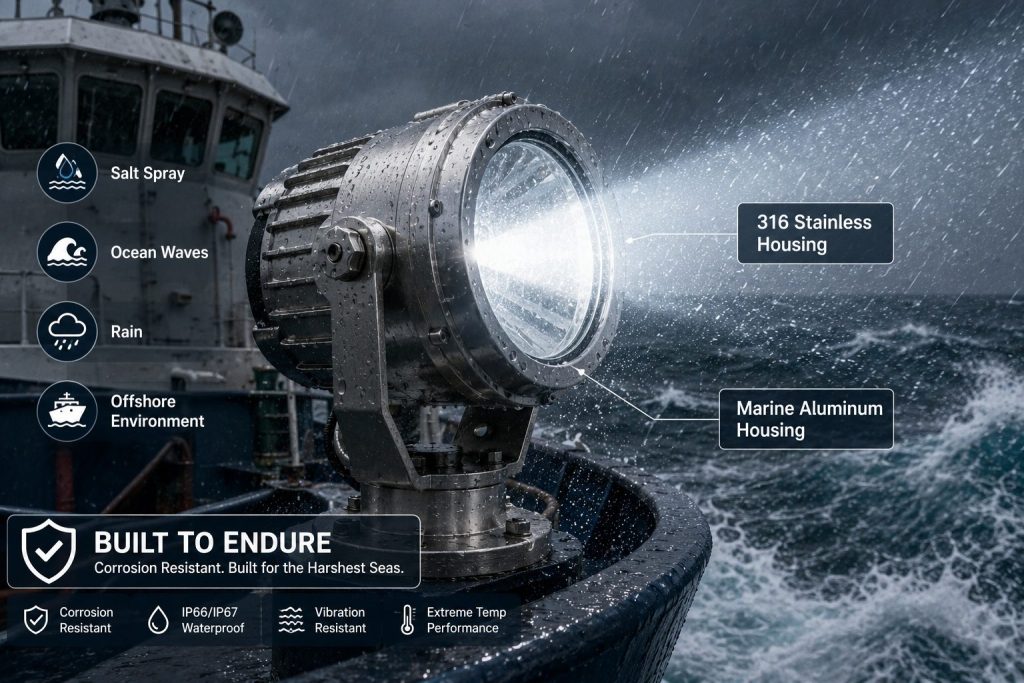
Salt Spray Resistance
Salt water tends to speed up corrosion processes that occur on the surface of metal parts..
Engine Vibration
Vibration is constant for commercial ships due to their propulsion and mechanical systems. Solid-state LED lighting has fewer moving parts compared to the conventional HID lighting, which leads to better performance stability.
High Humidity
The marine environment exposes lighting systems to water continuously. Effective sealing can help to avoid moisture inside the lighting system.
Temperature Changes
Fluctuations in temperature can occur due to changing seasons and day and night operations. Temperature stabilization is necessary for proper lighting system performance.
Shock Resistance
Wave impacts and vessel movement subject onboard equipment to repeated mechanical shock. Durable housing construction helps maintain alignment and optical performance.
For operators working in demanding marine environments, long-term reliability depends not only on light output but also on the spotlight’s ability to withstand corrosion, vibration, humidity, and mechanical stress.
Beam Performance: Long Distance Isn’t the Only Measurement
Many buyers compare boat spotlights based only on maximum beam distance. In commercial applications, however, beam quality is often more important than beam length alone.
Beam Distance
Long-range illumination remains important for navigation and search operations, particularly in open water.
Beam Uniformity
A consistent beam with even light distribution reduces dark spots and improves visibility across the illuminated area.
Target Recognition
Operators need to quickly identify buoys, floating objects, structures, and other vessels. Effective target recognition depends on both beam intensity and light distribution.
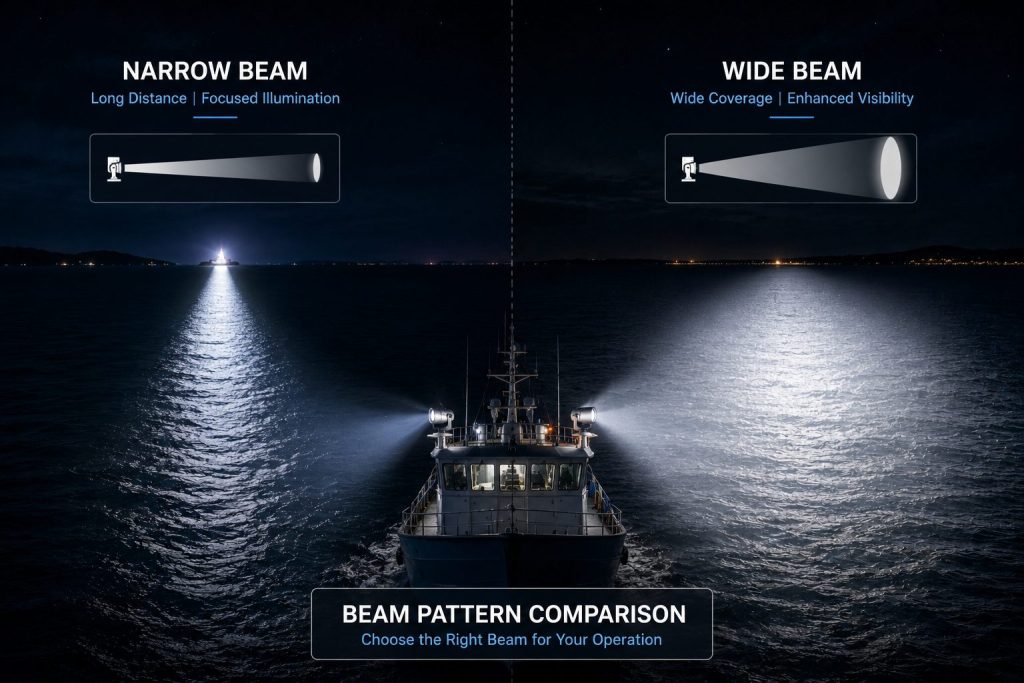
Beam Pattern
Different applications require different beam patterns. Narrow beams support long-distance observation, while wider beams improve working visibility during docking or deck operations.
Consistent Optical Performance
A stable beam pattern throughout the service life helps maintain predictable lighting performance and reduces operational uncertainty.
For commercial vessels, practical visibility depends on beam quality, target recognition, and application-specific lighting characteristics—not simply the maximum illumination distance.
LED vs HID: Feature Comparison
| Feature | LED boat spotlight | HID boat spotlight |
| Energy Efficiency | High | Moderate |
| Generator Load | Lower | Higher |
| Fuel Consumption | Lower | Higher |
| Maintenance Frequency | Low | Higher |
| Warm-up Time | Instant | Requires warm-up |
| Beam Uniformity | Excellent | Good |
| Replaceable Components | Minimal | Lamp, Ballast, Igniter |
| Service Life | Longer | Shorter |
| Spare Parts Inventory | Minimal | Required |
| Total Cost of Ownership | Lower | Higher |
Which Boat Spotlight Is Better for Your Commercial Vessel?
There is no single boat spotlight that suits every commercial vessel.
An LED boat spotlight is generally the preferred choice when operators prioritize:
- Lower energy consumption
- Reduced generator load
- Minimal maintenance
- Lower downtime
- Long-term operating efficiency
- Lower Total Cost of Ownership
Use of an HID boat spotlight might still be justified in cases where the vessels already have an HID system installed, and the cost of replacement or retro-fitting is higher than the benefit from upgrade.
As opposed to comparing the price of purchase alone, the commercial buyer should consider the total lifespan of operation.
FAQ
1. Is there any possibility that the LED boat spotlight will replace the HID boat spotlight on any commercial vessel?
Yes. LED boat spotlights can be installed in place of the HID boat spotlights on most commercial vessels. Users need to confirm mounting size, operational voltage, beam angles, and control methods prior to installation.
2. Which beam angle is the most appropriate for commercial vessel boat spotlight?
It varies with applications. Narrow beams can be used for long-distance navigation while wide beams can give you good visibility when docking or working on deck..
3. What housing materials do marine boat spotlights use?
There are two popular materials that include marine-grade aluminum alloy and 316 stainless steel. Moreover, it is highly recommended to ask for salt spray testing reports.
4. Manual or remote controlled boat spotlights – which to prefer?
Manual boat spotlights can be used in fixed light installation. The best option for patrol and rescue operations is remote-controlled boat spotlights.
5. What are the voltage options for commercial boat spotlights?
Commercial boat spotlights may work at 12V, 24V, 48V, 110V, 220V.
6. What information should the buyer provide before requesting a quotation?
Provide the type of the vessel, operating voltage, beam distance, installation position, quantity, and certification requirements. Full project information helps suppliers choose the optimal solution.
7. Is it possible to customize a boat spotlight for OEM projects?
Yes. Most of the manufacturers provide OEM services, including custom voltage, beam angle, mounting brackets, color of the housing, and branding.
8. Besides the product price, what factors should buyers consider?
Compare warranty, delivery period, certifications, test reports, spare parts, and after-sale support. This list of factors plays an essential role in project value rather than the price only.
