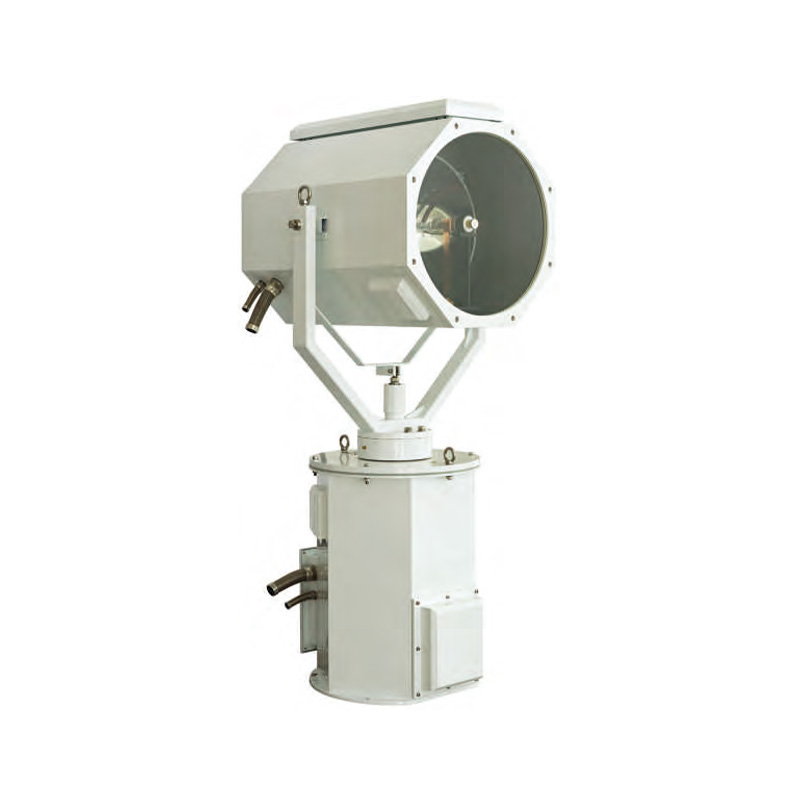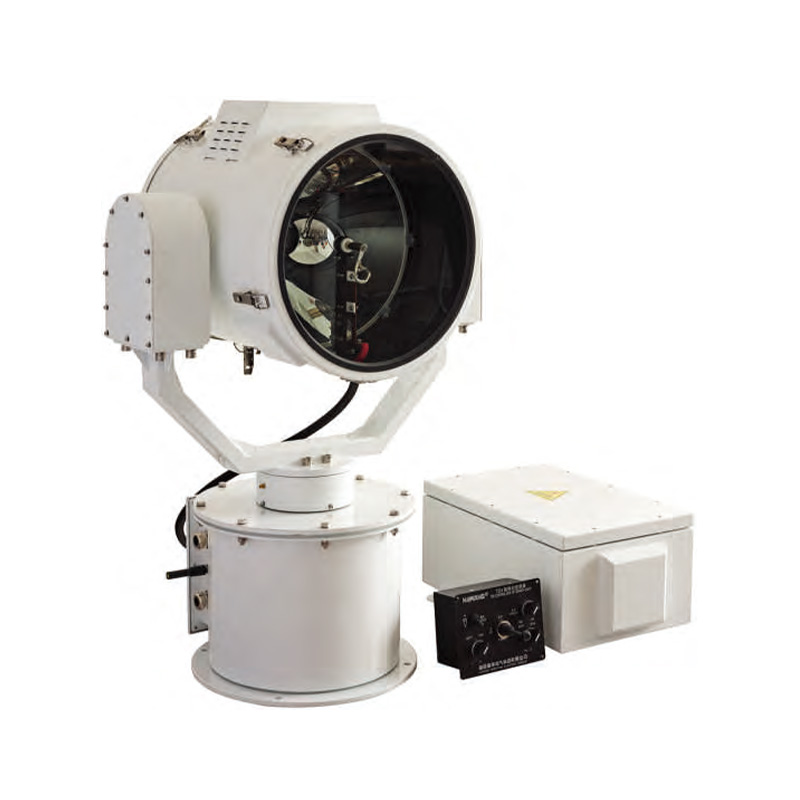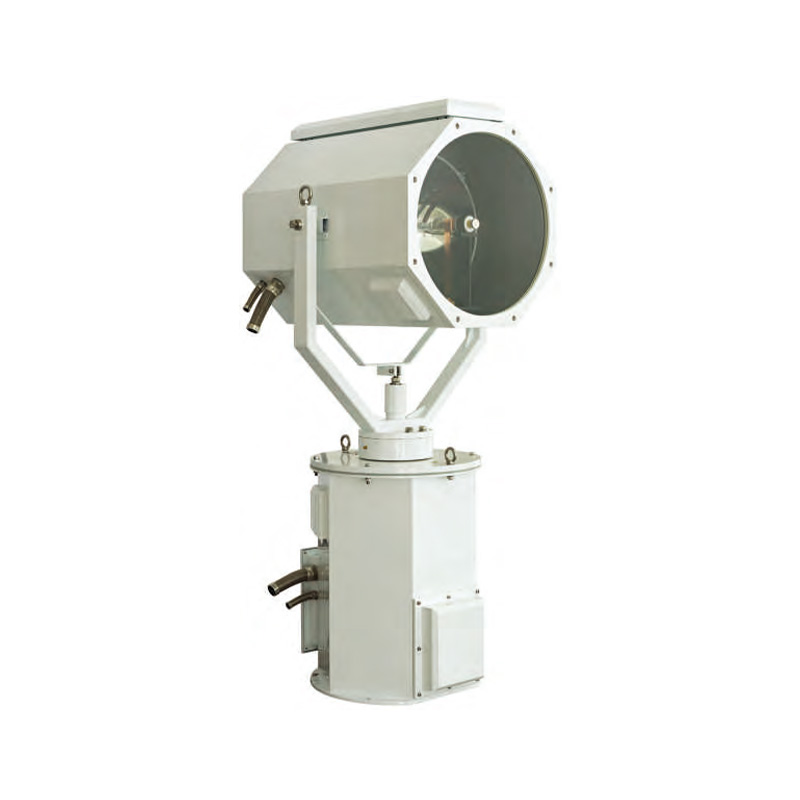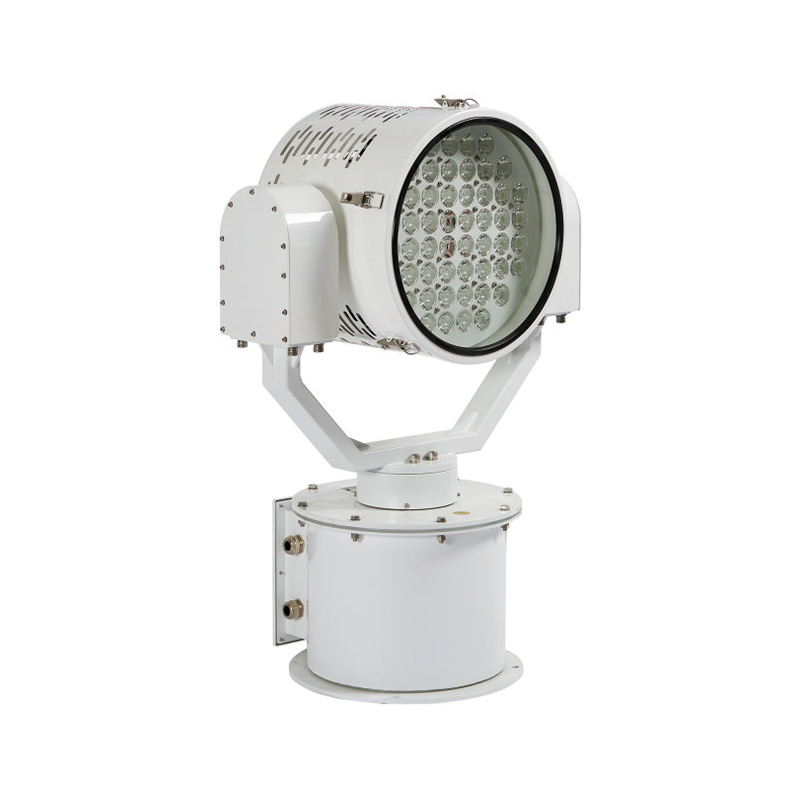
Who Needs an Ultra-High-Performance Marine Searchlight and Who Doesn’t
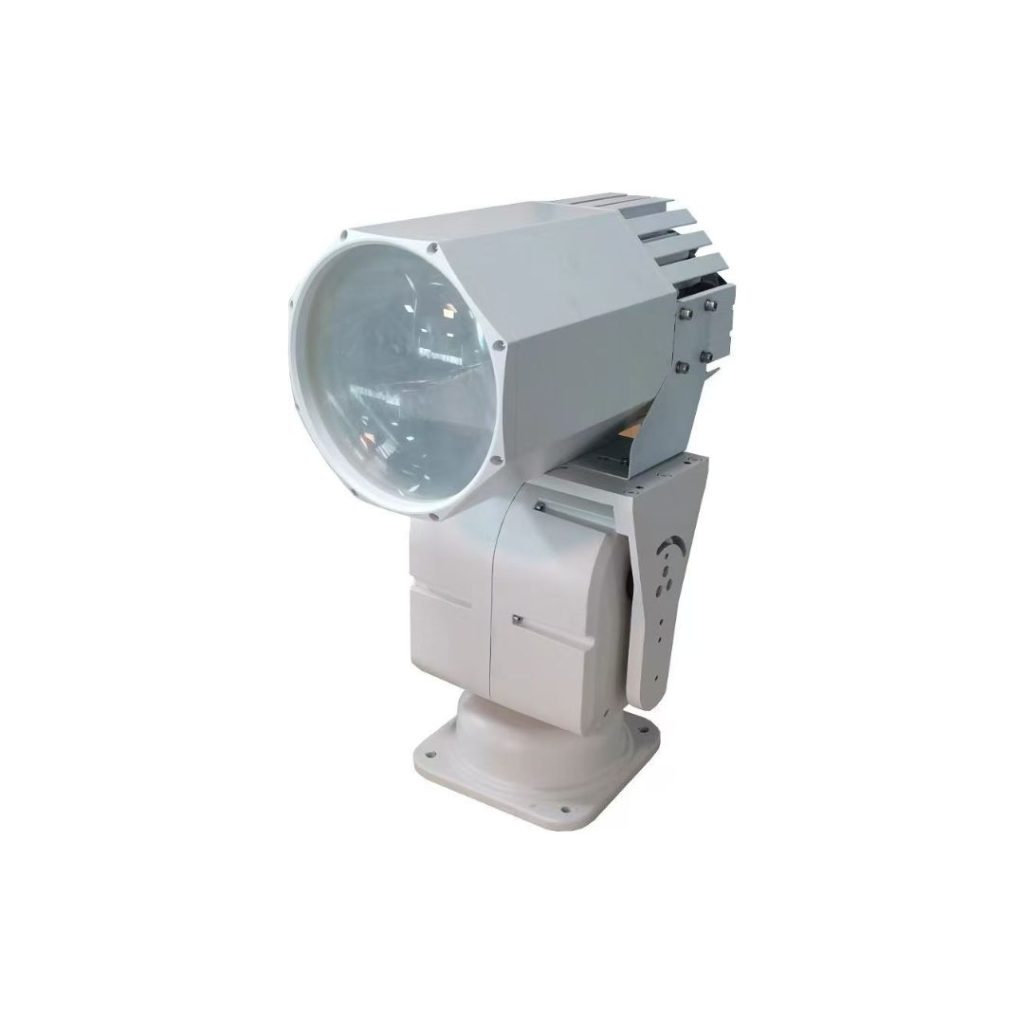
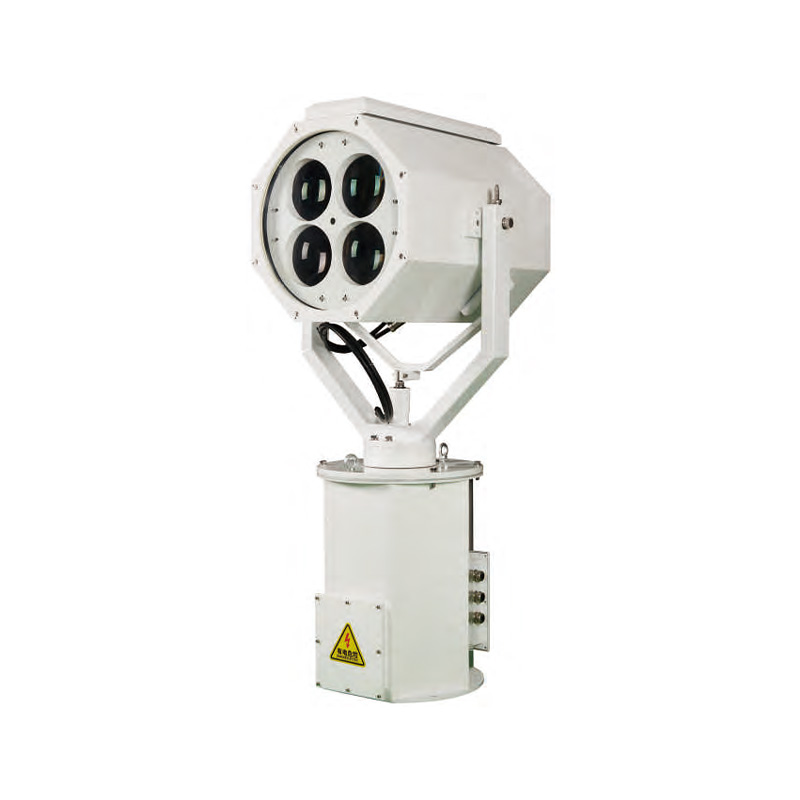
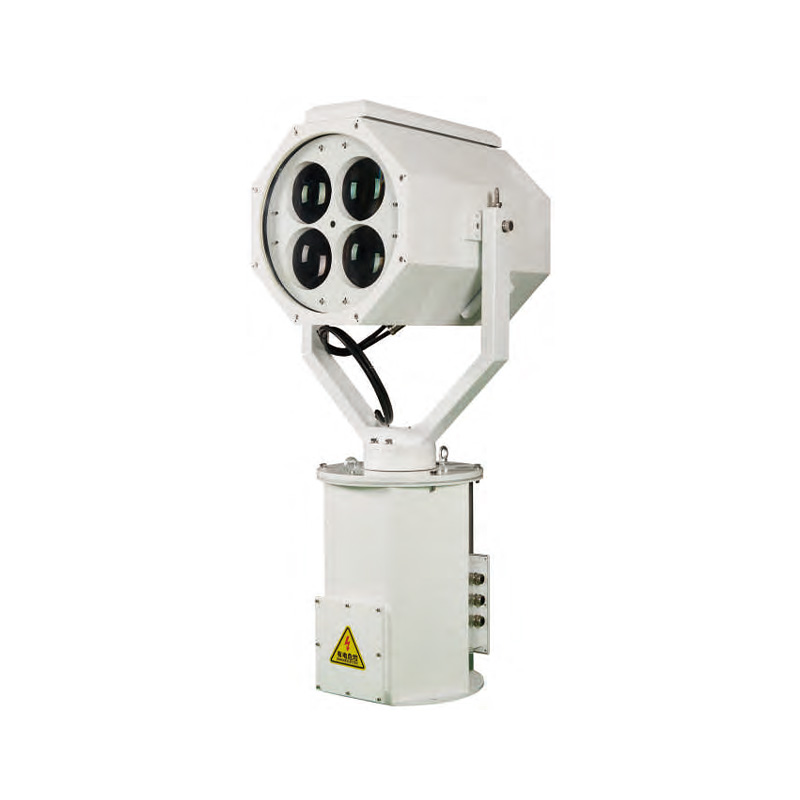
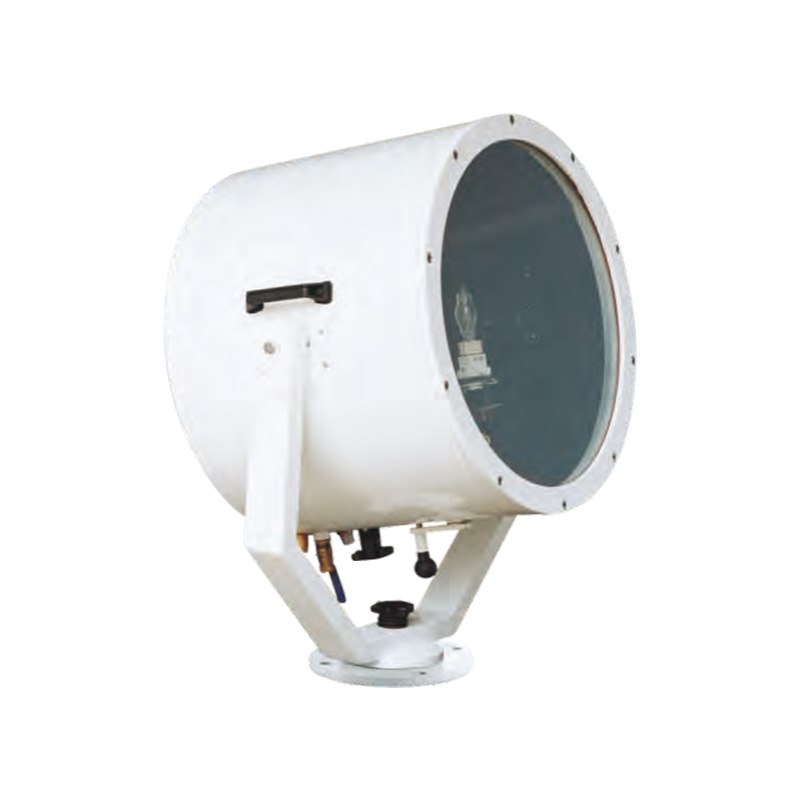
Marine searchlights with ultra-brightness, ultra-long-range capability, automated/remote control, and durability to rough climates are called ultra-high performance marine searchlights. They can improve efficiency, and reduce risks in various situations and can even save lives. However, there is a misconception surrounding the searchlights, as the intuition generally says “the brighter, the better”. This description will cover the most common mistakes and provide guidance on “who should buy” and “who shouldn’t buy” to “how to choose the right model” and “installation, compliance, maintenance and environmental factors”.
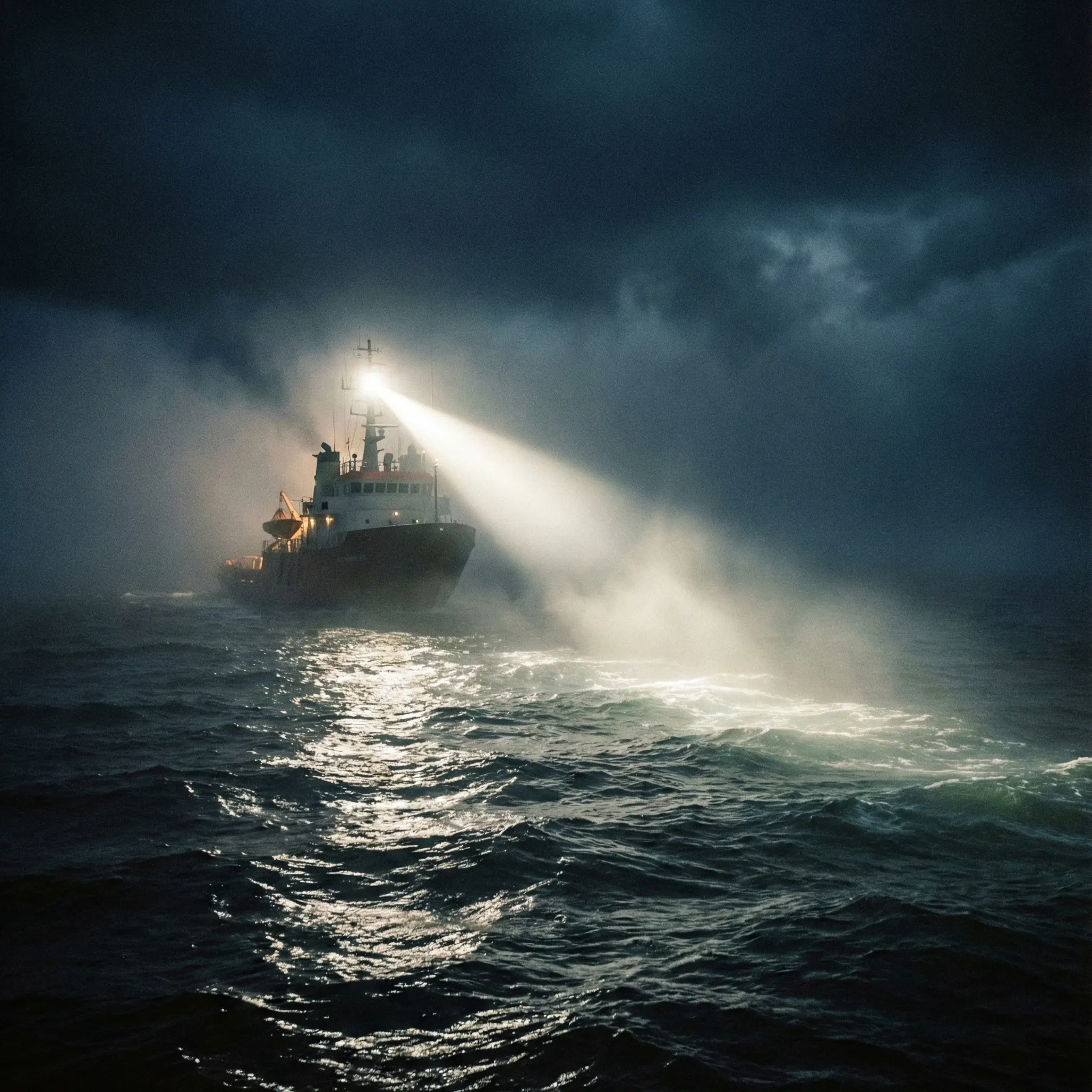
Table of Contents
What is Meant by Ultra-high Performance Marine Searchlights
“Ultra-high maintenance” searchlights are not merely a marketing term, but denote a type of professional grade equipment which far exceeds normal marine searchlights in regards to brightness, beam distance, control precision, durability, and adaptability to the environment. Their design purpose is not to simply see brighter but to meet the high requirements of safety for nighttime activities, rescue missions, and offshore engineering. These activities are where the performance of a searchlight is critical to determining life and death, and efficiency, and compliance.
Advantages of Ultra-high Performance Marine Searchlight
Ultra-high-performance marine searchlights provide more than just brighter illumination and an enhanced range. The technical capabilities of these searchlights aid in enriching the safety and operational efficiencies and emergency management of varying kinds of boats and ships.
Long-distance Lighting
For large ships, the tall hulls along with high speeds and high inertia require the captain to make predictions multiple steps in advance during nighttime navigation or when visibility is low due to rain, fog, or strong winds to prevent the risks associated with sea navigation. If there is no anticipation of the sea state, and any obstacles within the ship’s route, and there is a delay in reaction time by as little as a few seconds, the risk to the entire voyage magnifies.
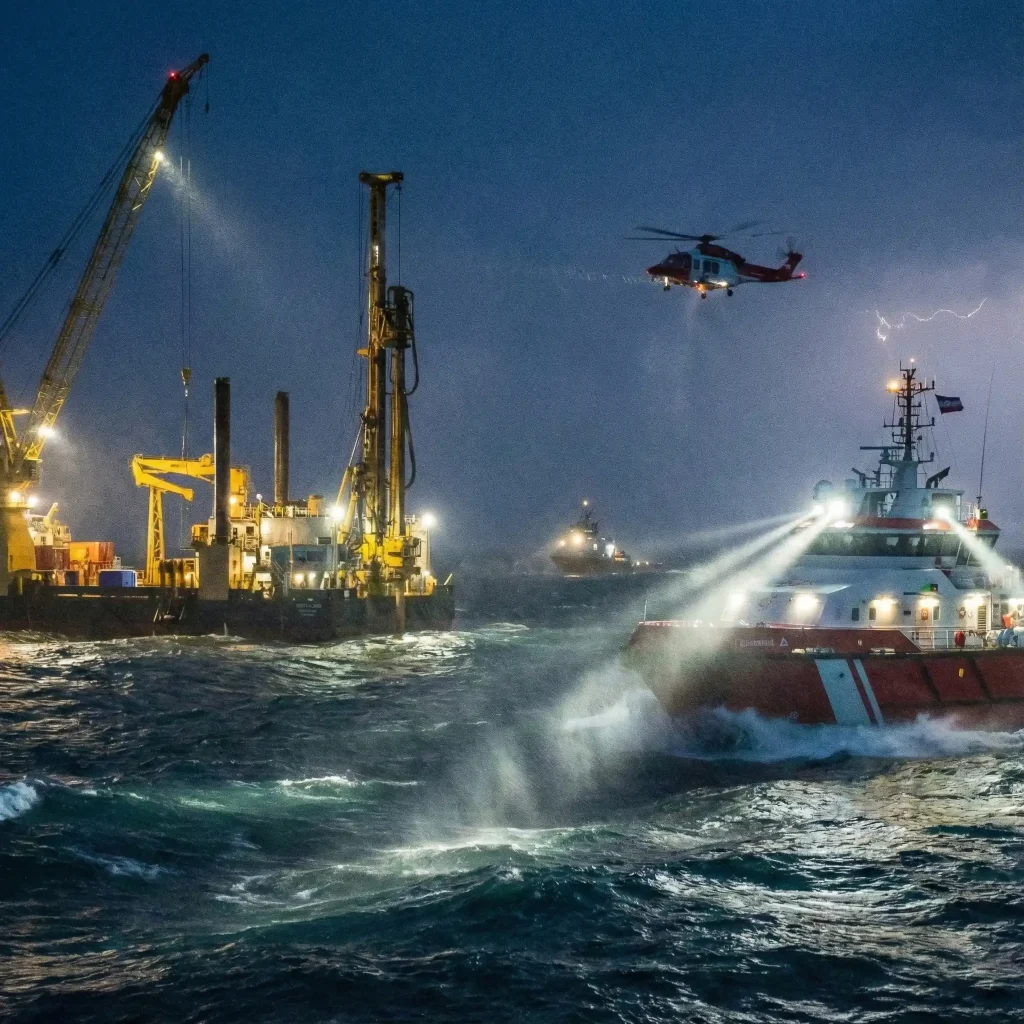
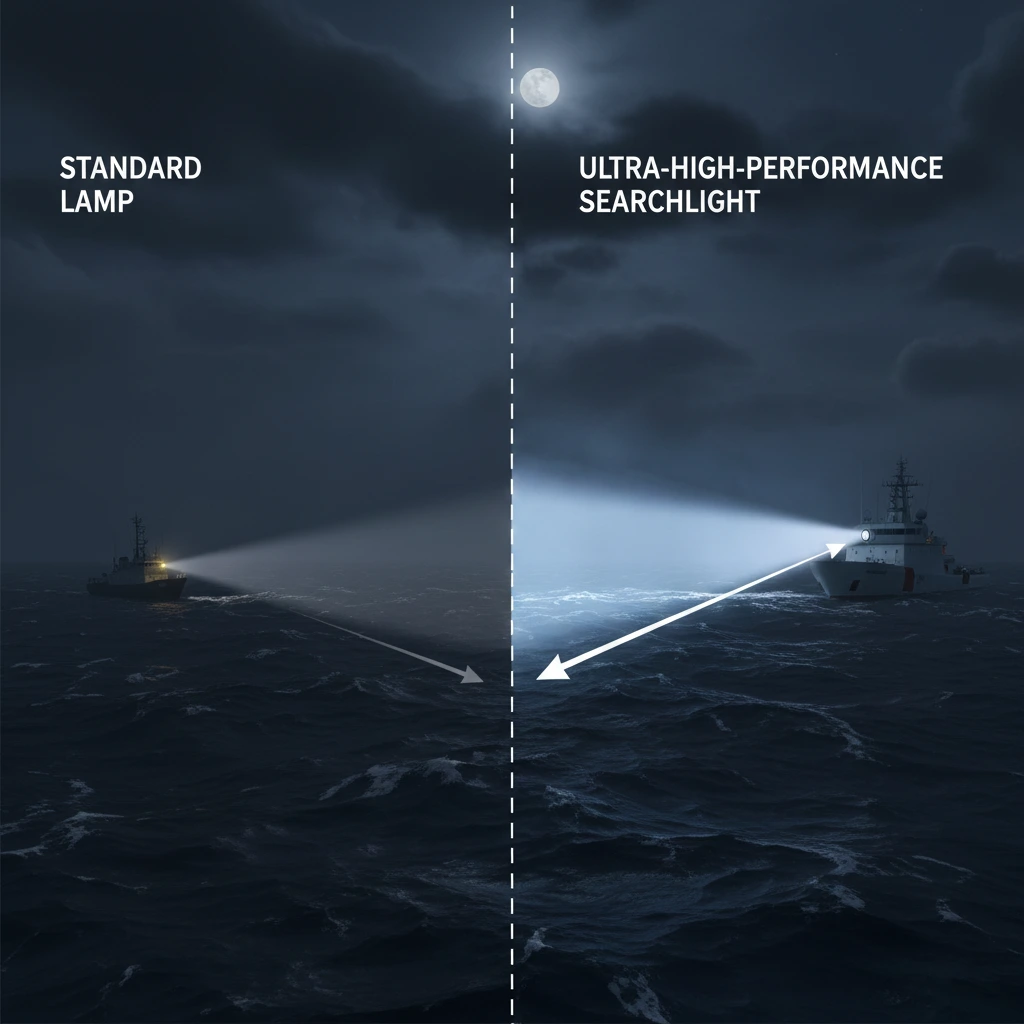
Ultra-high-performance searchlights provide large vessels with the crucial illumination to guide them with illumination distances of 1 to 5+ kilometres and precision focus that does not scatter at altitudes. They are the only means that allow vessels to determine their information while ensuring their safety by spotting potentially dangerous objects from afar.
Applications include units that perform manoeuvring at nighttime berthing of cargo and container ships, fishing fleet nighttime return to port, offshore wind power and oil and gas platform vessel net inspections, and search and rescue missions for distressed people or floating seaway contraptions. In all of the aforementioned tasks, to “see ahead” means to evaluate faster and avoid the risk sooner.
In this regard, long-range lighting is not merely about ‘seeing further’ and is, in fact, a primary regulatory mechanism ensuring the safety of the large deadweight tonnage ships while they are at a port and underway.
Fast Target Recognition
The sea is very dynamic; floating obstructions, life rafts, small vessels, marine debris, and even people who have fallen overboard can appear without warning. The ability to spot these targets quickly is directly related to the prevention of accidents, the efficiency of the search and rescue operation, and the safety of the vessel.
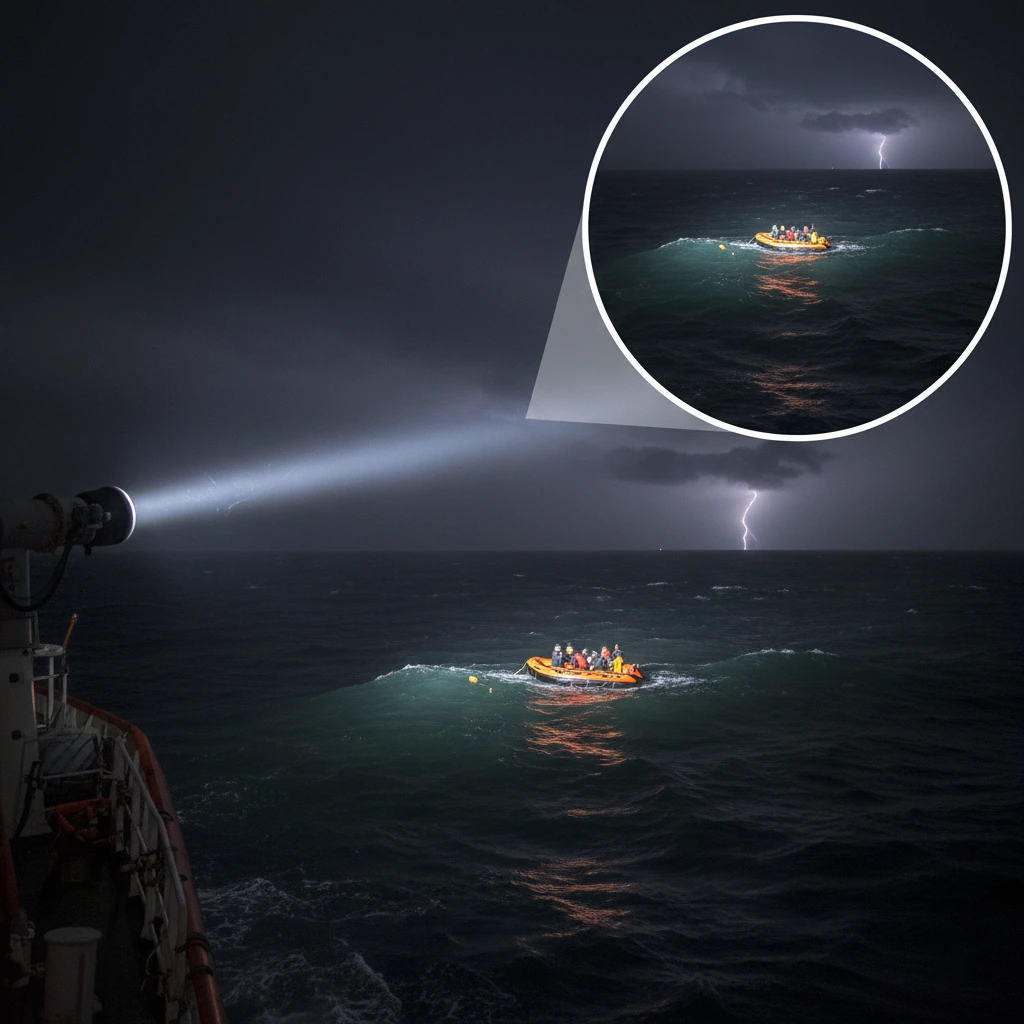
With their concentrated illumination and clean beam without trailing or scattering, ultra-high performance searchlights maintain visibility of targets even in turbulent sea conditions. In low visibility situations (fog, haze, nighttime), they can detect targets tens of seconds and even minutes earlier than other lights, providing the vessel with time to adjust its course and make safer navigation decisions. For search and rescue vessels, this means a shorter ‘golden rescue time’ and a marked increase in the success rate of rescues.
Reliability and Durability
Almost all equipment will fail when exposed to a marine environment due to high salinity, high humidity, corrosion, vibrations, and extreme temperature fluctuations. Portions of ordinary lighting equipment will fail due to such challenges.
Ultra high performance search lights have been engineered to survive severe environments for extended periods of time. Features include long life LEDs lasting 30,000 to 50,000 hours, and complex waterproofing and corrosion resistant engineering with active and passive cooling systems ensuring long lasting stable performance. With a vibration resistant structure and shields to protect from extreme temperature differentials, this equipment is far less prone to premature failure. This means lower maintenance costs, less downtime, and total ongoing reliability for critical tasks such as rescue missions and berthing.
Intelligent Control
Unlike the older models that had to be managed by hand to look for something, the new models of searchlights have automated and programmed control systems that make locating objects faster and easier while decreasing the manual workload that needs to be completed.
The searchlights can be controlled from a distance, eliminating the need for a user to put themselves in a potentially dangerous situation, and can be rotated and tilted at a range of angles in seconds. They can automatically search and scan for objects and can be programmed to shine at multiple brightness levels, flash in an SOS pattern, or turn off automatically to avoid shining at people or sergeants. The programmed control systems also make it possible for searchlights to remain stable while the systems scan and search for an object in rough waters. They are faster and more accurate than searching for something manually, which is especially necessary when operating in narrow canals.
The search and rescue, law enforcement, and Government Services need to be equipped and ready for critical and emergency situations, and high-performance models are the best searchlights available.
Operations at Night
A lot of boats do important work at night that includes lifting and pulling, unloading and processing fish, servicing wind power, offshore engineering repairs, servicing pipelines or structures, and carrying out inspections.
Ordinary lights would most likely be used to provide broad area flood lighting, which does not take into account the special requirements of the work for beam direction, beam stability, and illumination of confined work areas. Ultra-high performance search lights, on the other hand, provide stable and fully controllable working lights. No matter how much the vessel is rolling, the beam direction will not change, significantly improving visibility for workers and lowering the chances of improper manoeuvres, collisions, or falling.
On supply, engineering, and wind power operational vessels, these demands for safety and reliability of shipboard lights are absolutely necessary for the safe performance of the work at night.
Who is Suitable and Who is Not
| Suitability | Vessel/User Type | Core Needs | Essential Features / Recommended Configuration |
| Highly Recommended (Ultra-High-Performance) | Search & Rescue (SAR) Vessels | Long-range detection, rapid target identification, reliable operation in night/adverse weather | Lots of candela output, mixing a narrow-spot with a floodlight, reliable stable power, with power redundancy, auto-scanning, and SOS model features. |
| Cargo / Container / Tanker Ships (Large Commercial Vessels) | Night berthing, channel monitoring, floating object warning, deck operations | An adjustable, long-range beam with either a flood or spotlight, and corrosion-resistant housing, as well as having high power compatibility. | |
| Offshore Work Vessels (Engineering, Salvage, Pipe-laying, Marine Construction) | Continuous operation, harsh environment resistance, precise work illumination | Extreme durability with high temperatures, salt/fog resistance and vibration, continuous operation, and with the capability to synchronise with other helpful equipment like lifting lights. | |
| Possibly Suitable (Depends on Use) | Patrol / Maritime Law Enforcement Vessels (Coast Guard, Marine Police) | Night tracking, long-distance target inspection | For ultra long-range or high-performance operations, standard searchlights are probably good enough to use for near-shore patrols. |
| Large Yachts (Long-distance or Night Activities) | Night cruising, port entry, offshore rescue training | For ultra high performance, frequent night sailing is recommended; if not, lean towards comfort, regulations, and light pollution. | |
| Not Recommended (Ultra-High-Performance Not Needed) | Most Recreational Yachts | Light pollution, impact on other vessels’ night vision, high cost, energy consumption | Mixing lights of medium brightness with a shield or an LED floodlight are also options. |
| Small Fishing Boats / Dinghies | Disturbing fish, limited power supply, complex maintenance | Portable, low powered, and lightweight are characteristics of the LED lights. | |
| High-Speed Boats / Jet Skis | Strong lights can cause temporary blindness at high speed, affect navigation | Distance and low mounted lights, combining the navigation lights with the radar support. |
Important Factors and Some Mistakes to Avoid
Some people only pay attention to the watts (W) and the range (m) of the marine searchlights they purchase, yet buyers often will only take this one-sided information and will have no understanding of the light unit’s range and effectiveness in the diverse marine environment. To purchase a marine ultra-high performance searchlight, buyers need to consider the optical performance, mechanical and environmental adaptability, control and regulating functions, electrical measurement, and systems, and the capability of the light unit’s after-sales service and maintenance.
Key Parameters
| Category | Parameter / Feature | Description / Recommendation |
| Optical & Performance | Luminous Flux (Lumen, lm) | Indicates the total light output, but does not consider directionality; cannot directly measure long-distance illumination capability |
| Luminous Intensity (Candela, cd) | Reflects light intensity in a specific direction; key for judging range and penetration. Actual distance affected by fog, rain, sea reflections, etc. | |
| Beam Angle | Narrow beam (Spot) for long-distance detection, wide beam (Flood) for near-field work. Recommend switchable Spot + Flood combination | |
| Color Temperature (Kelvin, K) | High color temperature (5,000–6,500K) appears white and penetrates well; may increase scattering in fog, needs environment-based consideration | |
| Color Rendering Index (CRI) | Higher CRI improves color accuracy, useful for night deck work and target recognition | |
| Mechanical & Environmental Adaptation | Protection Rating (IP) | Recommended IP66 or higher for marine use to resist splashes and strong water impact |
| Salt & Corrosion Resistance | Housing material should be 316L stainless steel or aluminum alloy + special coating, tested under ASTM/ISO salt spray standards | |
| Vibration Resistance | Must meet ship vibration standards; essential for offshore vessels and large cargo ships to prevent damage during navigation or operations | |
| Operating Temperature Range | Verify lamps maintain performance in high-temperature areas (hot decks, engine rooms) without derating | |
| Control & Functionality | Control Method | Local manual, wired, wireless remote, or CAN bus / NMEA 2000 integration for linking with ship navigation systems |
| Automation Features | Auto-scan, tracking mode, one-touch SOS, preset angles, equipment-linked synchronization for higher operational efficiency | |
| Redundancy & Fault Protection | Dual power input, auto-reset protection, thermal protection, ensuring reliability in critical moments | |
| Electrical & Power Requirements | Rated Voltage & Power | 12/24/48V DC or 220–380V AC high-power models; must match shipboard power supply |
| Inrush Current | LED startup current is low but confirm compatibility with generators or inverters to prevent transient issues | |
| Thermal Management | LED lifespan depends on heat dissipation; check for passive cooling fins or corrosion-resistant forced air cooling |
Please Confirm before purchasing
- What you see in advertising is merely a reference. Distance is measured in ideal conditions. Candela (cd) with beam angle is a better measure.
- Ask what light degradation is expected. You can measure light decay rates by L70 and L80 to determine how long it takes light to go from 100% of its light output to 70% and 80%.
- Make sure the light will not disrupt the ship’s navigation, communication, and other electronic devices.
- It is helpful to consider the ease of on-site maintenance.
- Ensure the manufacturer can provide you with reports of salt spray, vibration, and thermal cycling. It will help you understand that you can rely on the light to perform for a long time at sea.
For ultra-high-performance searchlights, don’t just consider the wattage or the advertised range. Consider the optical performance, how durable it is, what functions the light has, and how easily it can be controlled. Ensure these lights can work seamlessly with other power supplies and how easy the lights and the system are to maintain. Understanding these factors for the purpose of investing in marine light systems will determine how successful the mission will be.
Must-Follow Operating Rules and Safety Tips
Choosing the Spot for Installation
For the searchlight to be properly installed, there needs to be an open and clear line of sight for both the searchlight and the captain; especially to ensure that the searchlight does not shine directly on the bridge of the ship or onto the captain or helmsman so that they do not lose night vision. The mounting location also needs to be able to hold the weight of the searchlight and tolerate the vibrations and shocks during navigation or when there are activities on the deck. The best placements are normally the highest areas of the deck and the purpose-built lighting towers. Safety during operation and the area that needs to be covered are also taken into account. Take time to simulate the coverage of the beam beforehand, or make use of the laser rangefinders so that the most appropriate height and direction are established before your actual installation.
Mounting and Vibration Protection
When installing lights on the ship, remember that the lights need to be secured using specialised anti-vibration mounting systems. The systems we have in place stop light sway caused by ship activity. Without using cushions, this sway can cause damage to the ship’s fixture structures. If this sway happens too often without the correct mounts that stop this swaying, it can lead to issues such as wear on the cable and breakage on welds along with further issues to the ship’s internal systems to the point where the ship’s:
- Service life can be significantly shortened.
The mounts that we have in place stop as much sway on larger ships as much as possible using shocks that can absorb the motion.
When using special rubbers, we can be certain that the mounts will meet the standards at stopping vibration mesh, ensuring that the smoothness of motion on the ship will be maintained at all times.
Proper vibration protection mounts and structures stop damage caused by lights and ensure that the balance of the ship can be sustained.
Cabling and Grounding
For optimum performance, cables should be marine grade, waterproof, and use sealed connectors that are reliable for saltwater, humid, and spray prone atmospheres. Proper grounding is essential to avoid the buildup of static and EMI that can disrupt navigation and communication systems. In order to avoid any issues, cable paths should avoid places prone to high temperatures and places that might mechanically rub against the cables, should use fixed trays where available, and provide relevant protection to the cable bends.
Power Redundancy
To prevent lighting blind spots due to loss of power, the searchlight must connect to two different power sources such as a dual power supply and/or a UPS (Uninterrupted Power Supply). This is most important during night berthing, search and rescue, or work on deck. To provide reliability, it is recommended that the searchlight have overcurrent protection and circuit breakers that include status indicators or remote monitoring alarms.
Operating Procedures
Prior to activating high intensity search lights in constricted channels or ports after dark, employ low frequency strobing or short flash techniques, as well as warn other boats with sound, radio, or AIS to avoid any potential temporary blindness effects. Set strobe intensity, angle, and concentration, and brightness in accordance with the channel width, distance of the target, and the visibility to avoid glare and/or deceptive reflections. These procedures for operations should be incorporated into the vessel’s standard operating procedures for navigational exercises after dark.
Beam Direction and Shielding
To prevent glare for nearby boats and onshore individuals, install light shields and adjust angle limiters. Shielding allows for precise beam control, reduced light pollution, and less interference from reflection. Angle limiters prevent excessive rotation or tilting at night, protecting deck structures and people from unintended light and collisions.
Training and Logging
Every operator should be properly trained and know how to perform quick beam switching, beam switching between spot and flood, emergency SOS mode, adjusting the angle of the beam, and troubleshooting general faults. Training is to include night-time emergency procedures, low visibility methods, and emergency maintenance procedures. Each significant night-time operation is to be recorded in such a way as to include the date and time, weather conditions, what light modes were in use, and any other abnormalities to be used for further determination and improvement in procedures for operations.
Port, Channel, and Waterway Regulations
There are often notations on the maps pertaining to Ports, Channels, and Particular Maritime Zones about the maximum levels of artificial light (especially due to search lights being permitted), the usage temporal order, and for what activities the lights are allowed to be used. These are even stricter near Conservation Zones, Residential Areas, and other Protected Areas. These guidelines should be consulted for Permits or Restrictions on the use of search lights before departing to or arriving from a port. Ignoring restrictions can result in delays relating to operations, safety issues, and/or fines.
Navigation Safety Rules
When at sea, it is important that operators do NOT shine beams into the bridges of other vessels because this can impair vision and create dangerous situations. In some regions of the world, it is illegal to shine high-beam or other high-intensity directed lights because they may misinterpret it as a danger or emergency situation. The directing and timing of high-powered beams is important to maintain safe navigation for all vessels nearby.
International Guidelines
Even though there is no law preventing the use of ultra-bright search lights, there are certain guidelines like SOLAS and COLREGs that stress the need to avoid lighting that may cause unsafe navigation of other vessels and to not jeopardise the vessel’s own safety. Operators should always cross-check the flag state regulations against the local port regulations to ensure compliance, especially in sensitive and high traffic areas.
Recommended Practices
To keep the company safe and within regulations while conducting business:
Create a Standard Operating Procedure (SOP) with directions and restrictions regarding the use of Searchlight beams and their regulations over beam angles, the intensity of the beam, and the amount of time the beam is to be used over water which may fall within regulated boundaries.
Reduce the intensity of the beam and the time the beam may be used within regulated boundaries or in proximity to other marine vessels.
Be proactive in creating an audit trail to defend against potential litigation by thoroughly documenting the use of searchlights by time and location with communications to/from Port Authorities or other marine vessels.
Coordinate with the lookout and the bridge to ensure the crew is properly positioned and operating the beams to keep the darkness and strike of light coordination set for safety and for the protection of other marine vessels in the area to avoid possible accidents.
Conclusion
Ultra high-performance marine searchlights are essential for large commercial vessels, workboats, and SAR vessels for which firm, early target detection, operational reliability, and safety are critical. Conversely, for recreational yachts, small fishing boats, and other high-speed crafts, these searchlights are often patently overkill, leading to incurred costs, excess energy consumption and potential safety and environmental concerns.