How to Operate Marine Searchlights for Maximum Visibility
Marine searchlights are a critical tool for safe navigation. But just flipping them on is not enough for good results. To get the best visibility, operators have to sort out how to control the beam’s direction, the beam’s intensity, the focusing angle, and even how the light adapts to the surroundings. When people operate them in a effective way, it improves situational awareness, lowers navigational risk, and makes objects easier to spot out there on the sea.
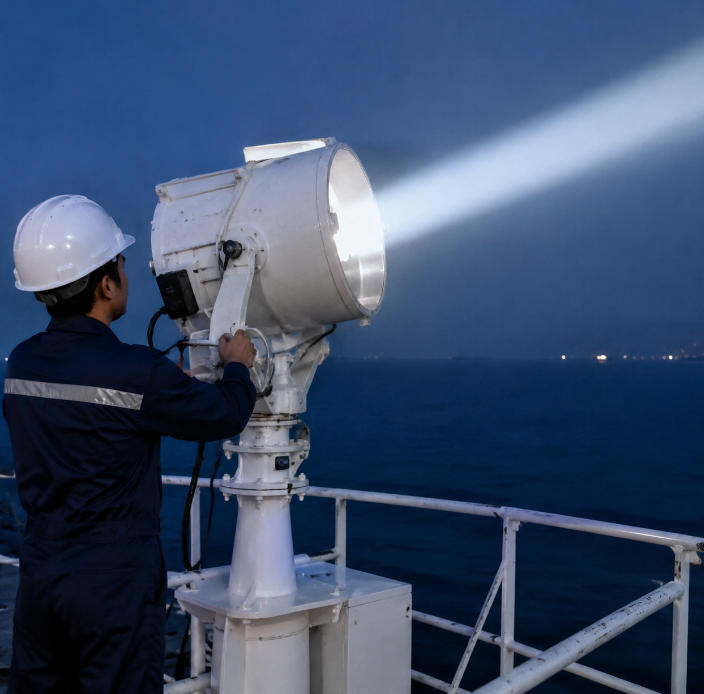
Table of Contents
Why Ensuring the Visibility of Marine Searchlights Is Important
Ensuring the visibility of marine searchlights is very important for safe and efficient maritime work, especially when it’s dark or when visibility drops hard, like in fog, rain, or rough seas. When the light performs well, the crew can spot obstacles, other vessels, buoys, and possible rescue targets fast. That helps cut down collisions and navigation mistakes. It also has a big role in search and rescue work, where quick target recognition can actually save lives. Plus, if operators maintain the searchlight visibility at an ideal level, it improves situational awareness, supports more exact maneuvering, and adds to overall operational safety and confidence while at sea.
Understanding the Components of Marine Searchlights
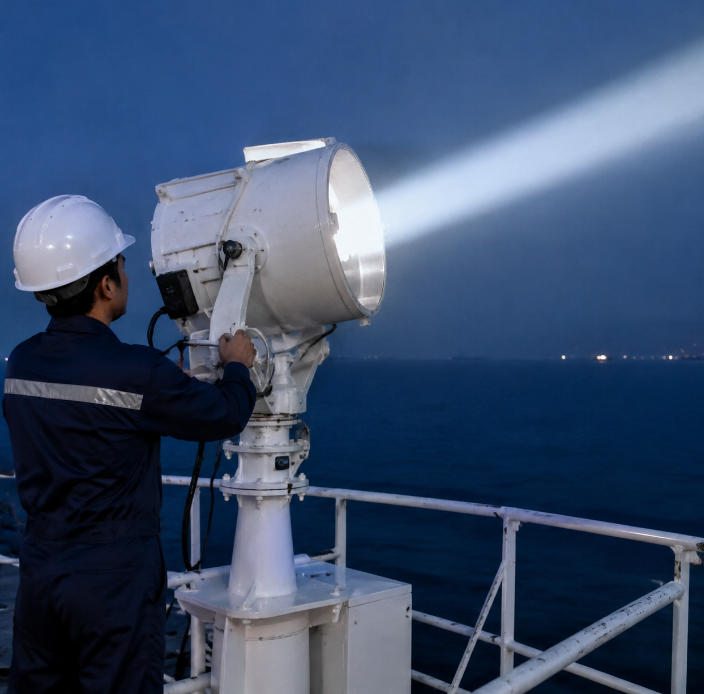
Before operating a marine searchlight, it is important to understand its main components.
| Component | Function | Importance in Operation |
| Light Source (Lamp/LED Module) | Generates high-intensity illumination for navigation and search tasks | Core element determining brightness, range, and energy efficiency |
| Reflector | Focuses and directs light into a controlled beam | Ensures long-range projection and beam uniformity |
| Lens / Front Glass | Protects internal components and shapes the emitted beam | Maintains light clarity and protects optics from marine environment |
| Housing / Casing | Encases and protects internal components | Shields system from saltwater, vibration, and harsh weather |
| Rotation Mechanism (Azimuth Control) | Enables horizontal movement of the beam | Allows wide-area scanning and target tracking |
| Tilt Mechanism (Elevation Control) | Controls vertical beam direction | Essential for targeting objects at different distances/heights |
| Control System (Panel/Joystick/Remote) | Provides user interface for operation | Enables precise and responsive operation from safe locations |
| Power Supply Unit | Provides stable electrical energy to the system | Ensures consistent performance and prevents electrical failure |
| Cooling System | Manages heat generated during operation | Prevents overheating and extends component lifespan |
| Motor System | Drives rotation and tilt movements | Enables smooth and accurate directional adjustments |
| Mounting Base | Secures searchlight to vessel structure | Ensures stability during vessel motion and rough seas |
| Sealing & Waterproofing System | Prevents water and dust ingress | Critical for long-term reliability in marine environments |
| Dimming / Intensity Control Module | Adjusts light brightness levels | Improves visibility under different weather and sea conditions |
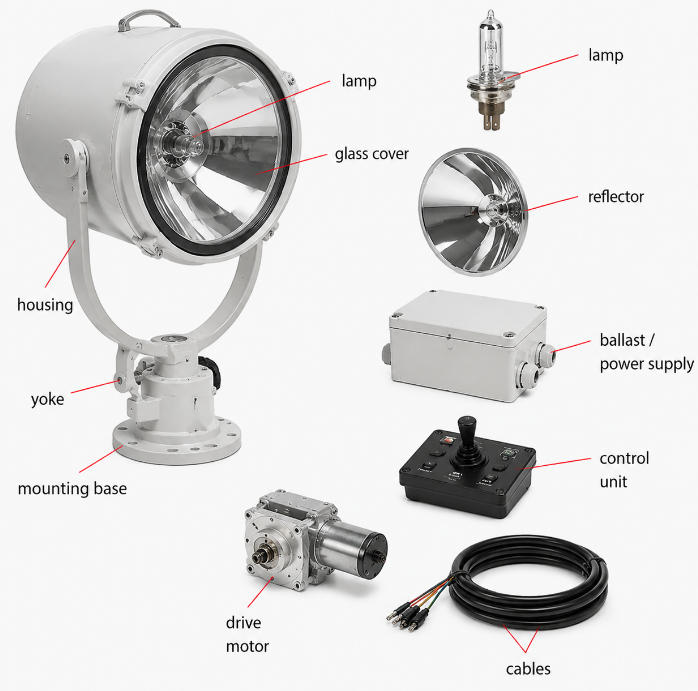
Proper Techniques of Operating Marine Searchlights for Maximum Visibility
1. Select the Right Beam Intensity
Getting the maximum visibility begins with selecting the suitable light intensity for the searchlights.
| Beam Intensity Level | Best Operating Conditions | Visibility Effect |
| High Intensity | Open sea, long-distance detection, clear weather | Maximum illumination range and strong beam penetration |
| Medium Intensity | Mixed conditions, coastal navigation, general operations | Balanced visibility with controlled brightness |
| Low Intensity | Fog, rain, mist, or reflective environments | Reduced glare and improved contrast in poor visibility |
| Adaptive / Auto Mode | Changing sea and weather conditions | Automatically adjusts brightness based on environment |
| Dimming Mode (Fine Control) | Search-and-rescue, precision tasks, close-range work | Continuously adjustable beam strength |
2. Adjust Beam Focus for Distance and Coverage
How you set the beam focus strongly affects visibility improvement of the searchlights. A tight, concentrated beam carries farther and is usually the best choice for finding buoys, vessels, or obstructions out ahead.
A broader beam spreads illumination across a wider patch, which makes it practical for deck tasks, docking support, or search and rescue activity areas.
Operators should keep tuning focus in real time to match what is happening out there, instead of just sticking to one fixed setting all the time.

3. Optimize Beam Direction with Precision Control
For maximum searchlight effectiveness, directional control needs to be steady, not just close enough. You want Operators to move smoothly, with measured control, while changing azimuth, which is the horizontal rotation, and elevation, meaning the vertical tilt.
If the motion is too fast or jittery, it can briefly knock the target out of the beam, and that reduces situational awareness in the moment. For finding objects across open water, slow scanning patterns work better.
When stabilized searchlight systems are available, they help hold the beam alignment even while the vessel is moving, and that improves visibility quite a lot.
4. Use the Correct Angle in Different Sea Conditions
Sea state matters because it changes how light travels and lands on the water’s surface. In calm conditions, a direct horizontal beam gives very good visibility. In rougher seas, though, the waves can reflect and scatter light in a way that is not predictable.
A slight downward turn of the beam can help reduce glare caused by wave tops, while raising it may be needed when scanning for higher features or distant objectives.
Choosing the right angle limits light bounce, and also helps the target appear clearer.
5. Reduce Glare and Light Scatter in Fog or Rain
Fog, mist, and rain scramble light and lower visibility. In these conditions, running at maximum brightness can make it worse, because backscatter increases.
So, operators should lower the intensity, broaden the beam just a bit, and point the illumination downward. That combination reduces reflection from airborne droplets and raises contrast.
Some advanced setups offer anti-glare schemes or adaptive lighting profiles, made for low-visibility use.
6. Maintain Stable Illumination During Vessel Motion
Vessel motion is among the hardest parts of keeping sight. Rolling, pitching, and yawing can make the searchlight beam drift in a less controllable way.
To counter this, operators should make small corrective adjustments or lean on gyro-stabilized searchlights if they exist. These systems automatically compensate for vessel motion so the beam stays fastened on target.
Stable illumination means you get continuous visibility of critical things like buoys, other vessels, or rescue targets, even when conditions change.
7. Use Scanning Techniques for Area Coverage
When searching for objects or hazards, a systematic sweep is more effective than random moving around.
Operators can run the beam slowly side to side, while also tweaking elevation a bit at a time, so different ranges get covered. This structured method helps ensure no blind spots show up, and it raises overall detection efficiency. In search and rescue work, overlapping scan patterns can greatly improve the probability of locating targets.
8. Coordinate with Navigation Systems
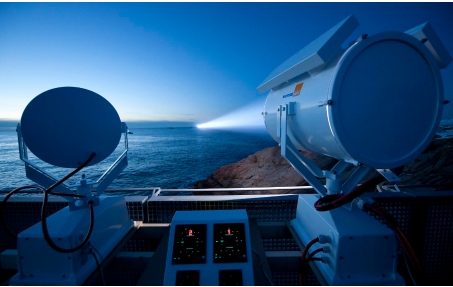
Modern marine searchlights now often tie in with radar, GPS, and bridge navigation systems, and it’s sort of a big deal. When the searchlight direction gets coordinated with electronic navigation data, the targeting becomes more precise, and the response time goes down. For instance, when radar spots a likely object, the beam can be aimed right away toward that position, so a visual check happens immediately. This whole blend supports both better visibility and smoother operations in practice.
9. Avoid Overexposure and Reflection Issues
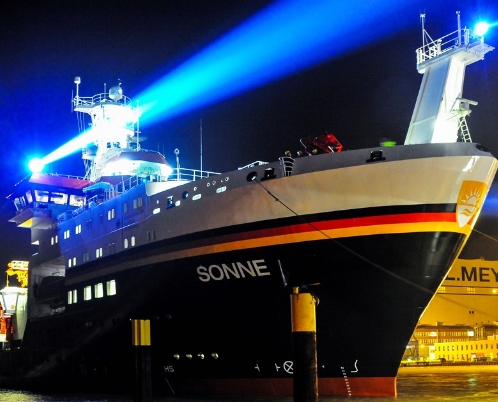
More visibility does not always mean more brightness. Overexposure can trigger glare from waves, ship structures, or even fog particles, and then the picture gets less clear. Operators should keep tuning brightness and beam angle, to hold the right contrast between the target and what’s behind it, in the surrounding environment. The correct equilibrium between intensity and direction is the key for sharp visual perception.
10. Ensure Proper Lens and Reflector Cleanliness
Even the best operational techniques will not really make up for dirty, or blocked optics. Little salt deposits, dust, and moisture on the lens or reflector can seriously cut down the light output. If the lens or reflector stays contaminated, more light gets scattered, so visibility drops. That is why regular cleaning is needed, it keeps the light transmission at its highest and helps prevent stray glow. Because of this routine maintenance becomes a key requirement for reliable searchlight performance, every time.
11. Use Remote And Automated Controls Efficiently
Remote control searchlights let operators tweak the light from the bridge, or from the control room, without wasting time. When those systems are used well, the unit can respond faster and the aiming becomes more exact.
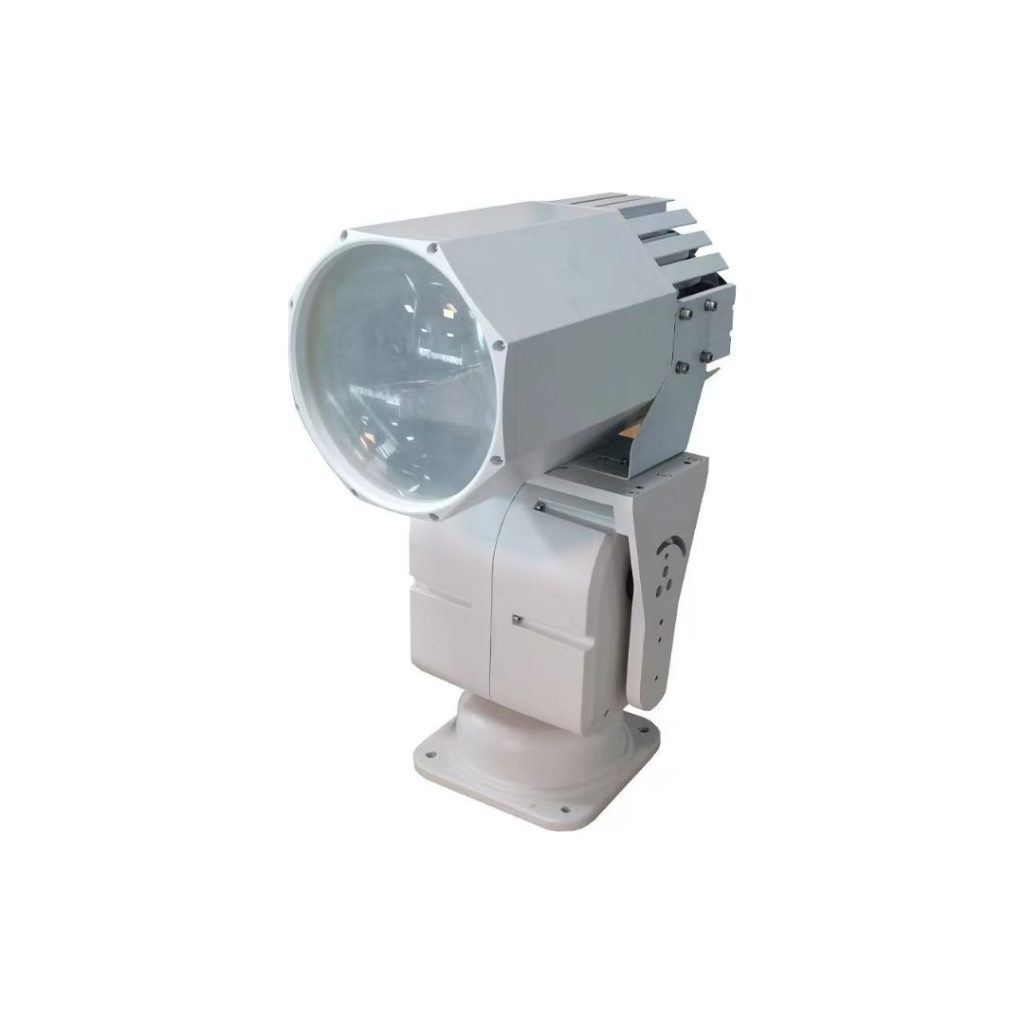
Some advanced automated searchlights include preset modes or automated tracking. This can improve what you see, by maintaining proper alignment in real time.
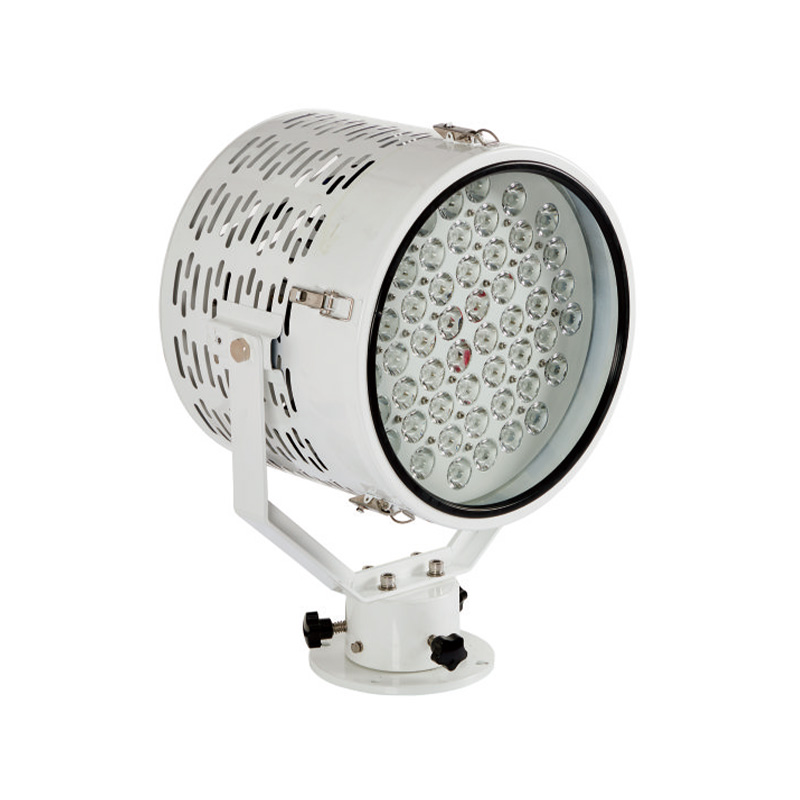
Operators should go through every control function before deployment, so nothing feels unfamiliar later.
Final Thoughts
Operating marine searchlights for maximum visibility is more than flipping the system on. It takes careful handling of how intense the beam is, where the focus lands, the direction it points, and the beam angle, too, plus a constant adjustment as the sea state and weather start shifting.
When you blend careful manual control with modern aids like stabilization systems and navigation integration, the operators can raise visibility a lot, even in places that feel really harsh, like in rougher open water.
Proper technique also supports safety and efficiency, and it helps make sure the marine searchlights reach their full capability right when they are most needed.
