Practical Marine Lighting Design Reference for Cruise Ships
Previously, marine lighting design in the cruise industry was just about fulfilling illumination requirements. Nowadays, however, it is a complex design process involving many disciplines including maritime regulations, architecture, human psychology, and long vessel operation.
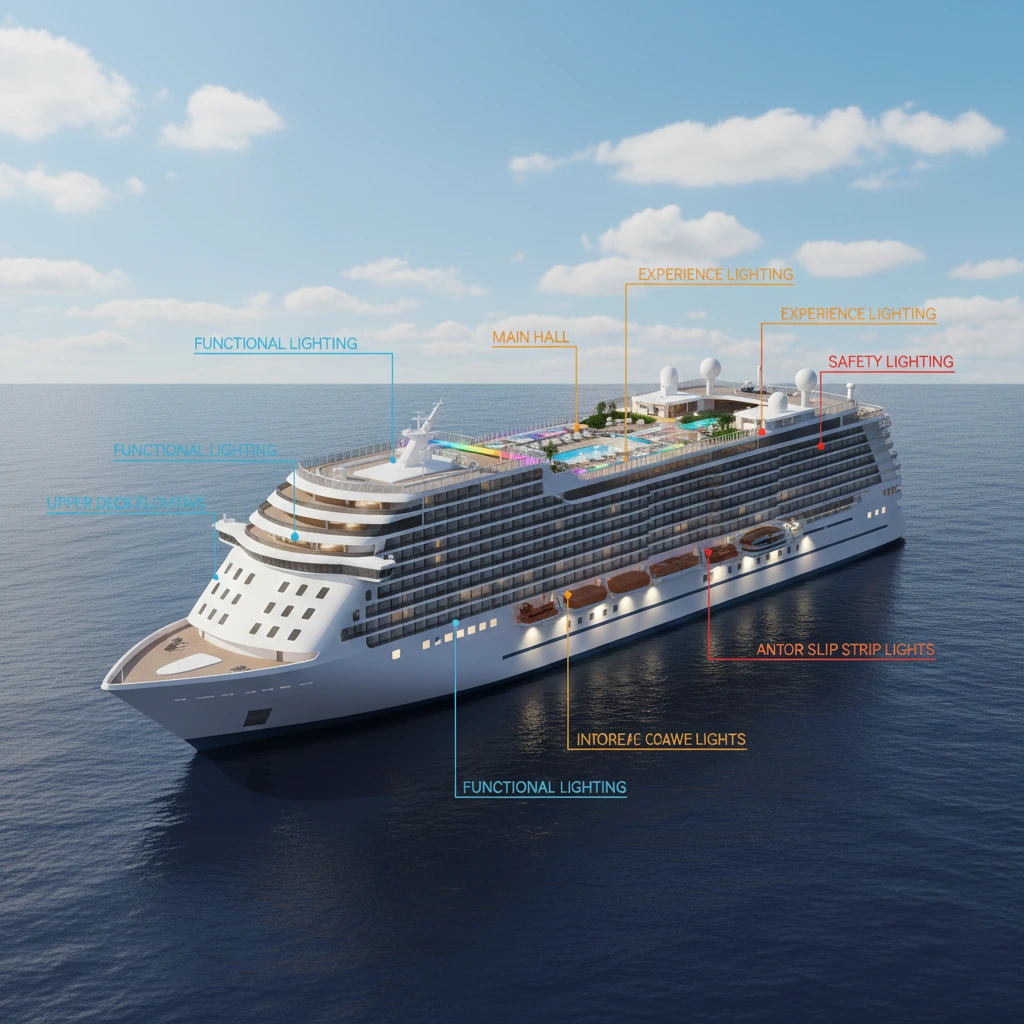
Cruise ship manufacturers have to consider marine lighting design as part of the whole ship’s design process. Each stage from concept definition to detailed engineering and later retrofit projects, every decision of lighting has a direct impact on safety compliance, spatial quality, and brand perception. This article describes a stage-based marine lighting design reference framework which is in line with actual cruise ship project workflows and underpinned by international maritime standards.
Table of Contents
Concept Design Phase
Defining the Overall Lighting Narrative
During the concept design stage, lighting is considered a spatial storytelling tool rather than a technical specification. Before anything else, the designers should determine a lighting narrative that is totally unified and that will give support to the cruise ship’s brand positioning, the target passenger profile, and the characteristics of the itinerary.
Luxury liners usually apply warm and layered lighting techniques that accentuate comfort and exclusivity, whereas the ships oriented towards expedition or families may consider the factors of clarity, visibility, and functional brightness as the most important. At this point, the lighting zoning concepts should be very clearly defined and at the same time, they should be based on the International Maritime Organization (IMO) passenger ship safety framework.
Having such a reference allows the designers to verify that their early conceptual ideas are still in line with the safety requirements that are necessary.
Early Integration of Regulatory Boundaries
Cruise ship lighting design even in concept stage has to be in compliance with SOLAS visibility, emergency lighting, and escape route principles at least drastically. non-compliance with regulations in the concept stage usually results in expensive redesigns and delays in the later stages of the project.
Designers should have a good idea about where to place backward emergency lighting, low-location lighting, or anti-glare solutions, especially in places like corridors, stairwells, and assembly stations.
Initial Design Phase: Translating Concepts into Technical Logic
Space-Based Lighting Function Definition
At the beginning of the design process, abstract lighting ideas have to be changed into function-oriented lighting logic. The different areas should be considered according to the function, how long people stay, and the users’ way of behaving.
To illustrate, restaurants and lounges need multi-level lighting which consists of ambient, accent and task lighting. However, circulation areas need uniformity and visual continuity in lighting. Areas for the crew only need high light levels and glare control to help people who work there for a long time.
Preliminary Fixture Typology and Protection Strategy
During the initial design phase, designers identify fixture categories rather than individual products. The choices made at this stage may involve the type of lighting that would be needed for the area: recessed, surface-mounted, or indirect; IP ratings and corrosion resistance levels for marine environments.
Public deck lighting, for instance, has to take into account the conditions of the previous exposure to salt spray, UV light, and vibration, even though no specific fixture models are chosen yet.
Detailed Design Phase: Engineering Precision and System Integration
Lighting Calculations and Visual Comfort Control
During the detailed design phase, lighting is transformed into a fully-engineered system. Illuminance calculations, uniformity ratios, glare indices (UGR), and color temperature also need to be checked with professional lighting simulation tools.
Visual fatigue in cruise ships is an issue, since passengers are onboard for a long time. Designers have to be very careful with contrast ratios and must not allow the transition of brightness between the adjoining spaces to be too big.
Power Supply, Control, and Redundancy Design
The electrical architecture of the vessel should completely incorporate the lighting systems, in addition to emergency power sources, dimming systems, and unified control platforms.
More and more cruise vessels are using smart lighting control systems that provide scene setting, energy saving, and adaptive lighting schedules. Still, the designers have to make sure that every smart control solution ever applied will meet the marine redundancy and fail-safe requirements.
Retrofit and Refurbishment Projects: Adaptive Lighting Strategies
Compatibility with Existing Infrastructure
Retrofit lighting design, as opposed to newbuild projects, is limited to existing cables, power capacities, and structural barriers. Designers have to decide if they can carry out lighting upgrades without greatly interrupting the systems.
Energy efficiency is silenced through LED retrofitting, but if the marine-grade standards are not being followed, the wrong replacement could cause thermal issues or electromagnetic interference.
Enhancing Passenger Experience Without Structural Changes
In refurbishment projects, the lighting system is usually the most efficient method for visual renewal and at the same time it will not require any invasive construction at all. The designers can through different color temperatures, better beam control, and more accent lighting to modernize the interiors considerably and at the same time the layouts will be existing.
Ship operators are in very close cooperation when planning lighting upgrades which coincide with branding refreshes and operational schedules thus downtime is minimized.
Conclusion
To automotive cruise ship designers, marine lighting design is a discipline of continuous lifecycle and not a single design task. Decisions relating to lighting from the conceptual vision through to detailed engineering and even future retrofits will have an impact on safety, comfort, and the overall passenger experience.
If marine lighting design is organized by clear project stages and decisions are based on internationally accepted maritime standards, designers will have the ability to create the environments of cruise ships that are both compliant with regulations, visually coherent and operationally resilient.