Hazardous Area Lighting: How to Select the Right Solution for Flammable Gas and Vapor Environments
Oil and gas industries, chemical plants, ship engine rooms, and fuel storage and transportation areas are some of the places where flammable gases or vapors might be present at all times. In these environments, lighting fixtures are not just a part of the infrastructure but are also critical for the safety of the personnel and to the project’s compliance.

Using non-compliant lighting fixtures can be a fire ignition source; on the contrary, choosing the right hazardous area lighting is the most fundamental and vital part of any risk control system.
Table of Contents
Why Ordinary Industrial Lightings Are Unsuitable for Flammable Gas Environments
The main reason that standard industrial lighting cannot be installed in areas with flammable gases or vapors is that the potential ignition sources are not controlled. Such fixtures may produce electrical sparks, arcs, or heating in a small area during their normal operation or when malfunctioning. The surface temperature of these fixtures does not have a limit that corresponds to the auto-ignition temperature of the flammable gas. Moreover, the body of typical industrial light fixtures is only afforded minimal protection; it would not be able to withstand the pressure created by an internal fault nor would it be able to completely vent the internal energy to the outside without losing some of it. If a short circuit, aging of parts, or abnormal heating happens inside, the surrounding gas or vapor might catch fire immediately. Additionally, the usual light fixtures have not undergone testing and certification in line with hazardous area criteria such as ATEX, IECEx, or NEC. They were not able to prove compliance with the applicable regulations regarding design, materials, and safety redundancy, and thus, from safety and compliance viewpoint, they are not to be used in hazardous areas.
To summarize, the typical fixtures of industrial are suitable for “non-hazardous areas” only. The use of such fixtures in locations where flammable gas or vapors may occasionally be present is not only the ignition risks’ failure to control but, also, non-compliance with regulatory and safety management requirements. Selecting certified hazardous area lighting or explosion-proof light fixtures is needed to ensure the safety of personnel, equipment, and project operations fundamentally in such environments.
International Classification System for Hazardous Areas
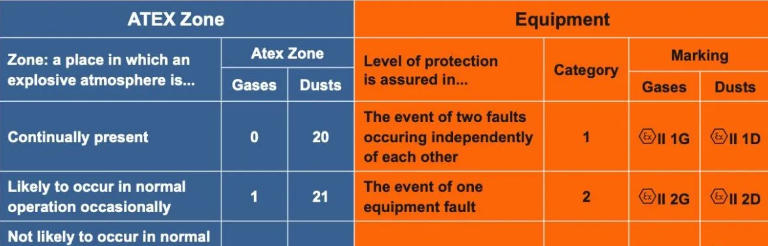
When it comes to environments with flammable gases or vapors, choosing the right lighting fixtures depends on the correct hazardous area classification. There are various area classifications, and each one has its own risk level and lighting fixture protection requirements. Moreover, there are two main internationally accepted standard systems: the IEC/ATEX zone system and the North American NEC division system.
| International Standard | Zone / Division | Definition | Gas Group | Recommended Lightings |
| IEC / ATEX | Zone 0 | Flammable gases continuously or for long periods | IIC (highest risk), IIB, IIA | Flameproof (Ex d), Intrinsically Safe (Ex i) |
| Zone 1 | Flammable gases may occur during normal operation | IIC / IIB / IIA | Explosion-proof (Ex d), Intrinsically Safe (Ex i) | |
| Zone 2 | Flammable gases occur only under abnormal conditions | IIB / IIA | Explosion-proof LED (Ex d) | |
| NEC / North America | Class I, Division 1 | Flammable gases may occur during normal operation | IIC / IIB / IIA | Explosion-proof, Intrinsically Safe |
| Class I, Division 2 | Flammable gases occur only under abnormal conditions | IIB / IIA | Explosion-proof LED |
Choose the Right Hazardous Area Lighting
In zones where there could be flammable gases or vapors, the usually installed industrial lighting still cannot be used. It is only the Lightings that are approved for use in hazardous areas based on international standards that can guarantee safety and trustworthiness. The selection of light fixtures primarily comprises those that are explosion-proof, flameproof (Ex d) and hazardous area LED respectively, based on the application and risk level.
Explosion-Proof Lightings
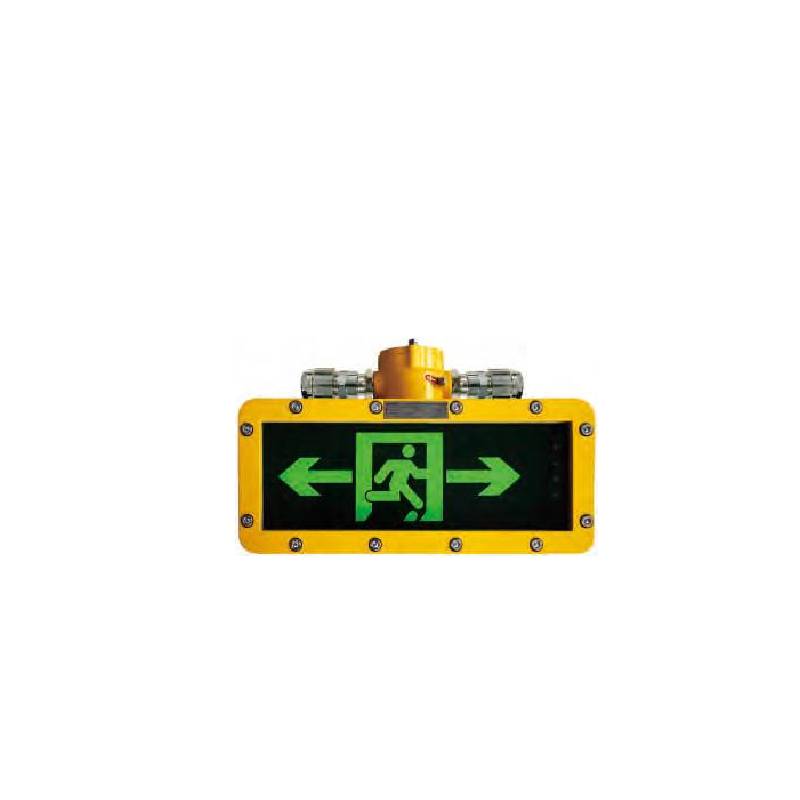
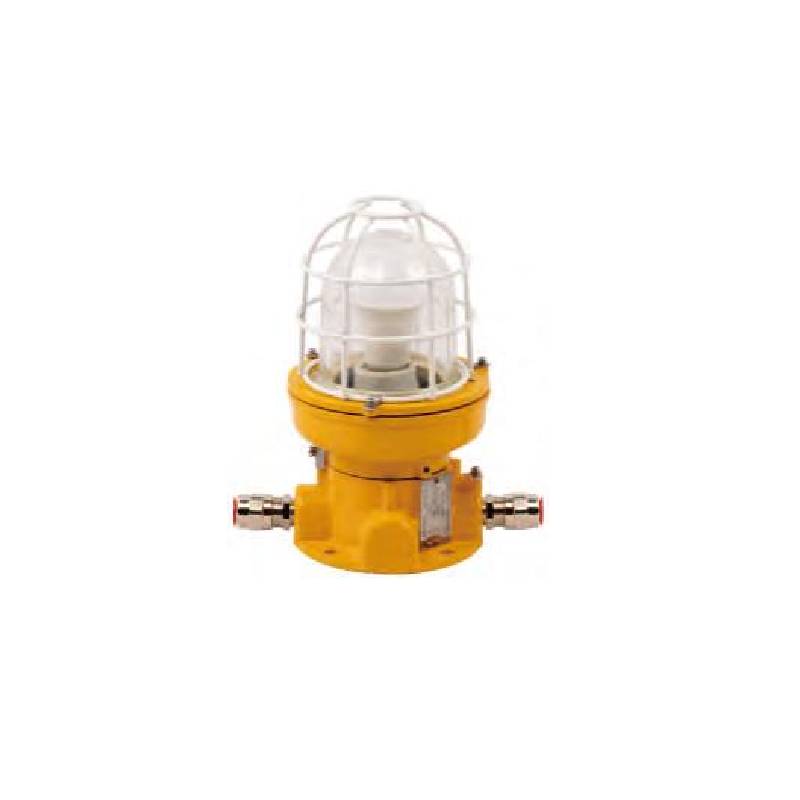
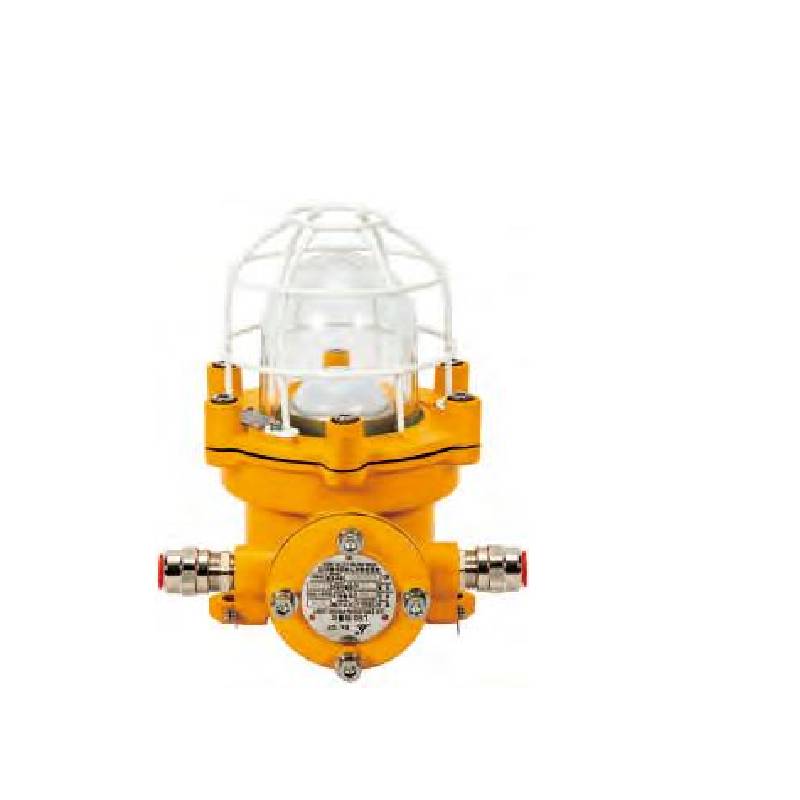
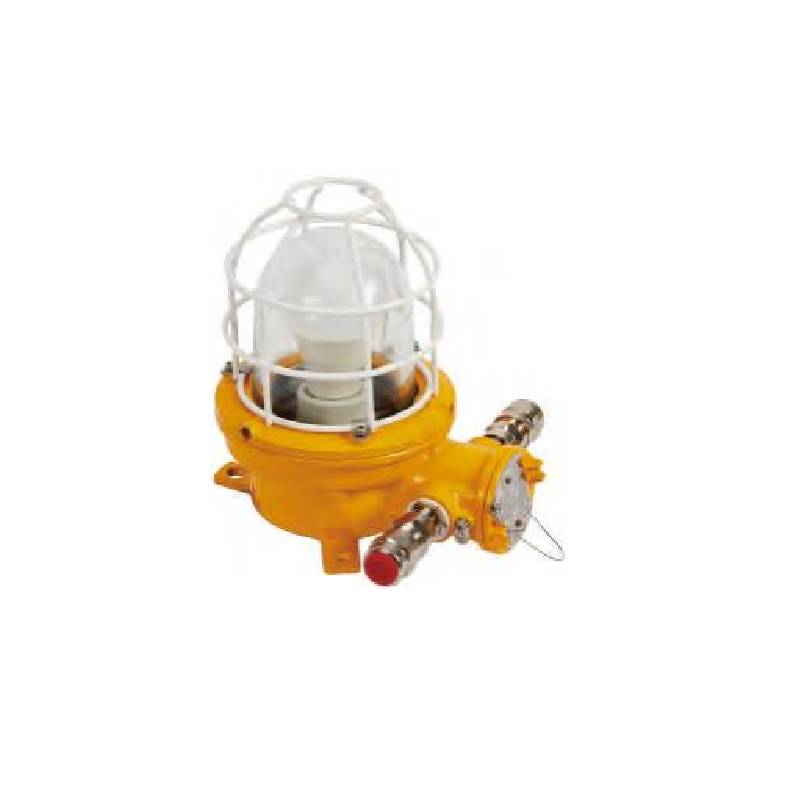
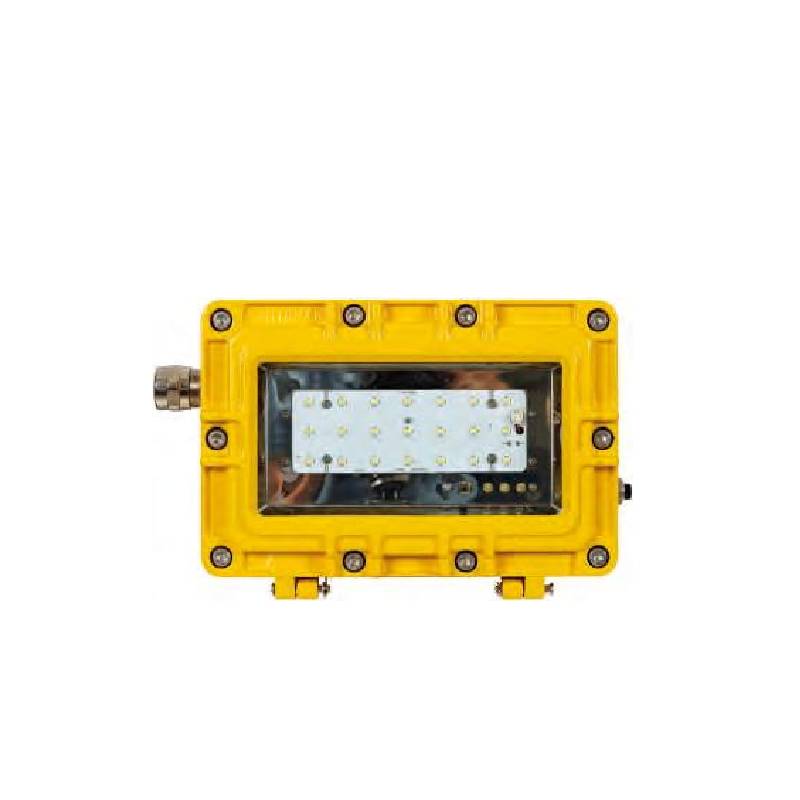
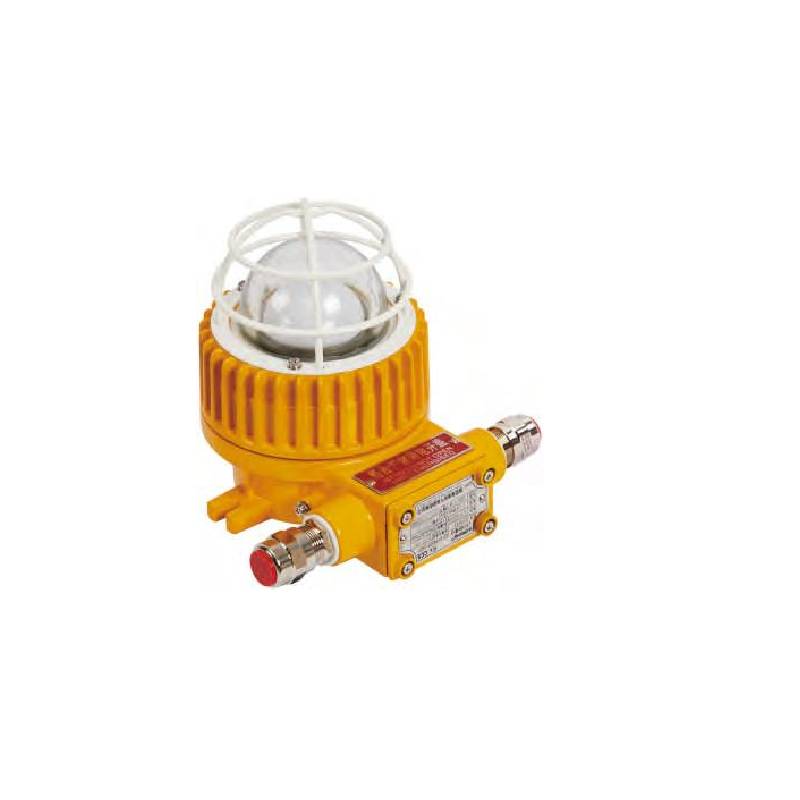
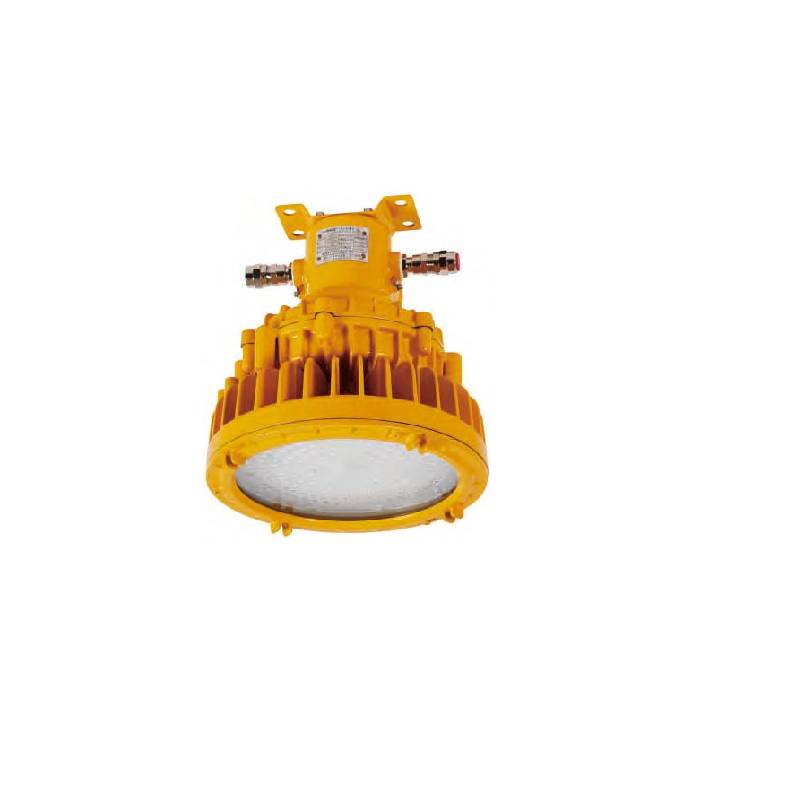
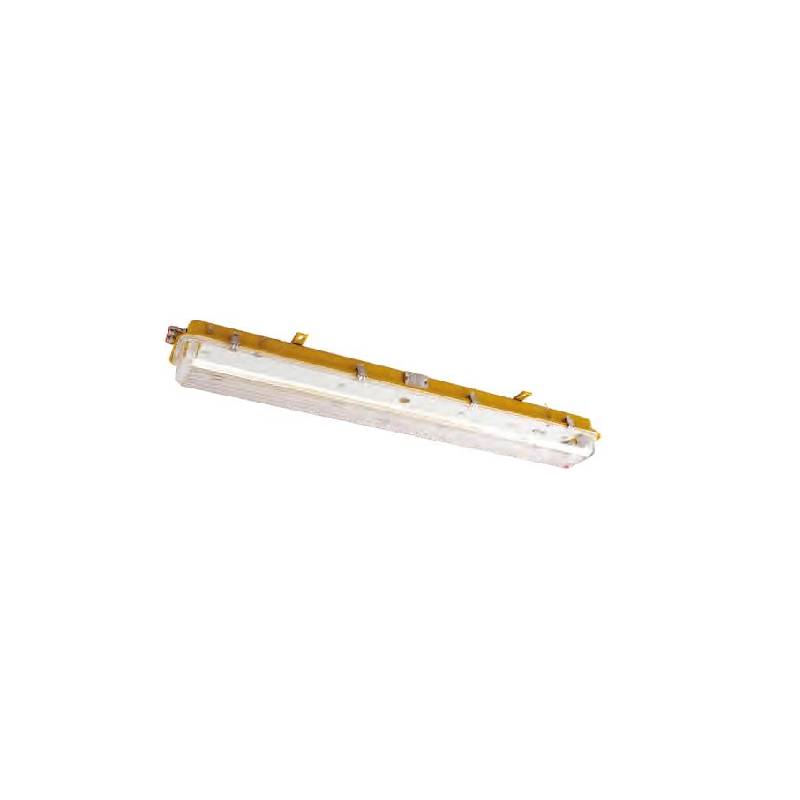
In case of lighting for hazardous areas in an environment with combustible gases or vapors, it is a must to install Lightings that are specially designed and certified for those conditions. Yushuo has a whole range of explosion-proof lighting solutions to satisfy this particular demand of the industry. The marine explosion-proof lights from Yushuo are equipped with highly durable and totally sealed enclosures that cannot let any internal sparks or heat ignite the surrounding hazardous atmosphere while providing light in offshore platforms, ships, and industrial facilities, where safety is the number one priority, with no doubt about that.
Yushuo’s explosion-proof LED products take advantage of energy-efficient LED technology along with the ruggedness of the construction to have a long service life, resistance to corrosion, and stable performance even under the most extreme environmental conditions. These Lightings are perfect for dirty applications like oil refineries, chemical processing, or any other place with a risk of flammable gas or vapor being present; thereby, they will improve the visibility and also the safety compliance.
Flameproof Lightings (Ex d)
Flameproof lightings are considered to be the most important type of explosion-proof lighting. They completely enclose the internal flames or high temperatures with a robust enclosure and do not allow the ignition of outside flammable gases. These lights are perfect for heavy-duty industrial applications or areas with very high-risk gas, such as oil refineries, chemical plants, and LNG storage or transfer zones, where the operation is continuous. In addition, the flameproof lightings are capable of bearing the pressure from an internal explosion and still perform safely during normal or even extended operating conditions.
Hazardous Area LED Lightings
The progress in LED technology has moved certified LED hazardous area lightings to the forefront as the preferred option for numerous contemporary projects. LED lightings are characterized by lower surface temperatures, very high energy efficiency, and longer service lives which allow easier compliance with T-Class temperature requirements thereby reducing maintenance and downtime costs to a significant extent. But it must be mentioned that not all LED lightings are explosion-proof just by virtue of being LEDs; they have to be certified for hazardous locations first before being installed in places where flammable gases or vapors are present thus making them safe. The good news is that certified hazardous area LED lightings are giving the industry a reliable long-term lighting solution that is safe and at the same time an efficient source of lighting for modern industrial projects.
Key Safety Parameters to Verify for Hazardous Area Lightings
When it comes to areas where there is a possibility of flammable gases or vapors, the selection of lighting fixtures involves more than simply picking the appropriate explosion-proof class. A thorough verification of critical safety parameters must be done to assure effective and durable protection even under the actual working environment. The main factors given below should be cautiously weighed throughout the purchasing and designing process.
Certification
Lightings should have internationally accepted certifications like ATEX, IECEx, or NEC, and the level of their certification must be equal to or exceed the risk level of the area where they will be installed. It is advisable for buyers to check the genuineness of the certification papers in order not to become a victim of safety risks or non-compliance resulting from using mistaken or fake certifications. The right certification brings not only safety but also a prerequisite for project approval and regulatory compliance.
Temperature Class (T-Class)
The auto-ignition temperature of the surrounding flammable gases or vapors must not be exceeded by the luminaire surface temperature. Different gases have different auto-ignition temperatures; for instance, ethane is about 510°C, while hydrogen is nearly 560°C. In very dangerous gas areas, lighting fixtures are usually required to have either T4 (≤135°C) or T6 (≤85°C) classification for preventing fire or explosion danger even in cases of prolonged operation or fault.
IP Rating & Mechanical Strength
Lightings need to have a high level of ingress protection, usually IP66/IP67, and exhibit a strong mechanical design that can endure vibration, impact, and extreme environmental conditions. In the case of marine or chemical applications, corrosion resistance and salt-spray protection are also major factors in prolonging the life of the equipment and cutting down on maintenance. Such protections are structural and, hence, very necessary for safety and performance in very challenging hazardous locations.
Environmental Adaptability & Service Life
Typically high-grade hazardous area Lightings utilize elaborate thermal management systems and heat-resistant components thereby guaranteeing their stable functioning even in high temp, high humidity or heavily corrosive places. Choosing Lights that boast long lifespan and need little upkeep not just boosts operation safety but also cuts down on the total long-term operational costs.
Conclusion
In regions where flammable gases or vapors are present, the selection of hazardous area lighting is done through a straightforward yet vital reasoning: zone designation → protection level correspondence → choosing certified lighting → checking important safety parameters. If you stick to this procedure, you will not only avoid mistakes in selection but also have safe and reliable operation of your projects for a long time.